

Menu

Menu
Jonathan Moyer, director of Pardee Institute, and Taylor Hanna, associate director of development analysis, traveled to Nairobi to participate in an author's meeting for the United Nations Environment Program (UNEP) Seventh Global Environment Outlook (GEO-7). This meeting was focused on finalizing the second-order draft of the report, as well as writing the summary for policymakers.
The GEO-7 encompasses around 250 authors to complete its 21-chapter report, which focuses on “assessing solutions pathways for policymakers” regarding climate change and other environmental instabilities. Hanna and Moyer will serve as lead authors on two chapters of this report, chapters 11 and 12, alongside coordinating lead authors, contributing socioeconomic data provided by the International Futures (IFs) tool.
Chapters 11 and 12 focus on the long-term future of planetary crises such as climate change, pollution, land degradation, and biodiversity loss, as well as the long-term future of socioeconomic development. These chapters explore transformational pathways to solve these crises while balancing human development needs, using the International Futures model and other models to tell the broader story.
"I am very proud to work with Taylor and our integrated modeling colleagues from around the world to play a small role in shaping the UNEP GEO-7. This is the third GEO that Pardee and IFs have contributed to, and we believe that it puts forward a strong message about the challenges associated with the ongoing environmental crises and what kinds of policies could be enacted to get us on a better development path. I just hope people listen," said Moyer.
Once finalized, the report will undergo another round of comments and feedback, with the final report concluding in December 2025.
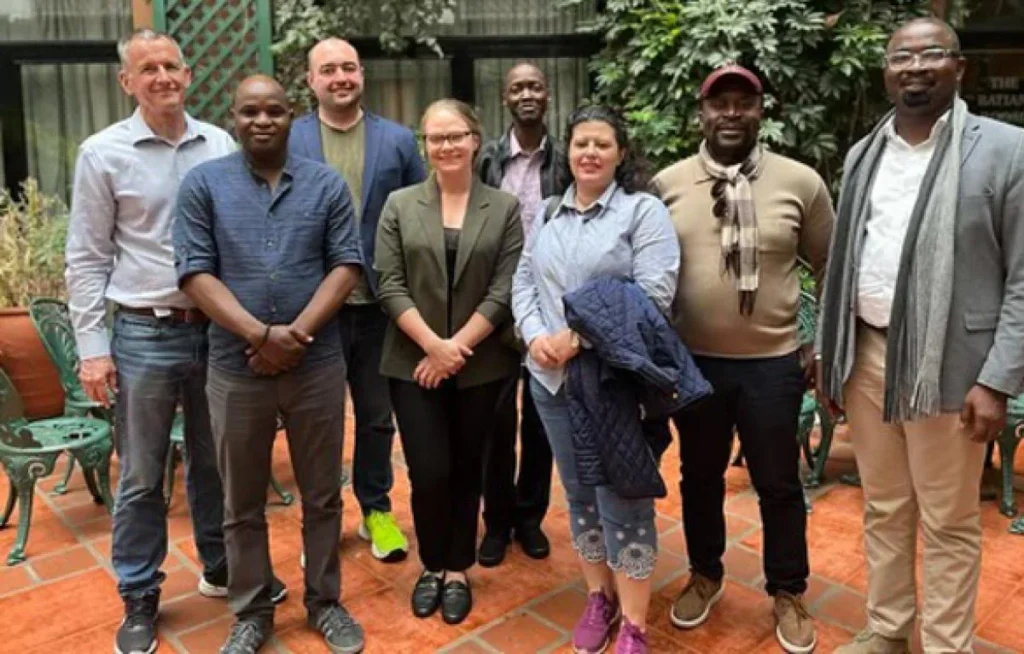
The African Union is currently at the end of the first decade of implementation (guided by the First Ten-Year Implementation Plan) of Agenda 2063. Pardee Center Associate Director for Development Analysis Taylor Hanna and Pardee Director Jonathan Moyer participated in a four-day workshop in Nairobi with the Technical Working Group to draft the Second Ten-Year Implementation Plan.
Participants included representatives from AUC, AUDA-NEPAD, ACBF, APRM, JSSO, UNDP, UNICEF and RECs. Sessions included walking through proposed STYIP targets and evaluating their feasibility and what policy interventions might be required to successfully meet the target.
On March 14, Research System Developer Steve Hedden and Lead System Developer José Solórzano led a workshop at the UN Data Innovation Lab in Nairobi. Forty-seven development practitioners from UN agencies including UNDP, UNDP, WFP, FAO and UNICEF participated in a hands-on exploration of the International Futures (IFs) integrated assessment model. The goal of this workshop was to teach members of these organizations how the IFs model might be useful in their work.
The workshop also provided an overview of how the Pardee Center thinks about integrated, long-term strategic planning, and gave Pardee the opportunity to showcase the SDG dashboard in the IFs model. This dashboard allows users to track a country's progress toward achieving different SDGs based on forecasts made by the IFs model. This is particularly relevant to the organizations that were in attendance as it demonstrated how the IFs model could complement their own data-driven research across areas of human development. The brief training session produced several continuing conversations about future collaborations between our center, the UN and its issue-focused programs.
In November 2017, two Pardee Center research affiliates and current Pardee researcher joined a public seminar hosted by ENACT (Enhancing Africa’s Response to Transnational Organised Crime [TOC]) in Nairobi, Kenya. The program explored innovations in research and response to TOC. Lily Welborn (MA 2017), who is now employed by the Institute of Security Studies (ISS) in Pretoria, South Africa, kicked off the event with a presentation on some of the most used approaches in the measurement of drugs trafficking, wildlife crime and illicit arms trading. Zachary Donnenfeld (MA 2015), also from ISS, and Alex Porter, currently a research consultant at the Pardee Center in Denver, joined a panel focused on the future of TOC in Africa. Zach demonstrated how the International Futures (IFs) model can be used to analyze trade patterns between Africa and the rest of the world and within Africa, and how those broad trends may shape how TOC evolves into the future. Alex showed how modelling drug-demand could provide insight into the future of the illicit drug trade both in Africa and around the world. ENACT is a project funded by the European Union’s Pan-African Programme, dedicated to “enhancing Africa’s response to transnational organised crime (TOC)” by mitigating the impact on development, governance, security, and the rule of law in Africa.
Copyright ©2026 University of Denver | All rights reserved | The University of Denver is an equal opportunity institution