
Join us for Open House on November 13, 2026. Register now.

Menu

Menu
Join us for Open House on November 13, 2026. Register now.
Artificial intelligence depends on more than advances in software. Its expansion requires energy, data centers, semiconductors, and financing. Whether its productivity gains translate into better jobs and wider economic opportunity also depends on investments in people and choices about how institutions respond.
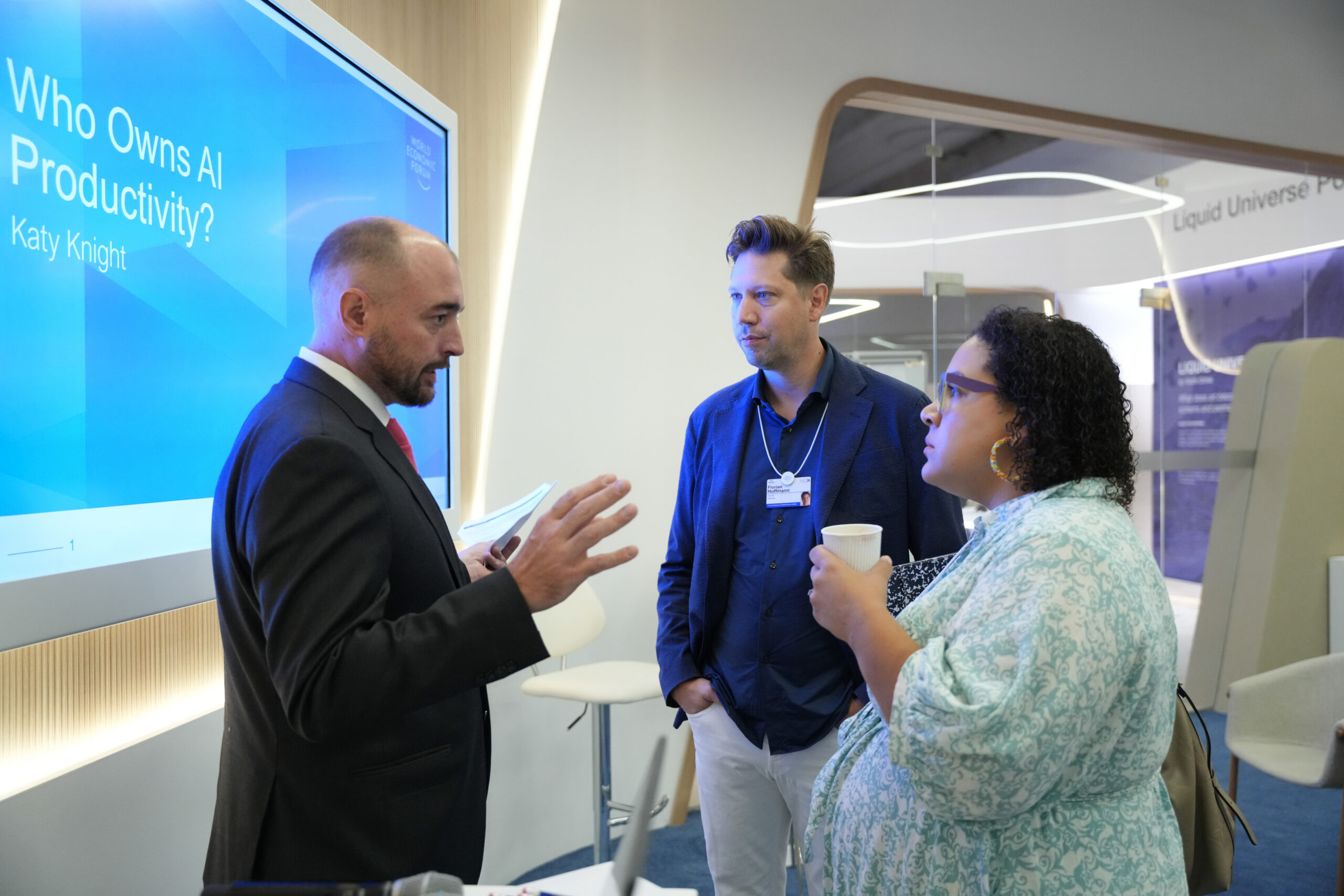
Those relationships were central to two Opportunity Labs that Pardee Institute Director Jonathan Moyer helped facilitate at the World Economic Forum’s Annual Meeting of Global Future Leaders, held Oct. 13–15 in Dubai. The meeting brought emerging leaders together with policymakers, researchers, entrepreneurs, and other practitioners to explore opportunities and risks across technology, economic growth, and other areas of global change.
Moyer participated through WEF’s Global Foresight Network, which he joined earlier this year. The labs used backcasting: participants began with a desired outcome for the coming decade, then worked backward to identify decisions, partnerships, and actions that could help bring it about. The exercises asked what businesses, governments, and marginalized communities would need to do to shape AI’s development and use.
In the AI infrastructure lab, Moyer moderated a discussion examining the physical and economic foundations behind the technology, including energy networks, cloud computing, and capital. Participants considered the investment, partnerships, and governance needed to make that infrastructure more reliable, inclusive, and sustainable. A second lab focused on the impact of AI on productivity and jobs, looking at how skills investment, labor markets, and public policy could help translate AI-driven gains into broader economic opportunity. Emirates News Agency’s coverage describes both sessions.
Beyond the labs, Moyer visited UAE government facilities and met with representatives of the prime minister’s office in a meeting facilitated by Pardee Founding Director Barry Hughes. Those encounters offered a closer view of efforts to incorporate AI into government operations and decision-making. At a water and electricity facility, officials described changes in employees’ work as AI became embedded in their processes.
The meeting with the prime minister’s office opened a related discussion about different ways models inform policy. Moyer and officials reviewed the benefits and limitations of inductive approaches, which infer patterns from data, and deductive approaches, which work from specified relationships and assumptions. They also discussed International Futures (IFs), Pardee’s integrated modeling system for exploring longer-term change across human, social, and natural systems.
Copyright ©2026 University of Denver | All rights reserved | The University of Denver is an equal opportunity institution