

Menu

Menu
Keisuke Minai. (2026, April 12). Qatar's mediation diplomacy strength: An analysis of reactions to Israel's September 2025 attack. The SAIS Review of International Affairs. https://saisreview.sais.jhu.edu/qatars-mediation-diplomacy-strength-an-analysis-of-reactions-to-israels-september-2025-attack/
Keisuke Minai used the Formal Bilateral Influence Capacity (FBIC) Index and Global Power Index (GPI) from the Pardee's Institute's Diplometrics research program to explore Qatar's use of mediation diplomacy following an air strike in its capital in September 2025. According to Professor Minai, their advanced statistical analysis "confirms that Qatar’s mediation activities are positively associated with its international influence in the long term, while its national power plays a role in the short term."
By: Wara Irfan
A recent article published by the Modern War Institute at West Point analyzes how longstanding foreign actors will navigate Syria’s geopolitical landscape following the fall of Assad. It cites the Pardee Institute’s Formal Bilateral Influence Capacity (FBIC) Index data to identify major foreign actors and track the trajectory of their influence in Syria since the 1960s.
Written shortly after Assad’s fall, Assad’s Downfall in Syria: Who Wins and Who Loses? highlights, using FBIC data, the regional uncertainties and forecast potential winners and losers of Syrian regime change by examining the last 80 years of foreign influence exerted on Syria by major actors like Russia, Turkey, China, Iran, the United States, Europe (particularly through the activities of France), and Israel.
The FBIC Index measures formal relational power between countries across economic, political, and security dimensions, focusing on state-sanctioned interactions like diplomatic exchange and trade. Developed by the Diplometrics Program, it helps quantify global power dynamics and informs the International Futures (IFs) model, aids researchers and U.S. policymakers in assessing global power shifts.

Credit: Modern War Institute at West Point
The authors’ analysis of FBIC data suggests that Iran and Russia’s influence in Syria will likely continue to decline in a post-Assad era. Meanwhile, Turkey, which supports the Syrian National Army against both Assad and the Kurds, views this as an opportunity to expand its influence. FBIC data shows that Turkey’s capacity has grown over the past two decades and can see the regime change as an opportunity to continue countering perceived threats from the Syrian Kurds.
Furthermore, FBIC data reveals that U.S. influence in Syria began declining around the mid-2010s. While the U.S. still maintains approximately 900 troops at the al-Tanf garrison near the Iraqi and Jordanian borders to counter ISIS and Iran-backed militias, the future of this key outpost remains uncertain, as President Trump may choose to shut it down.
Modern War Institute at West Point—a leading research hub dedicated to the study of contemporary warfare—highlights the significance of the Pardee Institute’s FBIC data in analyzing global dynamics. This index not only informs strategic analysis but also shapes discourse surrounding bilateral relationships between nation-states.
Collin Meisel, the Associate Director of Geopolitical Analysis at the Pardee Institute for International Futures, joined other scholars at the 2024 International and Area Studies Symposium at the University of Oklahoma. Collin presented a conference paper on China’s influence capacity in South Asia from the Cold War era to the present.
The conference paper, co-authored by Jonathan Moyer, the Director of the Pardee Institute for International Futures, analyzed the shifting patterns of China's presence and power in the region. Their analysis utilized the Formal Bilateral Influence Capacity (FBIC) Index, a tool developed by the Pardee Institute to track relational power in the international system using data that cut across economic, political, and security dimensions of bilateral influence.
The International and Area Studies Symposium provides scholars a platform to meet annually, share their research, challenge prevailing narratives, and foster academic growth. Collin noted that the conference paper received positive comments from the participants. with other presenters offering various perspectives on conceptualizing and measuring China's influence abroad.
He added that “while some remain skeptical of a global index of influence capacity – area studies folks can at times insist that a measure conforms to every nook and cranny of the few cases which they are thoroughly familiar – all agreed that our data and analysis are an important contribution to the study of influence in the international system.”
Collin further credited Adam Szymanski-Burgos, formerly, a Research Associate at the Pardee Institute, who led a team to update the FBIC Index data used in this conference paper.
At the same event, Suisheng Zhao, Professor and Director of the Center for China-U.S. Cooperation at the University of Denver Josef Korbel School of Global and Public Affairs, presented a keynote speech.
The conference paper reinforces Pardee Institutes' mission of building and using real-world data to analyze the complex world and the long-term dynamics of change in human, social, and natural systems. This also provides resources to policymakers, academics, and others seeking to improve how we contemplate and plan for the global future.
A recent report published in the Economist, which utilized Pardee Institute’s Formal Bilateral Influence Capacity Index (FBIC) data to compare the level of influence of some countries among the members of the G77, has inspired another article by BBC Brasil. The piece titled “Who competes with Brazil for leadership of the 'Global South” delves into the dynamics of influence within the Global South, focusing on Brazil's role and its competitors.
The FBIC data influenced BBC Brasil's analysis of how Brazil positions itself as a leader among developing nations and leverages its economic, political, and cultural ties to assert influence. Observing Brazil’s strategic partnerships and initiatives aimed at strengthening its leadership status.
Additionally, the article compares Brazil's influence with that of other emerging powers, such as China, India, and Russia who also compete for leadership within the Global South.
Prominent publications like The Economist and BBC Brasil Pardee citing the Pardee Institute’s FBIC data highlights the tool’s relevance and utility in understanding global dynamics, grows the Institute’s contribution to the field of international studies, and affirms the importance of the Institute's research in informing public discourse and policymaking.
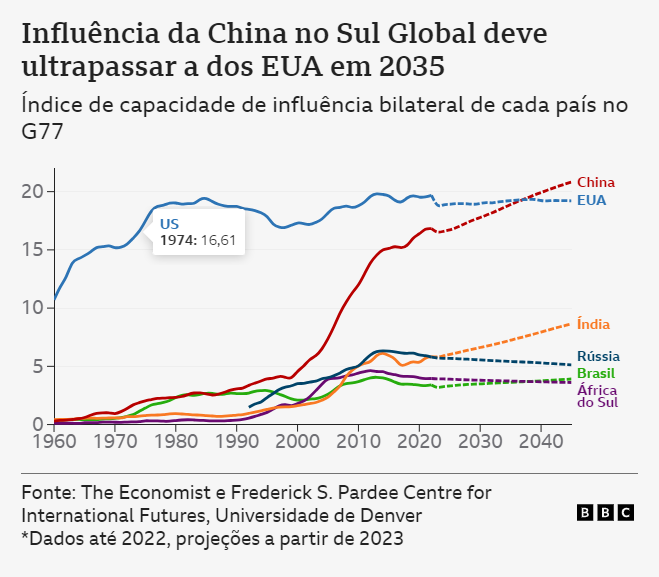
Pardee Institute for International Futures' work on the Foreign Bilateral Influence Capacity Index (FBIC Index) has been prominently featured in a recent article in The Economist. The article titled “Is China or America the Big Boss of the Global South? In a dog-eat-dog world, competition is fierce” underscores the significance of Pardee's research in understanding global power dynamics.
The FBIC Index, a brainchild of Pardee's collaborative efforts with the US government, emerged from rigorous academic inquiry and practical application. Developed as part of a dissertation project, the index aims to capture the concept of "weaponized interdependence" by blending monadic and dyadic data. It delves into the intricate web of economic, political, and security dependencies between countries, offering insights into the advantage one nation holds over another based-on market size and asymmetries.
Associate Director of Geopolitical Analysis, Collin Meisel, leads the FBIC Index project at Pardee and supplied data to The Economist for its analysis.
The article sheds light on the FBIC Index's application in analyzing global power dynamics, offering readers valuable insights into the evolving geopolitical landscape. By illuminating the complexities of international relations and the dynamics of influence.
The Economist's broad, international platform and role as an authority in this space help to amplify the utility and reach of Pardee's FBIC Index.
FBIC is part of the Pardee Institute's Diplometrics Program, which is sponsored by the U.S. government. For more information on Pardee's research and the FBIC Index.
Meisel, C., Moyer, J., Burrows, M. J., & Petry, C. (2023, August 6). The Russian invasion of Ukraine is boosting the potential for U.S. influence abroad. Lawfare. https://www.lawfaremedia.org/article/russian-invasion-ukraine-boosting-potential-us-influence-abroad
In this commentary with Lawfare, hosted by the Brookings Institution, Jonathan Moyer, Caleb Petry, Mat Burrows, and Collin Meisel discuss findings from our recent report with the Stimson Center examining future long-term trends in geopolitical influence across alternative scenarios.
Meisel, C., & Szymanski-Burgos, A. (2023, August 3). Why many Nigeriens want Russia in and the West out. Time Magazine. https://time.com/6301177/niger-african-support-russia/
In Time, Pardee Center Research Associate Adam Szymanski-Burgos and Collin Meisel explain how the U.S. and Europe are poised to fall further and further behind their geopolitical competitors in terms of aid, trade, arms transfers, and diplomatic engagement on the African continent—key sources of international influence. Unless Western leaders change tack, Western publics should prepare for more waving of the white, blue, and red—Russia’s tricolor flag—than of the American red, white, and blue in capitals beyond Niamey, Niger.
Full Citation: Meisel, Collin, Jonathan Moyer, and Mathew J. Burrows. 2023. “The US is losing the Global South: How to reverse course.” The Hill.
On its present course, the U.S. is set to be overtaken by China as the world’s leading influencer within the next 25 years.
Chinese influence has already surpassed the U.S. in 61 countries due to its substantial trade, investment and development assistance, according to a study we made of influence between pairs of states from 1960 onward with forecasts through mid-century across economic, political and security dimensions. China’s “inroads” include particularly Africa and Central and Southeast Asia in addition to eroding U.S. advantages virtually everywhere else.
Full Citation: Meisel, Collin J., Caleb L. Petry, Jonathan D. Moyer, and Mathew Burrows. n.d. “Spheres of Influence in the Coming Decades: Four Alternative Scenarios.” Stimson.
Putin’s invasion and Xi’s pandemic mismanagement have opened a narrow window of strategic opportunity for the West
In August 2021, Pardee Institute Director Jonathan Moyer and Research Associate Collin Meisel presented at the Strategic Multilayer Assessment (SMA) speaker series. The presentation was titled “China-US Competition: Measuring Global Influence." Analysis focused on China-US competition globally with a particular focus on trends and relationships in Southeast Asia by introducing the Formal Bilateral Influence Capacity (FBIC) Index, a quantitative measure of multidimensional influence between pairs of states from 1960 through 2020. The FBIC Index attempts to capture the size of interactions, as well as the reliance that one country has on others across economic, political, and security dimensions. The combination of these factors is influence capacity or relational power. Analysis shows that Chinese influence has grown in both size and reach around the world, reinforcing and contextualizing experts’ understanding of this changing international system. From the end of the Cold War to the present, Chinese influence has cut into or supplanted Western countries’ sway in every geographic region. To the extent that the United States and the West have been caught off guard by the rise of China, the “game” is not over. The United States still has many opportunities to counterbalance the expansion of Chinese influence through greater bilateral engagements and increased support for regional integration, policy prescriptions which this analysis unpacks.
Copyright ©2026 University of Denver | All rights reserved | The University of Denver is an equal opportunity institution