
Join us for Open House on November 13, 2026. Register now.

Menu

Menu
Join us for Open House on November 13, 2026. Register now.
Sahadevan, D., Irfan, M. T., Luo, C., Moyer, J. D., Mason, C., & Beynon, E. (2025). Charged for change: The case for renewable energy in climate action. UNDP; Pardee Institute for International Futures; Octopus Energy.
March 2025 | Skopje, North Macedonia
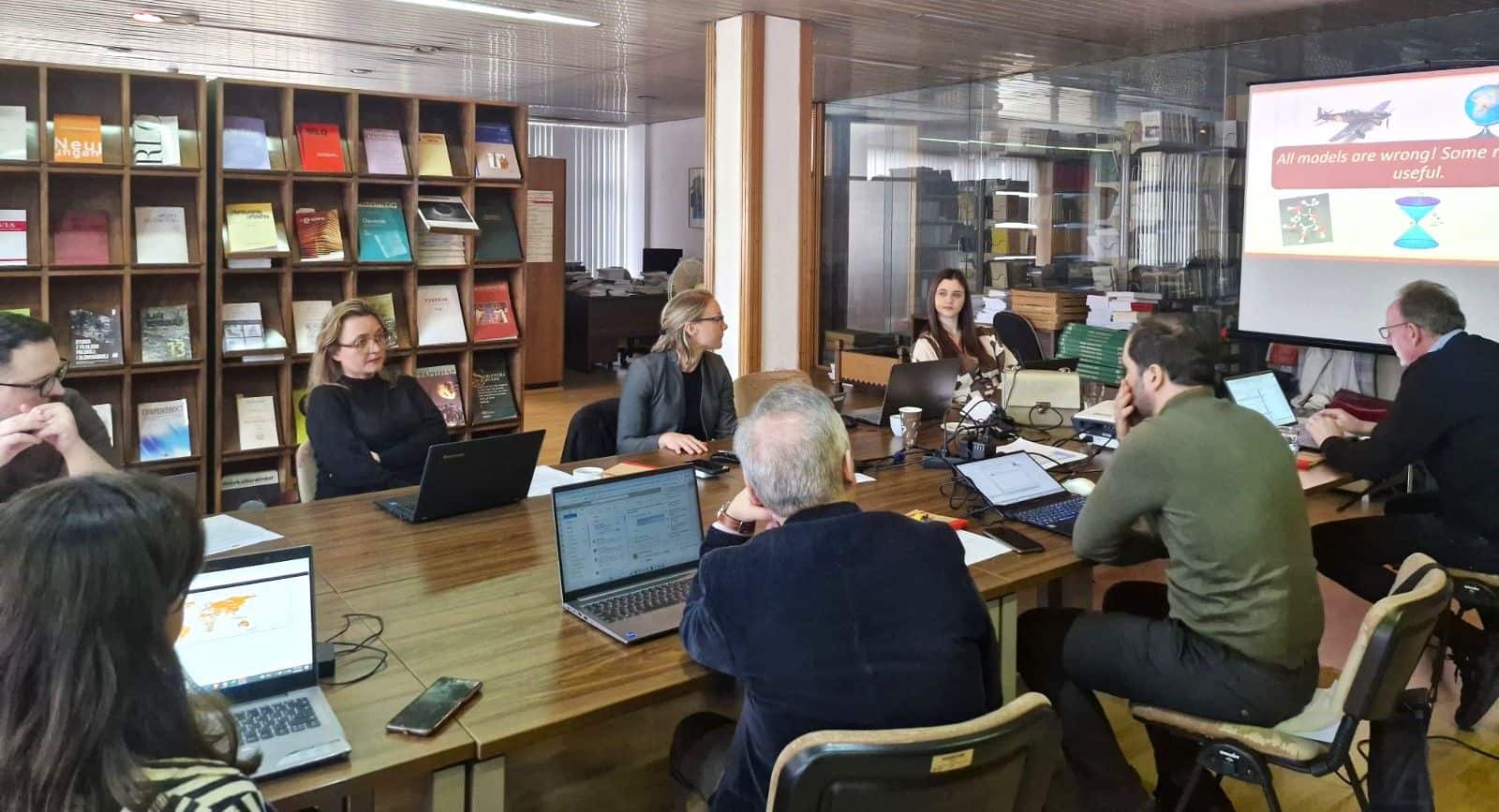
The Frederick S. Pardee Institute for International Futures at the University of Denver recently led a week-long training in Skopje, North Macedonia. The training helped government officials, researchers, and development practitioners use the Institute’s flagship International Futures (IFs) forecasting system to support the country’s National Development Strategy (2024–2044).
Taylor Hanna, Associate Director of Development Analysis at the Pardee Institute, led the training. Eleven participants joined from the Macedonian Academy of Sciences and Arts, the Faculty of Economics in Skopje, the Ministry of Finance of the Republic of North Macedonia, the General Secretariat of the Government, and the United Nations Development Programme (UNDP) North Macedonia. In addition, Aleksandar Stojkov of Ss. Cyril and Methodius University provided local support for the workshop.
The training builds upon Pardee's longstanding collaboration with UNDP North Macedonia. After supporting the development of the country's National Development Strategy using the International Futures model, the Institute returned to help ensure that local institutions have the capacity to use IFs independently for evidence-based planning, policy analysis, and long-term forecasting.
Throughout the week, participants received hands-on instruction covering installation of the IFs platform, data review and validation, scenario development, and policy analysis. They also updated North Macedonia’s national data in the model. Then, working together, they refined development scenarios based on feedback and discussion during the workshop.
As a result, government and academic partners can better monitor progress toward the goals in the National Development Strategy. They can also explore alternative development pathways and bring long-term forecasting into public decision-making.
The activity was conducted in partnership with UNDP North Macedonia as part of the "Support to Public Finance Management Reform" project, funded by the Ministry of Finance of the Slovak Republic through the "Public and Private Finance for Development Programme."
Hanna, T., Kruczkiewicz, A., Owen, M. (2024, December 10). Land degradation and human development in Yemen. United Nations Development Programme. https://www.undp.org/yemen/publications/land-degradation-and-human-development-yemen
This study, “Land Degradation and Human Development in Yemen,” was commissioned by UNDP in 2024 as part of a collaboration with the Frederick S. Pardee Institute for International Futures, Josef Korbel School of Global and Public Affairs, University of Denver and climate researchers. Yemen is frequently said to be experiencing one of the worst development and humanitarian crises in the world after more
than ten years of ongoing conflict. At the same time, it is among the countries most vulnerable to climate change and for decades has faced a worsening water crisis as well as land degradation (including deterioration of historical terracing systems), desertification and soil erosion. This report seeks to better understand how the above-mentioned phenomena could affect economic and human development in Yemen on immediate, medium and long-term timescales.
The report explores the links between climate change, land degradation and desertification, conflict, and human development outcomes in Yemen. This report begins with a review of the literature of the drivers, context, and intervening factors around land degradation and desertification in Yemen so far. This is followed by an analysis of historical subregional data on land degradation and climatic variables within
the country. Turning toward the socioeconomic effects, the report first reviews literature on the pathways through which desertification can alter agricultural production and otherwise affect economic and human development. Finally, the report uses integrated modelling techniques and scenario analysis using the International Futures (IFs) model to explore the effect of degradation and restoration pathways on future development in Yemen. The IFs model has previously been applied to assess the effect of ongoing conflict in Yemen on human development and to examine possible recovery pathways in the Impact of War trilogy of reports and the Impact of Climate Change on Human Development produced by UNDP and the Frederick S. Pardee Institute for International Futures.
Abidoye, B., Banda, A., Baumwoll, J., Carman, R., Moz-Christofoletti, M., Orlic, E., Patterson, L. (2024). Advancing the SDG Push with equitable low-carbon pathways. UNDP. https://www.undp.org/publications/advancing-sdg-push-equitable-low-carbon-pathways
The ‘SDG Push x NDC 3.0’ research, a collaboration between UNDP and the Frederick S. Pardee Center, outlines a framework for a fair, low-carbon energy transition that considers the needs of both wealthy and lower-income nations. The report updates the second flagship publication, Leaving No One Behind: Impact of COVID-19 on the Sustainable Development Goals (SDGs), examining an integrated set of policy strategies that accelerates climate actions while promoting human development. By supporting equitable access to energy, green investments, and digital infrastructure, it aims to foster inclusive, sustainable growth and align with the Paris Agreement targets.
The research finds that an additional 60 million people could be lifted from poverty by 2030, and upwards of 175 million people by 2050, through these ambitious, yet feasible policy choices. In addition, nine out of ten low-human development countries could make significant strides towards improving their current development outcomes by 2050 while carbon emissions are reduced by two-thirds by 2050.
Sahel Human Development Report 2023. (2024, February 15). United Nations Development Programme. https://www.undp.org/africa/publications/sahel-human-development-report-2023
Sustainable energy could regenerate Africa’s Sahelian zone by using the region’s abundant clean energy potential to transform lives, diversify economies, give hope, and protect the planet. Analyzing viable pathways to move the Sahel away from energy dependency to energy agency that delivers accessible, reliable, and affordable energy for all, is the focus of this Human Development Report, which covers Burkina Faso, Cameroon, Chad, The Gambia, Guinea, Mali, Mauritania, Niger, Nigeria, and Senegal. The HDR uses empirical techniques and political economy analyses to consider optimal energy strategies that would be most appropriate for the sub-region and also for each country's context.
Hanna, T., Kelley, C., Kruczkiewicz, A., & Moyer, J. (2023, December). The Impact of Climate Change on Human Development in Yemen. UNDP. https://www.undp.org/sites/g/files/zskgke326/files/2023-11/impact_of_climate_change_on_human_development_in_yemen.pdf
This report presents the findings of a study on projections of climate change in Yemen and its effect on human development. The United Nations Development Programme commissioned the Pardee Center for International Futures to complete this study.
Full Citation: Sahadevan, D., Hanna, T., Moz-Christofoletti, M. A., Orlic, E., Okiya, S., Abidoye, B., & Moyer, J. D. (2023). UNDP. https://data.undp.org/sites/g/files/zskgke476/files/2023-11/20230606_Universal-Electrification-Research-Report.pdf
Pushing for universal electricity access through Sustainable Development Goals (SDG) interventions can have powerful multi-faceted effects across economic and human development. Despite its benefits, expanding electricity access comes with significant costs that may require trade-offs in fiscal choices. By using futures modelling that captures both synergies and trade-offs of pursuing particular SDG targets, UNDP and the Pardee Center for International Futures (University of Denver) assessed the current state of electricity access and modelled different pathways to achieving significant milestones in electricity access, including the UN-Energy Pledge and the UNDP commitments. Read the official report and others here.
Modelling Universal Access
Development Impacts of Electrification
Full Citation: Mekonnen, S. M., Mbate, M., Osman-Elasha, B., Akol, C., Janneh, A et Al., (2022). 2022 Africa Sustainable Development Report. UNDP. https://www.undp.org/sites/g/files/zskgke326/files/2023-01/Africa%20Sustainable%20Development-Report_2
The Coronavirus pandemic, the war in Ukraine, and climate change have all hampered Africa’s efforts to achieve the Sustainable Development Goals (SDGs). Halfway towards 2030, most African countries are struggling to meet most SDG targets. Without deliberate policies to accelerate progress towards the SDGs, by 2030, at least 492 million people will be left in extreme poverty and at least 350 million people by 2050.
The report evaluates Africa’s progress towards the SDGs and the objectives of the African Union’s Agenda 2063 in the context of the triple crises of COVID-19, climate change, and the war in Ukraine, which are all adversely impacting the continent’s performance on both agendas.
Full Citation: Verhagen, W., Meziere, M. E., Bohl, D. K., Howe, B., & Moyer, J. (2010). Guinea-Bissau: Exploring Alternative Futures of Development - Report 2. Pardee Center for International Futures. https://korbel.du.edu/pardee/Guinea-Bissau/en
UNDP Guinea Bissau & Frederick S. Pardee Center for International Futures. Bissau, Guinea-Bissau and Denver, USA. Access translations:
French Version
Portuguese Version
Verhagen, W., Pereira, C. C., Bohl, D. K., Meziere, M. E., Irfan, M. T., Moyer J. M. (2022). "Guinea-Bissau: Exploring Alternative Futures of Development. Report 1: Economic and human development trends to 2040."
UNDP Guinea Bissau & Frederick S. Pardee Center for International Futures. Bissau, Guinea-Bissau and Denver, USA.
Access translations:
Copyright ©2026 University of Denver | All rights reserved | The University of Denver is an equal opportunity institution