
Menu

Menu
Address today’s most urgent human rights challenges head-on. This program focuses on gender and identity rights, the status of migrants, indigenous people’s rights, human trafficking, and other contemporary social justice issues.
You’ll develop a deep understanding of the complexities of human rights issues, the role of international organizations, and the challenges of advocacy. And you’ll gain the skills to analyze situations and find creative approaches to some of the world’s most troubling problems.
Whether you’re drawn to protecting children, supporting refugees, advocating for reproductive rights, preventing mass atrocities, or advancing environmental justice, you’ll be equipped to effect meaningful change.
Program length
60 credits
Degree awarded
MA in International Human Rights
Course delivery
On campus
Term length
10 week quarter
Admission & merit aid priority deadline
Priority: October 15, 2026, followed by rolling admissions

INTS 4091

4 Credits
INTS 4940
4 credits
INTS 4011
4 Credits
INTS 4091
4 Credits
INTS 4569
4 Credits
INTS 4649
4 Credits
INTS 4670
4 Credits
INTS 4808
4 Credits
INTS 4909
4 Credits
INTS 4928
4 Credits
INTS 4929
4 Credits
INTS 4935
4 Credits
INTS 4936
4 Credits
INTS 4940
4 Credits
INTS 4947
4 Credits
INTS 4987
4 Credits
INTS 4057
4 Credits
INTS 4644
4 Credits
Learn More

Learn More
Learn More
Learn More
Learn More
Learn More
Learn More
Strategic Intelligence
TRAN 4100
4 Credits
View Info

TRAN 4110
4 Credits
View Info
TRAN 4120
4 Credits
View Info
TRAN 4130
4 Credits
View Info
TRAN 4140
4 Credits
View Info
TRAN 4150
4 Credits
View Info
TRAN 4160
4 Credits
View Info
TRAN 4170
4 Credits
View Info
TRAN 4180
4 Credits
View Info
TRAN 4190
4 Credits
View Info
TRAN 4901
4 Credits
View Info
TRAN 4902
4 Credits
View Info

Hands-on experience is essential to your success. You’ll find an abundance of opportunities to develop your professional skills and explore career paths.
Build experience across city, state, and national government agencies, international organizations, global NGOs, and the private sector. With guidance from our career coaches, you’ll land positions that align with your skills and interests.
Join one of our simulations for a taste of on-the-ground realities in an interactive environment. From negotiating international conflicts to managing humanitarian crises, these engaging scenarios are a highlight for Korbel students.
Korbel students have the opportunity to study in vibrant cities like Rio de Janeiro, Geneva, Vienna, and Washington, D.C. These experiences offer rich firsthand experience and insights, all at no additional tuition cost.
At Korbel, research directly contributes to real-world impact. Many students engage in applied research at places like our Pardee Institute for International Futures, serving clients like the US government, the United Nations, and the African Union.
Ready to Take The Next Step
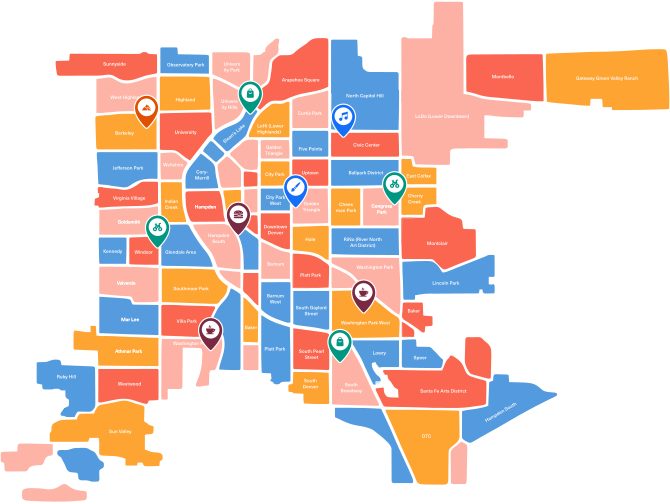
Balance your graduate work with an active outdoor lifestyle in the Mile-High City. Take advantage of a vibrant art, music, and food scene — while enjoying Colorado’s 300 days of sunshine each year.
Explore


One of the most valuable lessons I learned at Korbel is that the principles of international relations are everywhere. The insights I gained from the faculty and staff deepened my understanding of how policy decisions at all levels of government shape the global community. Korbel offered me education, training, and mentorship, and I would not be the same without it.

Being part of the Human Rights Program at Korbel has been really transformative. It’s not just about studying theories- it’s about application and making a real-world impact on the issues that matter most to me. The program offers incredible opportunities to connect with human rights activists and alumni globally, which has given me valuable insight into the field. The faculty’s support has been amazing, and collaborating with passionate students from all backgrounds has pushed me to grow both personally and professionally.
Applicants typically come from political science, human rights, law, sociology, international studies, or related fields. Professional or volunteer experience with human rights organizations, advocacy groups, or legal settings can strengthen an application but is not required.
The program covers international law, human rights advocacy, accountability mechanisms, conflict and atrocity prevention, migration and refugee rights, gender justice, environmental rights, and global governance. Students gain strong research, policy analysis, and advocacy skills.
International Human Rights is not a JD program. Instead, it prepares students for human rights advocacy, policy analysis, research, and program work. Students study international law from a policy perspective rather than a litigation-oriented approach.
Graduates work for NGOs, human rights organizations, think tanks, international tribunals, refugee and migration agencies, and advocacy groups. Many go into research, policy analysis, monitoring and reporting, legal support roles, or nonprofit program management.
Students without legal training succeed in the program. Those with legal backgrounds may deepen their understanding of international human rights systems and advocacy methods.
In addition to theory-based courses covering important thematic areas and international law, IHR students develop technical skills through coursework in statistics, research methods, and more.
Students often engage in simulation exercises, study abroad, and internships with human rights NGOs, legal advocacy organizations, refugee resettlement agencies, and international institutions. Faculty also support research and field-based projects.
Students can choose to complete an optional thesis or substantial research paper. Faculty advisors guide students in selecting the best option based on career goals.
Korbel is known for its strong ties and alumni network, including human rights practitioners, internationally recognized faculty, and research centers focusing on human rights, genocide prevention, migration, and global justice. The program blends rigorous academic training with practical advocacy tools.
Yes. International applicants are encouraged to apply and receive assistance with CPT/OPT, job search support, and guidance navigating environmental policy careers in U.S. and global markets.

Military & Veteran Pathways
Explore
Copyright ©2026 University of Denver | All rights reserved | The University of Denver is an equal opportunity institution