Menu

Menu
Climate change and environmental threats are reshaping our world, with profound consequences for economic well-being, migration, health, conflict, and environmental justice. This program’s human-focused approach emphasizes understanding the causes and effects of climate change and developing strategies to limit the impacts.
You’ll explore diverse economic, political, and sociological perspectives to address these urgent challenges. And our location in Colorado puts you at the center of practical discussions on the role of government, the private sector, and civil society.
Whether you’re aiming to make policy on scales from local to global, drive corporate social responsibility, or lead advocacy organizations, you’ll be equipped to promote just and equitable sustainability initiatives.
Program length
60 credits
Degree awarded
MA in Global Environmental Sustainability
Course delivery
On campus
Term length
10 week quarter
Admission & merit aid priority deadline
Priority: October 15, 2026, followed by rolling admissions

INTS 4091

4 credits
INTS 4397
4 credits
INTS 4706
4 credits
INTS 4972
4 credits
INTS 4057
4 credits
Learn More

Learn More
Learn More
Learn More
Learn More
Learn More
Learn More
Strategic Intelligence

STEM-Optional Practical Training
The Master of Arts in Global Environmental Sustainability is a STEM-designated degree, which means eligible F-1 students may apply for a 24-month extension of post-completion Optional Practical Training (STEM OPT) after graduation.
Want to build additional analytical skills? The optional Applied Environmental Analysis (AEA) concentration is not required for STEM OPT eligibility, but it can help you develop additional analytical skills that may be valuable to employers. Students who choose the concentration declare it in their first quarter through the Korbel Office of Academic and Student Affairs.
STEM OPT is administered by the U.S. government. Eligibility and approval are not guaranteed and depend on federal requirements in effect at the time of application, including F-1 status, post-completion OPT eligibility, qualifying employment, and employer participation in E-Verify.
TRAN 4100
4 Credits
View Info
TRAN 4110
4 Credits
View Info
TRAN 4120
4 Credits
View Info
TRAN 4130
4 Credits
View Info
TRAN 4140
4 Credits
View Info
TRAN 4150
4 Credits
View Info
TRAN 4160
4 Credits
View Info
TRAN 4170
4 Credits
View Info
TRAN 4180
4 Credits
View Info
TRAN 4190
4 Credits
View Info
TRAN 4901
4 Credits
View Info
TRAN 4902
4 Credits
View Info

Hands-on experience is essential to your success. You’ll find an abundance of opportunities to develop your professional skills and explore career paths.
Build experience across city, state, and national government agencies, international organizations, global NGOs, and the private sector. With guidance from our career coaches, you’ll land positions that align with your skills and interests.
Join one of our simulations for a taste of on-the-ground realities in an interactive environment. From negotiating international conflicts to managing humanitarian crises, these engaging scenarios are a highlight for Korbel students.
Korbel students have the opportunity to study in vibrant cities like Rio de Janeiro, Geneva, Vienna, and Washington, D.C. These experiences offer rich firsthand experience and insights, all at no additional tuition cost.
At Korbel, research directly contributes to real-world impact. Many students engage in applied research at places like our Pardee Institute for International Futures, serving clients like the US government, the United Nations, and the African Union.
Experiential Learning
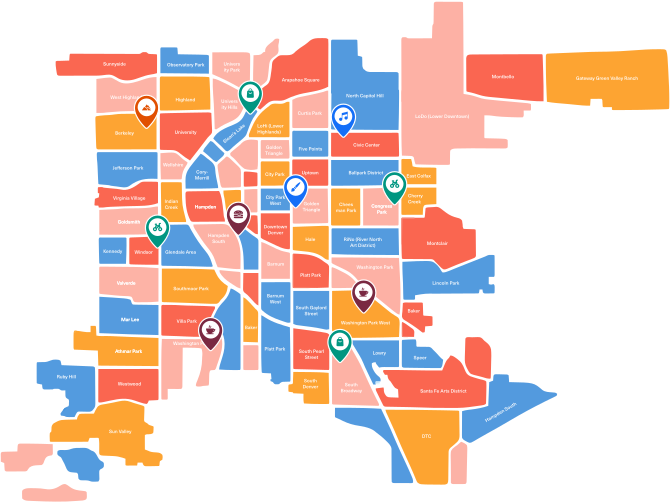
Balance your graduate work with an active outdoor lifestyle in the Mile-High City. Take advantage of a vibrant art, music, and food scene — while enjoying Colorado’s 300 days of sunshine each year.
Explore


One of the most unique aspects of the Global Environmental Sustainability program that drew me to Korbel is the well-rounded education and set of skills the degree offers. To efficiently advance sustainability, we must be able to understand and analyze its relationships with development, human rights, security, the economy, public policy, and more – the Korbel school provides all of these lenses.
GES welcomes applicants from all backgrounds, particularly environmental studies, international affairs, public policy, geography, political science, natural sciences, and related fields. Applicants without prior environmental coursework may strengthen their application through relevant professional experience or a strong statement of purpose demonstrating clear interest in sustainability.
The program integrates environmental policy, climate governance, sustainability planning, and global development. Students gain analytical skills to evaluate environmental challenges, design policy solutions, and assess the political, economic, and social dimensions of global sustainability.
GES focuses on policy and governance, not purely natural science. Students examine how institutions, governments, and global systems shape environmental outcomes. Coursework is applied and interdisciplinary, emphasizing real-world policy, climate diplomacy, and sustainability leadership.
Graduates commonly work in climate policy, environmental NGOs, multilateral organizations, corporate sustainability, environmental consulting, energy and climate research, and government agencies. Many pursue roles in program management, policy analysis, environmental compliance, or sustainability strategy.
No specific technical background is required. Students are required to take statistics and can elect courses in GIS modeling, environmental economics, geospatial data, and more, depending on their interests. View GES courses here.
Students can choose to complete an optional thesis or substantial research paper. Faculty advisors guide students in selecting the best option based on career goals.
Yes. Internships offer valuable professional exposure in climate policy, environmental nonprofits, renewable energy companies, local government, or international organizations. Many students secure internships through Korbel’s career office or through faculty networks.
GES is one of the few programs that combines environmental policy + global governance + sustainability practice. Students can customize their path across energy policy, climate negotiations, conservation, environmental justice, or green development. The program draws on faculty expertise across public policy, economics, and environmental systems.
Yes. Students often take electives in geography, environmental engineering, business sustainability, or law. Cross-disciplinary study is strongly supported.
Tailor your program to pursue a certificate in any of the following:
Korbel offers international field courses, research opportunities with sustainability-focused institutes, and the Korbel in DC program for students interested in federal climate policy or international environmental institutions.
Yes. International applicants are encouraged to apply and receive assistance with CPT/OPT, job search support, and guidance navigating environmental policy careers in U.S. and global markets.
Military & Veteran Pathways
Explore
Copyright ©2026 University of Denver | All rights reserved | The University of Denver is an equal opportunity institution