

Menu

Menu
This reflection was written by Maddison Schink (MA, International Studies, 2027).
Over the University of Denver’s unique winter interterm, I spent nearly two weeks with Dr. Tamra Pearson d’Estree, a Korbel professor of conflict resolution, and a group of my peers in the Netherlands for a course on climate resilience and governance.
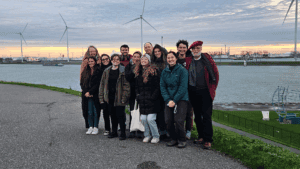
A group photo of participants in the Netherlands trip
Our group represented both first- and second-year students across Korbel’s graduate programs, from Global Environmental Sustainability to International Security and Global Economic Affairs, so a diversity of perspectives emerged and fostered deep questions during our site visits and rich conversations on the bus or over lunch. I am pursuing an M.A. in International Studies with a specialization in Environmental Conflict Resolution, so the part of the course that I found most interesting was visiting the House of Representatives and hearing about the Dutch polder model of governance, which is consensus-based and founded on ensuring that every party has a say in shaping the final decision. Considering the Netherlands’ long history of collectively contending with water, we realized the potential to draw upon their expertise to develop solutions to the international community’s growing challenges in the face of climate change.
For context, two of the Netherlands' top priorities are managing rising sea levels and shifting weather patterns that can result in inundation or drought. The country is a delta with many rivers, and much of the nation is below sea level. To help mitigate the dangers, the Netherlands has been engaging in centuries of land reclamation by using iconic windmills, which are now largely modern electric pumping stations that drain water and create arable plots of land called polders. Today, polders comprise around 20% of the country’s landmass.
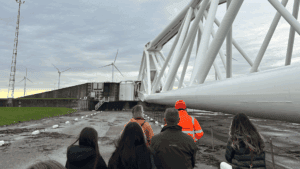
The class explores renewable energy infrastructure
Throughout our travels, we repeatedly heard a phrase that summarizes the Dutch pride in their transformation efforts – God created the world, but the Dutch created the Netherlands. Without the Dutch people’s ongoing commitment to collaboration through the formation and cooperation of democratic regional water boards around the year 1200, the building of their nation would not have been possible.
Professor d’Estree arranged for us to visit four different cities throughout the country: Amsterdam, The Hague, Delft, and Groningen. Each location presented us with an opportunity to see firsthand the variety of old and new technologies that the Dutch are adapting — from dikes to giant moving storm surge barriers — to keep themselves safe from flooding. However, as leaders in engineering and spatial planning shared with us, infrastructure alone is not enough to keep everyone’s feet dry. The Dutch meaningfully involve the public in building community resilience and co-creating policies that will more equitably serve the Dutch people across rural and urban landscapes.
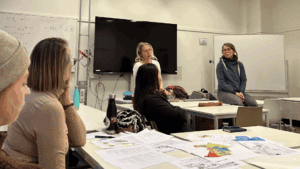
The class learns about community resilience and policy co-creation
In between lectures from local university professors and private tours to learn about the design and implementation of climate adaptation strategies, we enjoyed several festive Christmas markets, group coffee breaks to fuel us through lingering jet lag and writing our assigned journal reflections, scenic public transit adventures (I only nearly missed our train stop once!), and Dutch cuisine served on beautiful white and blue Royal Delft pottery at a traditional brown café.
We ended our time in the Netherlands reflecting on how we might carry what we learned into our continued studies at Korbel and our future careers. Growing up in Colorado and working at a nonprofit dedicated to convening diverse stakeholders around controversial environmental issues has shaped how I approach questions of governance and collaboration. In my final course paper, I am inspired to explore how elements of the Netherlands’ consensus-based approach to water governance, along with its emphasis on public engagement and education, might translate to an issue close to home: the complex and increasingly urgent renegotiation of the Colorado River Compact. Ultimately, this international travel course fulfilled its purpose by challenging Korbel students to think beyond borders and imagine new ways to address some of the most pressing global challenges, including climate change.
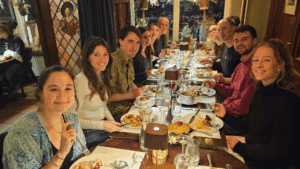
A group photo at dinner of participants in the Netherlands trip
Copyright ©2026 University of Denver | All rights reserved | The University of Denver is an equal opportunity institution