

Menu

Menu
More Than a Major: How International Studies Took Me from the Classroom to the Balkans
By Elias Barbour, BA International Studies '2028
As a history and political science major in the winter quarter of my first year at DU, I decided to take INTS 1700: Intro to International Politics. I felt sheepish walking into my first class at the Josef Korbel School of Global and Public Affairs since I had never taken an official international relations class, nor had I been abroad before. Yet, Korbel gripped me.
As I considered how the class content related directly to the current political state of the world, I realized that the big questions I asked in that class were the very same questions I found myself mulling over while in bed staring at the ceiling at night. I changed my major to International Studies by the end of the quarter. But one thing still bothered me. Despite my newfound affinity for international studies, my lack of actual experience abroad still loomed over me.
Then my Intro to Global Economy professor, Keith Gehring, advertised his interterm class on post-conflict politics, which would take place in Serbia, Bosnia and Herzegovina, and Croatia. Something clicked for me. This was the opportunity I had been looking for.
For some time, my ability to go on the trip was dubious due to financial constraints. Luckily, I was given just enough financial aid to make it work. Though I ended up blowing through nearly all my savings to go on the trip, the experience I got in exchange was worth every penny and proved that this cost would be an investment in my future.
Being able to finally go abroad while developing knowledge and practical skills to tackle some of the world’s most difficult political issues proved not only to be invaluable for my professional development, helping me work towards a potential career in international relations, but this experience also provided me with some much-needed perspective for my own personal development.
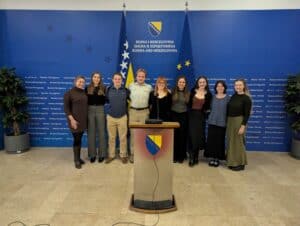
Throughout the two weeks of the Post-Conflict Politics in the Balkans course, I met with former US and foreign ambassadors, current diplomats, parliamentarians, ministers, investigative journalists, survivors of genocide, academics, and students involved in some of the largest protests the region has ever seen. Though our schedule was jam-packed, each meeting felt meaningful. Every person we spoke with provided their own insight and nuance into some of the most complicated and difficult issues.
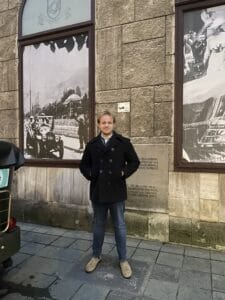
One of the most impactful interactions I had was with a tour guide named Zika in Mostar, a town in the south of Bosnia and Herzegovina that was sieged during the Bosnian War in the early ‘90s. Speaking to our group while we stood in a former sniper’s nest, he spoke of the significance of this place, where Bosnian Serb snipers once targeted civilians basically for fun.
Zika pulled from his pocket a piece of shrapnel and a bullet that was removed from him during the siege. He then brought us to a graveyard and showed us the grave of his childhood best friend – a grave he had dug himself. Zika’s friend had been hit directly by a mortar round right in front of him. They were both 19, younger than I am now.
As bleak as his story was, it was far from uncommon. Everyone I met had been impacted by the war in some way, even beyond the names included in the class itinerary. The stories of strangers I met in random taxis, restaurants, and bars also reflected the weight and pain of the region’s history. Despite this collective pain, I was moved by the level of resilience, kindness, humility, and humor of those I met.
This is what made the trip so transformative. I was able to immerse myself in the discomfort, allowing myself to experience the catharsis that came with seeing the consequences and aftermath of war and genocide, giving deeper personal meaning beyond the trip’s academic and professional aspects.
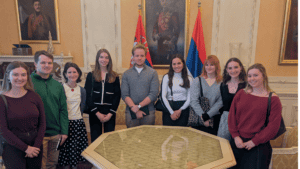
Another impactful part of the trip was the incredible opportunity to speak with both current and former foreign service officers. Since adding International Studies as my major, I’ve gravitated to career interests related to diplomacy or foreign affairs. As I discovered how complicated, difficult, and frustrating the actual process of peace negotiation and conflict resolution can be – directly from people who have spent their lives living that process – I noticed a shift within myself.
What started as changing my major on what seemed like a whim began to morph and solidify into something more real and tangible. My inclination to navigate complexity and operate in areas where it seems like there are no clear “right” answers, alongside my love for language, communication, problem-solving and a desire to do meaningful work, has led me to see diplomacy and conflict resolution as more personally significant and as a career path I legitimately see myself in.
Diplomacy, as it currently stands (I am only a sophomore in undergrad after all), is something that I am passionate about. A career in diplomacy is something that I believe plays into the strengths of both my abilities and my character. It is something that could reasonably be achieved as a result of the environment I am currently learning in. But most importantly, it is something that the world desperately needs.
My time in the Balkans was the perfect way for me to really start to internalize the importance of diplomacy. In the words of Professor Gehring, “If American politics is arithmetic, then the politics of the Balkans is trigonometry or calculus.”
The personal significance of this statement lies less in it not as a warning, but more as an invitation. After all, the most difficult problems are often the ones most worth solving.
Copyright ©2026 University of Denver | All rights reserved | The University of Denver is an equal opportunity institution