
There's still time to apply! Accepting applications for Fall 2026 with scholarship support available. Apply now!

Menu

Menu
There's still time to apply! Accepting applications for Fall 2026 with scholarship support available. Apply now!

Join Korbel Professor Singumbe Muyeba for a special look at his new book: The Homeowner Ideology: Economic (F)Utility of Real Property Rights in Four African Cities. He will discuss his book with Korbel Teaching Professor Stefan Chavez-Norgaard.
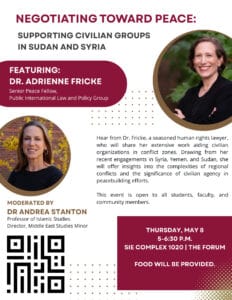
Hear from Dr. Fricke, a seasoned human rights lawyer, who will share her extensive work aiding civilian organizations in conflict zones. Drawing from her recent engagements in Syria, Yemen, and Sudan, she will offer insights into the complexities of regional conflicts and the significance of civilian agency in peacebuilding efforts.
This event is open to all students, faculty, and community members. Food will be served.
Verhagen, W., Pereira, C. C., Bohl, D. K., Meziere, M. E., Irfan, M. T., & Moyer, J. D. (2022, March). Exploring Alternative Futures of Development: Economic and Human Development Trends to 2040. https://korbel.du.edu/sites/default/files/2022-03/DU-UNDP_G
Guinea-Bissau is currently one of the least developed countries in the world, ranking 178th out of 189 countries on the Human Development Index (2019). We study the economic and human development outlook to 2040. We show that economic growth will improve the human condition in Guinea-Bissau (extreme poverty, undernourishment and child stunting), but that progress remains stunted without addressing broader development progress in education, governance and infrastructure.
John Calvert, Professor of History at Creighton University, examines the evolution, agenda and trajectory of the Egyptian Muslim Brotherhood within the framework of a changing Egypt.
Richard Bulliet, Professor of History at Columbia University, examines the relationship between religion and the state in the “Muslim South”—that half of the Muslim world located south of Medina, whose peoples came to Islam centuries after those of the “Muslim North”—and how understanding the different means of legitimating governance in the Muslim South sheds light on the crisis of legitimacy in Muslim-majority states like Egypt today.
Abdullah Al-Arian, Associate Professor of History at Georgetown University’s School of Foreign Service in Qatar, writes about the state of the Muslim Brotherhood in Egypt following the 2013 military coup d’état that ended Mohamed Morsi's presidency.
William Hartung explores the early relationship between the Trump administration and the Kingdom of Saudi Arabia and what it means for the region more broadly.
Utazi iyo ava ntamenya iyajya!
(If we don’t know where we came from,
we don’t know where we’re heading)
- Kinyarwanda proverb
The Africa Center and Students for Africa remember! “Kwibuka” which means “to Remember” in Kinyarwanda, begins on April 7th, and concludes July 4th on liberation day. The annual 100-day commemoration period is a global phenomenon that reminds us of our Ubuntu (humanity) and the horrors that could be fell us when we forget this requisite.
2023 marks twenty-nine years since the genocide against the Tutsi, moderate Hutu and Twa in Rwanda took place. Every April, the world and especially victims and survivors of the genocide join together to remember those lost and commemorate the atrocity that humanity had vowed never again! Kwibuka is a time for Rwandans and the global community to reflect on the past, and to continue to work on processes and measures to ensure that such an atrocity never happens again. For Rwandans, it is a time to reflect on the past and a future molded by collective trauma and reconciliation.
While tensions between Tutsis and Hutus were already high, the trigger for the genocide came on April 6th, 1994, when a plane carrying then Rwandan President Juvenal Habyarimana and his Burundian counterpart was shot down by unknown people. Upon his assassination, the Hutu extremist group Interahamwe, quickly organized, blaming the attack on “Tutsi Extremists” calling for total extermination of the Tutsi whom they branded traitors (from colonial experience) and dehumanized as “Tutsi cockroaches”. The Interahamwe hate speech was broadcasted through the radio across the country calling all Hutus to kill Tutsis and any sympathizers. In the ensuing 100-days an estimated 200,000 Hutu civilians participated in the killing of an estimated 800,000 people including Tutsi, moderate Hutus, and Twas; one-tenth of the country’s entire population at the time. Although the genocide took place over two decades ago, the impacts continue to linger, leaving no one untouched.
On April 7th, Rwandans across the country, diaspora, and the international community gather in Kigali’s Amahoro (“peace”) stadium to attend the annual commemoration ceremony. The ceremony is a time for Rwandans to unite in solidarity with one another, for a candlelight vigil in remembrance of the victims, and carry a torch as a symbol of commitment to ensure that what happened in 1994 never happens again.
Throughout the years, Kwibuka has become highly politicized, with those who do not attend the commemorations labeled perpetrators or family members of perpetrators. Many cases of arrest occur during the commemoration period due to subjective law. Outside of the three-month period of Kwibuka, the mention, discussion, and emphasis of ethnicity is in violation of the country’s “Ndi Umunyarwanda” (“I am Rwandan” law). The law was created to reinforce a post-genocide unified national identity. Yet, the most polarization of Kwibuka in the recent past was the renaming of the genocide in 2014 to restrict it to the killing of the Tutsis. This narrative has drawn criticism to the Kagame government’s handling of the commemoration period as well as the manipulation of the collective memory of the country. Critics argue and warn that there has been a sense of historical erasure of the many moderate Hutus and Twas who were also killed in the genocide, previously recognized as victims. Despite the controversy, Kwibuka remains a valuable time for Rwandans and the world to remember the victims of the genocide.
Rwanda’s resilience has stood the test of time, as the country remains at the forefront of African development and innovation. However, it is impossible to ignore the shared history and collective trauma that has pushed the country to where it is today. Rwanda is a solemn reminder of what happens when we as human beings lose our Ubuntu, and the 1994 genocide should always remain a reminder of the importance of human virtues, compassion, and unity.
This article was written by Dr. Abigail Kabandula and Natalie Impraim. Lindsey Mandolini served as editor.
Copyright ©2026 University of Denver | All rights reserved | The University of Denver is an equal opportunity institution