
There's still time to apply! Accepting applications for Fall 2026 with scholarship support available. Apply now!

Menu

Menu
There's still time to apply! Accepting applications for Fall 2026 with scholarship support available. Apply now!
By Francisco Rodríguez, Rice Family Professor of the Practice of International and Public Affairs
When a massive earthquake killed tens of thousands of people in Turkey and Syria in February, activists around the world scrambled to raise money for relief efforts through platforms such as GoFundMe. They immediately hit a roadblock: US sanctions. To comply with regulations, GoFundMe told users, it would not only block fundraising efforts mentioning Syria earthquake relief, but would suspend the accounts of those making requests.
Facing public outcry, the Biden administration issued a special, limited-time licence exempting Syria earthquake relief transactions, after which GoFundMe allowed the campaigns to go ahead. Yet while this carve-out may have eased some difficulties in bringing aid to victims, no such exceptions exist for other countries under US sanctions.
This article was published on May 4, 2023 in The Financial Times. To continue reading, please click here.
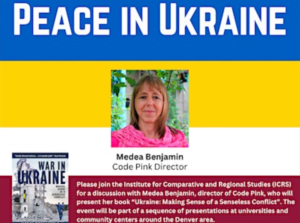
On April 4th, the Korbel School's former Institute, ICRS, hosted peace activist and Code Pink founder Medea Benjamin. Listen here for a short conversation with ICRS's former director, Aaron Schneider.
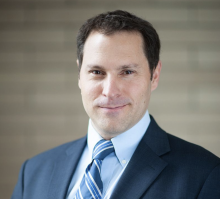
How do you see your work fitting into a Korbel Institute for Comparative and Regional Studies (ICRS) with a focus on labor, democracy, and the global South?
As a political scientist, comparativist, and latinamericanist, my research and policy work is directly connected to issues of justice, security, rights, and equity in the “global south.” The Latin America Center directly engages with these issues and convenes events and speakers to stimulate dialogues. My personal research agenda also touches on many of these areas. I am currently implementing a field experiment with a colleague at UT-Austin and the help of several Korbel students to study whether ex-combatants from the armed conflict in Colombia experience hiring discrimination in their searches for formal employment, and how to remedy any such bias. My primary line of research focuses on how communities can protect themselves from armed conflict violence. That research, spanning several countries, emphasizes the empowerment of communities in the “global south” through supporting their local democratic institutions as the foundation of their advocacy and protection (they can also pursue their autonomous development with great security and protection of their rights). As part of ICRS’s COVID-19 and Democracy project, we also convened an expert working group to produce a report on how the pandemic affected democratic trends in Latin America. At ICRS, I also run the Korbel Asylum Project to involve students in helping asylum-seekers from the Global South improve their chances at winning asylum based on sound research.
How does your identity and positionality shape your work as director of the Latin America Center?
We all have our own unique identities and cannot change where we come from. But we can recognize our unique backgrounds as individuals and what they imply for our interactions with others—including for academic dialogue and research. We can leverage such awareness for more respectful and productive engagements. I recognize that I come from a particular background with particular characteristics, as I am visibly a White cis-male from the U.S. and come from northern California in the U.S. I also have many other invisible aspects—opportunities, experiences, and challenges that I had to overcome—that shape who I am. My awareness of my positionality helps me understand how others view me and how I can bridge any social distance to connect with people of different backgrounds, whether they are students, research participants, government officials, or colleagues and friends. In my case, because I work a lot with residents of rural communities and activists in Colombia and elsewhere, I regularly interact with people who come from quite different places than I do. I have written several reflections on how positionality enters into my research. I also discuss how positionality enters into my “partnered” policy engagement process with local peacebuilders. By recognizing our differences we arrived at an even more impactful presentation of our insights on atrocities prevention (also in our forthcoming book on Responsible Policy Engagement).
What advice would you have to students, activists, and policymakers in terms of building solidarity between North and South?
Sometimes building solidarity can be challenging, not only because of physical distance but also because of cultural distance and differences in lived experiences. But building solidarity is definitely possible, and it has perhaps been the most rewarding part of my research and policy work. It begins with showing up, and being reliable and consistent. It involves focusing on and valuing relationships, and approaching people with respect. Perhaps most centrally, solidarity involves not only making contributions and supporting others, but also valuing and representing the contributions of others. To do this, one must have an open mind and listen to all voices, from wherever they may come.
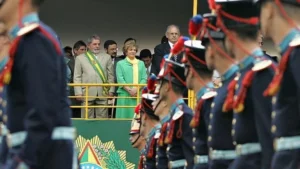
There is generalized unease with the Brazilian military, expressed by President Lula on the last 12th, which was generalized in the press and social media. This sentiment may be misplaced because, if the military failed in the January 8 crisis, the Republic has been failing the military for much longer.
When it comes to the military, all the presidents we've had since re-democratization failed because they played little role as commanders in chief. None of them made reform of the armed forces and the Ministry of Defense a priority, delegating or delaying and missing opportunities for greater presidential participation. The failure to reform effectively failed to comply with article 91, paragraph 1, item IV of the Constitution, which establishes that the National Defense Council is responsible for "studying, proposing and accompanying the development of initiatives necessary to guarantee national independence and the defense of the democratic State". This council never fulfilled its role, and the military are more consulted than subordinated to the priorities of the Presidency of the Republic. As a result, military activities are submitted to almost no external evaluation.
Worse, even with the history of military interventions in national politics, various governments have done nothing to reduce the political power of the military. On the contrary, they have become increasingly dependent on military agencies to build roads and bridges, distribute water, contain epidemics, fight organized crime and even guarantee elections, among other civil functions. As long as the military is central to public administration, it will have political involvement and bargaining power to remain insulated from civilian control.
Congress failed the military by never overseeing and intervening when the Executive failed to fulfill its role. Federal deputies and senators failed the military when they accepted a marginal role in the formulation of defense policy, and instead of developing qualified advisory oversight and public debate, submitted to the lobbying of formal and informal representatives of the military in the Legislature. Worse than that, Congress has always acquiesced, even when not necessary, to an exaggerated use of the military in civilian functions.
With the exception of Nelson Jobim, the Ministers of Defense failed the military by failing to amass qualified personnel, producing an unstructured hierarchy with limited effort to advance reform. None of them were able to develop a hierarchy adequate for analysis and management that could be independent of the military. Worse, they accepted that the military divvied up the Ministry of Defense by incorporating their fiefdoms and private agendas.
The Brazilian Judiciary failed the military when it did nothing to reverse the existence, a holdover from the military regime, of a parallel military judicial system with no equivalent in any democracy in the world.
Universities have failed to develop skilled defense expertise and knowledge and have never taken on a more central role in training the military. Most social scientists are averse, if not repulsed, to matters of defense and war in general.
The Brazilian military has failed itself. They never fully accepted being unreserved servants of the Nation and always flirted with the tutelage of democracy. They gave in to the temptation to expand subsidiary missions in exchange for an extraordinary budget, and accepted civilian positions in the Dilma, Temer and, mainly, Bolsonaro governments in exchange for financial gains, privileges and status that deformed and exposed their corporate interests.
Brazil's list of failures is long, and the general unease towards the military is unsurprising. What is surprising is how long it has taken to realize this fact.
Published originally in Portuguese here.
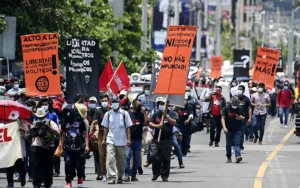
Imagine a future in which countries desperate for investment give up a patch of their territory and subcontract governance to a board chosen by a foreign corporation. Sound like the East India Company of the past? Until the 2021 election of Honduran president Xiomara Castro, the past was now—Zones for Employment and Economic Development (Zonas de Empleo y Desarrollo Económico in Spanish, or ZEDEs) had been permitted to establish their own near-tax-free paradises in company-governed territorial fiefdoms.
The investor-governed territories include one that accepts its own cryptocurrency and allegedly tramples rights of indigenous and Afro-Caribbean populations, another where small farmers were forced to sell their land—all were criticized by the United Nations as threatening basic human rights and criticized by Honduran civil society for worsening problems of tax evasion and narcotrafficking. What is clear is that they violated basic democratic principles of representative government and undermined national sovereignty, including denying the validity of international labor and environmental treaty obligations agreed by the Honduran state.
It all began when a 2009 Honduran military coup ousted a democratically elected president. The next Honduran president and the Congress passed a law to cede portions of its territory to corporate investors as “charter cities” but were blocked by the Supreme Court. In response, Congress impeached the judges, packed the court, and engineered a new law to create ZEDEs. According to a study published in Central American Journals Online, ZEDEs are comparable to the Spanish colonial model, creating foreign-controlled economic zones on Honduran territory. The president of the Congress, Juan Orlando Hernández, went on to be the next president, governing two terms after his handpicked Supreme Court-sanctioned reelection. Eight years later, Hernández now sits in a U.S. jail awaiting trial for narco-trafficking, the same charges on which his brother was sentenced to life in a U.S. prison.
Last year, the first opposition government elected since the coup made doing away with ZEDEs part of its electoral campaign, and among the first laws passed by the new Congress was ZEDEs elimination. The law passed unanimously, including votes from the very party that had put the ZEDEs in place. The reversal was the culmination of a broad civil society movement that brought together women, indigenous, Afro-Honduran, labor, and local business interests. Predictably, only the foreign investors want the paradises to remain.
It is worthwhile to look at the record of the ZEDEs. They found resonance among conservative Honduran economists and were championed by Paul Romer, an economist who extrapolated from the experience of places like Singapore and Hong Kong to presume that cities could carve out independent regulatory regimes to promote development in the midst of poorly governed areas. Originally part of an oversight board to the charter cities, Romer resigned in response to Honduran government evasion of oversight processes and lack of “transparency.” Romer’s fears appear to have been well-founded, as the oversight board established for the ZEDEs is now a self-perpetuating body that even a think tank founded to support charter cities views skeptically for including "Ronald Reagan’s son (a conservative media personality), anti-tax activist Grover Norquist, and a member of the Habsburg dynasty.” It goes on to say that “the ZEDEs were clearly more of an ideological exercise than a practical exercise to generate development.”
Romer may have gotten out just in time for additional reasons, as the record of the ZEDEs has been poor in terms of economic, environmental, and democratic impacts. Compared to what Honduras would have collected otherwise, even conservative estimates suggest the tax exemptions offered to the ZEDEs would cost equal to almost half of current sales taxes by 2025 and a value equal to all current import taxes by 2026. Worse, some of the ZEDEs build investor paradise workplaces and residences but appear to provide almost no public services, except their private police, even as they deny the Honduran state sufficient tax revenue to provide schools, health clinics, and courts. Pitched as model cities, ZEDEs are actually far from that, including one that offered preferential treatment for agricultural investments and mining concessions, evading existing environmental and other regulations on decidedly nonurban activities. In the face of social opposition to the ZEDEs, the Honduran Congress had toughened punishments for blocking property or businesses, making it easier for ZEDEs private security forces to repress protesters. Private security force and paramilitary violence against opponents of megaprojects like ZEDEs is common in Honduras—and in one case a lawyer representing indigenous communities opposed to the original charter cities law was murdered, sparking condemnation from the State Department, but impunity for the killers meant there was no proven link to his political work.
In spite of this poor record, most of those who want to preserve the ZEDEs point to potential benefits without any evidence. Supporters claim ZEDEs will be a boon to employment, but rates of unemployment have remained unchanged since ZEDEs began, estimates of the actual number of ZEDEs jobs created hover around 15,000 in the eight years ZEDEs have been on the books, and ZEDEs undermine and evade existing labor legislation. Supporters present ZEDEs as complementary to U.S. nearshoring, but estimates of benefits to Honduras from nearshoring lag behind eight other Latin American countries, none of which have ZEDEs. Supporters argue ZEDEs will head off growing Chinese influence, but China is one of the countries interested in investing in ZEDEs. Supporters suggest ZEDEs will address problems of corruption, but the director of the ZEDE oversight board was secretary of the presidency to the jailed former president and has continued to draw a salary even after fleeing to neighboring Nicaragua to escape his own corruption and narcotrafficking investigations. Supporters argue ZEDEs will generate trade, investment, and growth, but since the ZEDEs law was passed in 2013, trade as a percentage of GDP dropped in five of eight years and is now lower than it was before, foreign direct investment decreased as a percentage of GDP every year except 2018, and GDP growth was below 4 percent in six of the eight years. Overblown aspirations have two main problems: first, they violate basic democratic principles of citizen representation, adherence to rule of law, and international treaty obligations; and second, in the eight years since ZEDEs were allowed, none of these promises have been fulfilled.
Why the sudden kerfuffle about an obscure scheme abandoned by its founder, instituted by a corrupt politician now in jail in the United States, revoked by the country that adopted it, and that showed minimal actual impact? Perhaps because one ZEDE investor has provided grants to think tanks to start a dialogue on the issue, the results of which may have convinced some in the State Department, the U.S. Embassy in Honduras, and a few members of Congress, even threatening the newly elected Honduran government with reprisals such as withdrawal of aid, forced restitution payments, or limiting the Honduran share of the Partnership for Central America, the private sector investment plan led by Vice President Kamala Harris. For the richest country in the hemisphere to threaten to withhold or extract resources from the third-poorest country lends credence to the critiques of those who viewed the ZEDEs as colonial. Worse, withholding funds or forcing restitution would undermine the core intent of the Harris plan—invest in Honduras to stem outmigration, address low growth, and improve governance. Instead of listening to those who are advocating for a few private corporations’ desire to cash in on their fiefdoms, the United States should be supporting stronger Honduran institutions, starting with respecting the democratic will of the Honduran people.
Aaron Schneider is Leo Block Professor of International Studies at the University of Denver. Mark L. Schneider is a senior adviser with the Americas Program and the Human Rights Initiative at the Center for Strategic and International Studies in Washington, D.C., and former director of the Peace Corps.
Originally produced by the Center for Strategic and International Studies (CSIS). All views, positions, and conclusions expressed in this publication should be understood to be solely those of the author(s).
PRESS PLAY WITH MADELEINE BRAND
Jan. 09, 2023 INTERNATIONAL
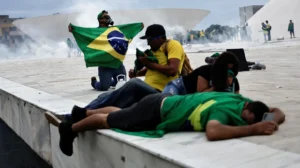
Supporters of Brazil's former President Jair Bolsonaro react during a demonstration against President Luiz Inacio Lula da Silva, outside Planalto Palace in Brasilia, Brazil, January 8, 2023.
Protestors in Brazil have been arrested after thousands of former President Jair Bolsonaro’s supporters stormed the country’s government buildings. They broke through police barricades, climbed on roofs, and smashed windows. Bolsonaro’s supporters falsely claim that Brazil’s elections were rigged and are calling for him to be reinstated. President Luiz Inácio Lula da Silva has condemned the violence.
Listen to the Podcast now:
Credits:
Guest
Aaron Schneider - Professor of international studies at the University of Denver’s Korbel School of International Studies
Host
Madeleine Brand
Producers
Sarah Sweeney, Angie Perrin, Michell Eloy, Amy Ta, Brian Hardzinski, Bennett Purser, Marcelle Hutchins
Copyright ©2026 University of Denver | All rights reserved | The University of Denver is an equal opportunity institution