
Join us for Open House on November 13, 2026. Register now.

Menu

Menu
Join us for Open House on November 13, 2026. Register now.
At the DU Faculty Fulbright Series event “Teaching in Serbia”, Keith Gehring described five months spent teaching policy strategy in Belgrade while his students were actively contesting their country’s direction. As a Fulbright scholar at the University of Belgrade’s Faculty of Political Sciences, he asked them to use International Futures (IFs), Pardee’s open-source, integrated assessment model, to look past the protests to a harder question: If their movement succeeded, what Serbia would they inherit?
Gehring is a teaching associate professor at the University of Denver’s Josef Korbel School of Global and Public Affairs and a faculty affiliate of the Pardee Institute for International Futures.
From a research question to a student movement
Gehring explained that his Fulbright proposal, “Serbia at the Crossroads: Modeling Political and Economic Futures,” submitted in September 2024, grew from a question he had pursued for years: How could Serbia’s educated, politically engaged population coexist with persistent corruption and weak government effectiveness?
About six weeks later, a railway station canopy collapsed in Novi Sad, killing 16 people. The tragedy sparked a student-led movement demanding government accountability. During his Fulbright interview, he recalled, embassy interviewers told him, “we wish you were here right now.” By the time he arrived in March 2026, students had occupied university buildings and mass demonstrations had filled Belgrade’s streets. His own classroom had recently housed students during the blockades.
"What if you win?”
When students doubted that political change would come, Gehring asked them, “what if you win?” Using IFs, they examined the economic, demographic, and political challenges a new government would face, and how it might choose among competing priorities.
Demography made those choices tangible. Students understood their country’s politics, Gehring said, but seeing the potential scale of population decline brought new pressures into focus. A smaller, younger generation would have to support an aging population, which raised questions about public spending and about sustaining opportunities for young people. Governance presented a different kind of challenge. Students could model stronger institutions, but Gehring noted that political change alone would not remove entrenched corruption. Building effective institutions would take sustained work. The classroom discussions weighed students’ ambitions against those structural realities, with decisions that reach beyond the next three to five years to the next 30 to 50.
An electoral breakthrough, with questions still open
By the time of his Fulbright Series talk, the movement had achieved an electoral breakthrough. In Gehring’s account, the student-backed list won roughly 140 of 250 seats in Serbia’s assembly. He expressed admiration for the movement and noted that questions about its governing priorities and cohesion remain open.
Gehring closed by encouraging faculty, students, and administrators in attendance to consider Fulbright opportunities.
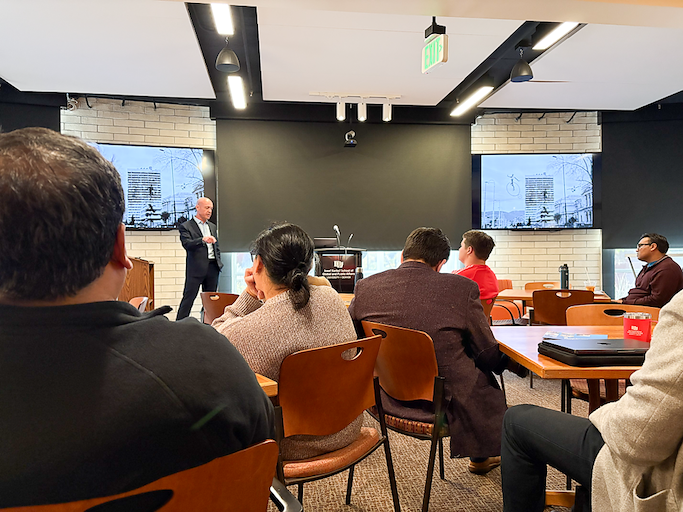
Artificial intelligence depends on more than advances in software. Its expansion requires energy, data centers, semiconductors, and financing. Whether its productivity gains translate into better jobs and wider economic opportunity also depends on investments in people and choices about how institutions respond.
Those relationships were central to two Opportunity Labs that Pardee Institute Director Jonathan Moyer helped facilitate at the World Economic Forum’s Annual Meeting of Global Future Leaders, held Oct. 13–15 in Dubai. The meeting brought emerging leaders together with policymakers, researchers, entrepreneurs, and other practitioners to explore opportunities and risks across technology, economic growth, and other areas of global change.
Moyer participated through WEF’s Global Foresight Network, which he joined earlier this year. The labs used backcasting: participants began with a desired outcome for the coming decade, then worked backward to identify decisions, partnerships, and actions that could help bring it about. The exercises asked what businesses, governments, and marginalized communities would need to do to shape AI’s development and use.
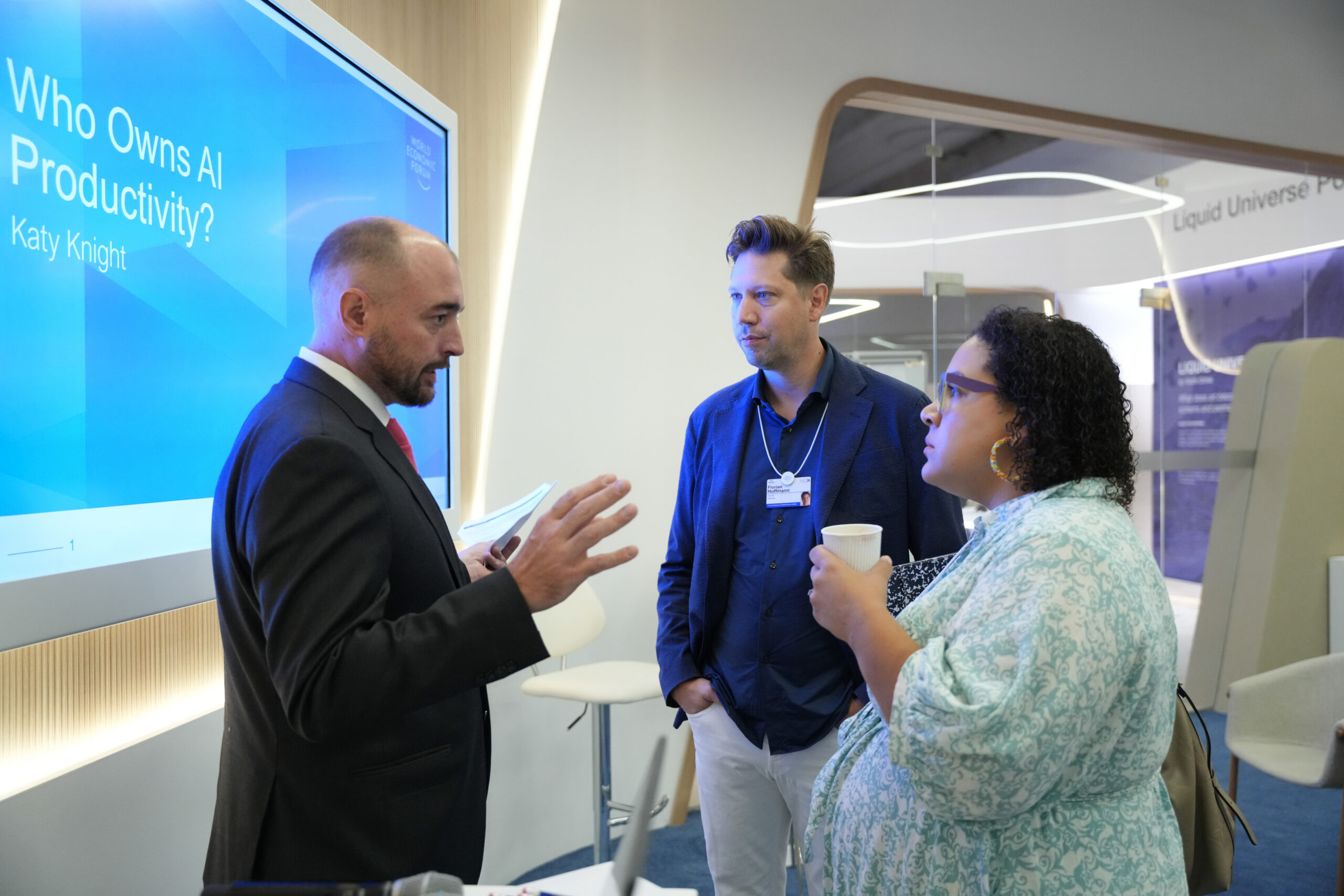
In the AI infrastructure lab, Moyer moderated a discussion examining the physical and economic foundations behind the technology, including energy networks, cloud computing, and capital. Participants considered the investment, partnerships, and governance needed to make that infrastructure more reliable, inclusive, and sustainable. A second lab focused on the impact of AI on productivity and jobs, looking at how skills investment, labor markets, and public policy could help translate AI-driven gains into broader economic opportunity. Emirates News Agency’s coverage describes both sessions.
Beyond the labs, Moyer visited UAE government facilities and met with representatives of the prime minister’s office in a meeting facilitated by Pardee Founding Director Barry Hughes. Those encounters offered a closer view of efforts to incorporate AI into government operations and decision-making. At a water and electricity facility, officials described changes in employees’ work as AI became embedded in their processes.
The meeting with the prime minister’s office opened a related discussion about different ways models inform policy. Moyer and officials reviewed the benefits and limitations of inductive approaches, which infer patterns from data, and deductive approaches, which work from specified relationships and assumptions. They also discussed International Futures (IFs), Pardee’s integrated modeling system for exploring longer-term change across human, social, and natural systems.
Building a More Knowable Future, the Pardee Institute’s 2025–2026 Annual Review, examines a central challenge for long-term strategy: immediate crises can narrow attention to what is urgent and visible, even when the forces shaping outcomes unfold across systems and over decades. The review shows how Pardee worked to widen that frame through research, data development, scenario analysis, teaching, and public engagement. It highlights efforts to connect development goals to plausible pathways, make global power and influence more measurable, advance the evolution of global scenario frameworks, and expand access to International Futures (IFs), alongside selected publications, events, awards, media engagement, and contributions from Pardee staff and student researchers.
New tools for global development, from crop forecasting to digital aid distribution, promise to reach people faster and at lower cost. Many work in a pilot phase. The harder test comes at deployment, when a tool meets the institutions, markets, and daily lives it is built to serve.
Taylor Hanna, Director of Research Development at the University of Denver's Pardee Institute for International Futures, took up that question as a panelist at "Tech for Good: How Startups Are Rewriting the Rules of Global Development." The United Nations Association (UNA) of Boulder hosted the Colorado Startup Week event.
Key takeaways
Hanna argued that the benefits of AI and other technologies depend on the systems into which they are introduced. Drawing on Pardee’s forecasting work with International Futures (IFs), she noted that while AI's trajectory remains uncertain, the systems it will interact with, such as demographics, education, infrastructure, and governance, follow more established patterns and offer a firmer basis for exploring its potential impacts. Infrastructure, human capital, institutions, and a society’s capacity to adapt, she said, help determine whether innovation leads to broad-based development gains.
Fellow panelists Juan Lucena of Colorado School of Mines, Gavin Power of PIMCO, and Vivek Ramavajjala of Google brought perspectives from engineering, investment, and technology. Power traced the evolution of Environmental, Social, and Governance (ESG) and impact investing, and Ramavajjala stressed designing AI applications around local contexts and user needs. Across the discussion, panelists returned to human-centered design and collaboration across academia, business, and technology. Hanna also emphasized connecting Colorado’s innovation ecosystem with international organizations, governments, and local partners so that new technologies respond to real-world development challenges.

Early results from a global survey suggest a disconnect between the socioeconomic scenarios researchers commonly use, and those respondents consider most reflective of today’s world.
Climate and development researchers lean heavily on a small set of scenarios to explore the decades ahead. Early results from a global survey suggest that many people who build and use those scenarios see today's world reflected in different ones.
Pardee Institute Director Jonathan Moyer shared those results at the 2026 Bath Conference on Earth System Governance, held September 7–11 at the University of Bath in England with the Earth System Governance Project. His presentation, "How might global socio-ecological change scenarios break out of silos?," was co-authored with Vanessa Schweizer (University of Waterloo), Bas van Ruijven (IIASA - International Institute for Applied Systems Analysis), and Ethan Sullivan (University of Denver).
The Scenario Evolution Process
The findings come from the Scenario Evolution Process (SEP), a global, community-led initiative to evaluate and update the Shared Socioeconomic Pathways (SSPs). Widely used in climate research, the SSPs describe alternative ways societies and economies could evolve this century. Pardee's role in the SEP is both technical and convening. The Institute hosts the SEP website, co-chairs its Orchestration Working Group, and leads the global survey, which gathers input from people who produce scenarios and people who use scenario-based information in research and decision-making.

What the survey found
Moyer’s presentation identified limits in the current SSP framework, including outdated baselines that assume no new climate policies and limited attention to how environmental change and inequality can feed back into social and economic pathways.
Initial survey results point to a gap between practice and perception. Respondents viewed the pathways characterized by regional rivalry (SSP3) and deepening inequality (SSP4) the most plausible descriptions of today’s world. Researchers, meanwhile, continue to rely heavily on the sustainability-focused (SSP1) and “middle of the road” (SSP2) pathways. And 60.2% of respondents said the SSPs’ traditional framework for comparing the challenges of cutting emissions and adapting to climate impacts is no longer sufficient for their work.
These initial findings reflect respondents’ judgments, rather than a forecast of the world’s direction. They raise questions about how researchers select scenarios and whether the existing framework captures the conditions and questions users need to examine.
Three priorities for the next generation
Moyer outlined three priorities: pathways linked to 2035 and 2050 milestones; greater attention to environmental conditions and inequalities; and scenario development that incorporates regional and national perspectives, including priorities from the Global South.
Get involved
Learn more about the Scenario Evolution Process and follow upcoming survey results at the SEP website.
Africa’s economic prospects depend partly on a demographic shift: a growing share of working-age adults relative to children and older dependents. In a new Foreign Affairs essay, Jakkie Cilliers, who founded the Institute for Security Studies (ISS) and has spent decades studying Africa’s long-term development, argues that policy choices today will shape when that shift translates into faster growth.
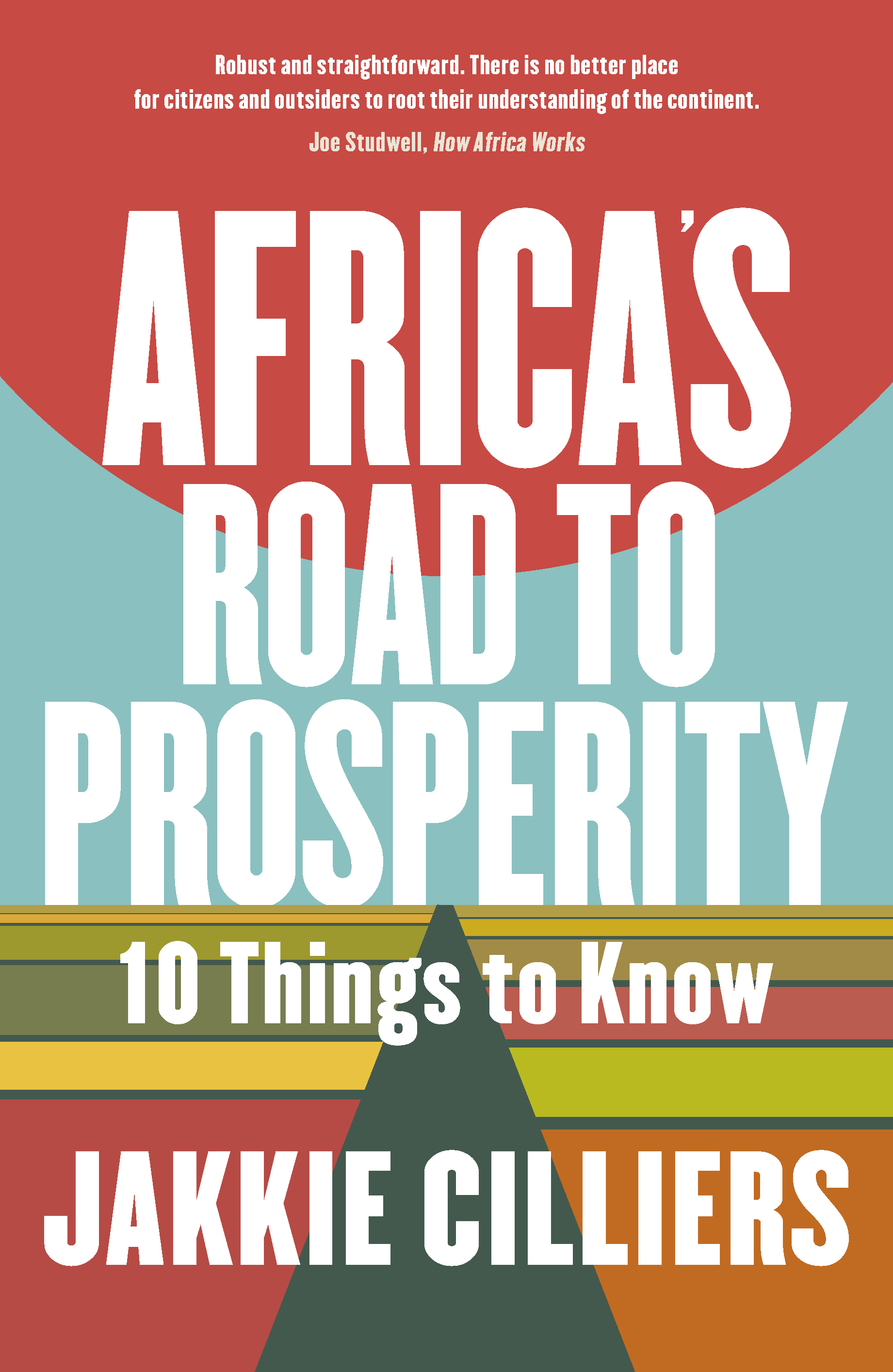
In "Africa Can't Afford to Squander Its Demographic Opportunity," Cilliers makes that case with analysis from International Futures (IFs), the Pardee Institute's open-source, integrated forecasting platform. Cilliers heads the ISS African Futures program in Pretoria, South Africa, which has partnered with Pardee since 2010 and uses IFs to analyze development across all 55 African countries. The essay is adapted from his book Africa's Road to Prosperity: 10 Things to Know.
What the IFs analysis shows
Citing IFs for his analysis, Cilliers identifies a ratio of at least 1.7 working-age people per dependent as a favorable condition for faster economic growth. Africa’s continental average today is about 1.4. IFs forecasts put Africa at that threshold around 2053, with northern and southern Africa and several island states reaching it much earlier. With the right policies, the forecasts suggest the window could be brought forward by about a decade.
Cilliers’ book is grounded in the realization that this opportunity depends on policy choices made today, many of which take decades to pay off. Better child survival and girls’ education can contribute to declining fertility, gradually raising the share of working-age adults. Education, health care, and employment opportunities then help determine whether that shift produces higher incomes.
Jakkie Cilliers's new book, Africa's Road to Prosperity: 10 Things to Know, draws on data and scenario modeling from International Futures (IFs), the Pardee Institute's open-source, integrated forecasting platform, to ask which choices could most improve development outcomes across the continent.
Cilliers is the founder and former executive director of the Institute for Security Studies (ISS). He chairs the ISS Board of Trustees and heads its African Futures and Innovation Programme in Pretoria, South Africa. Cilliers and ISS are longtime partners of the Pardee Institute.
Ten priorities, examined over the long term
The book identifies 10 priorities for Africa’s development, including infrastructure, energy, regional trade, employment, land management, and income convergence with wealthier regions, and examines the forces that shape them.
These priorities interact. Expanding electricity access can raise productivity and support new jobs, while a faster-growing workforce needs education and job opportunities to translate demographic change into higher incomes. Using International Futures (IFs), Pardee’s open-source forecasting platform, [Jakkie] Cilliers examines how these relationships unfold over time and how different policy choices could strengthen or constrain Africa’s prospects for prosperity.
Moyer, J. D., Hughes, B. B., Irfan, M., Solórzano, J., Petry, C. L., Xiong, Y., Hanna, T., Meisel, C. J., Sahadevan, D., & Sullivan, E. (2026). Broadly quantifying SSP elements for 188 countries to 2150 in international futures. Nature Communications, 17(1). https://doi.org/10.1038/s41467-026-73836-0
How can researchers better connect the social, economic, and governance dynamics that shape long-term climate futures?
New research from the Frederick S. Pardee Institute for International Futures, published in Nature Communications, expands the socioeconomic foundation available to researchers using the Shared Socioeconomic Pathways (SSPs)—the community-developed framework that underpins much of today's long-term climate and sustainable development research.
Using International Futures (IFs), Pardee's integrated assessment model, the research team developed open-source SSP projections spanning 188 indicators across 188 countries through 2150. The projections connect population, economic development, governance, conflict, infrastructure, health, education, public spending, and other interconnected systems within a single, internally consistent modeling framework.
By bringing these assumptions together, the research addresses a longstanding challenge in scenario analysis: many long-term projections rely on separate models with different underlying assumptions. The new IFs-based projections provide researchers and practitioners with a transparent foundation for exploring risks, trade-offs, adaptive capacity, and policy choices whose effects may unfold over decades.
How can long-term analysis help decision-makers prepare for futures that are uncertain, interconnected, and still partly knowable?

That question guided a three-day foresight and forecasting training in Rwanda, from May 4th to the 6th, where the Pardee Institute joined Rwanda’s National Council for Science and Technology, AUDA-NEPAD, and the Institute for Security Studies (ISS) to introduce participants to International Futures (IFs), Pardee’s open-source, integrated forecasting platform.
Led in part by Taylor Hanna, Associate Director of Development Analysis at Pardee, the training brought together 33 participants for hands-on engagement with IFs. Over the three days, participants explored the model, built and tested scenarios, and discussed how integrated forecasts can support long-term planning across complex development systems.
The training connected continental and national planning questions. Participants examined how IFs supported analysis related to the African Union’s Agenda 2063 Second Ten-Year Implementation Plan and considered how scenario-based approaches can inform Rwanda’s Vision 2050. Hanna stated, “This kind of analysis helps bridge the gap between long-term ambitions such as Vision 2050 and Agenda 2063 and the practical steps needed to achieve them.” Rather than treating development goals as isolated targets, IFs enables users to explore how changes in areas such as education, health, infrastructure, governance, economics, and the environment may interact over time. The participants tested a scenario to explore the effects of meeting national R&D investment targets on productivity.
The training also builds on Pardee’s longstanding relationships with ISS and AUDA-NEPAD. Through the African Futures Project, Pardee has collaborated with both institutions to support long-term strategic analysis across the African continent. AUDA-NEPAD’s mandate includes strengthening the capacity of African Union member states and regional bodies, while ISS’s African Futures and Innovation program provides forward-looking policy analysis on Africa’s development prospects using dynamic forecasting tools.
“What stood out most was the enthusiasm participants brought to thinking about Rwanda’s future. Putting integrated forecasting and scenario tools in the hands of policymakers allows them to test ideas, explore alternative futures, and better understand how decisions in one area affect outcomes across the development system,” reflected Hanna. For Pardee, this exchange reflected one of the central purposes of capacity-building: creating space for policymakers, researchers, and practitioners to work with shared tools, transparent assumptions, and a common language for thinking about the future.
Collin Meisel. (2026, June 11). What America's demographic future means for Africa and Europe. Megatrends Afrika Spotlight No. 71. https://www.megatrends-afrika.de/en/publication/mta-spotlight-71-us-demographic-decline-could-reshape-the-global-balance-of-power
Demographic shifts in the United States could reshape its relationships with Africa and Europe over the coming decades. Using the International Futures (IFs) model developed by the Frederick S. Pardee Institute for International Futures, the piece explores how lower immigration could slow U.S. population growth, weaken the labor force, and reduce long-term economic and geopolitical influence. It also considers how these demographic changes could affect the balance of global power and opportunities for cooperation between regions. By modeling alternative long-term scenarios rather than making fixed predictions, IFs help policymakers better understand the trade-offs and potential consequences of today's policy decisions.
Copyright ©2026 University of Denver | All rights reserved | The University of Denver is an equal opportunity institution