

Menu

Menu
After nearly 40 years at the Korbel School, Professor Frank Laird is retiring, closing a chapter defined by intellectual curiosity, institutional growth, and a deep commitment to students and scholarship.
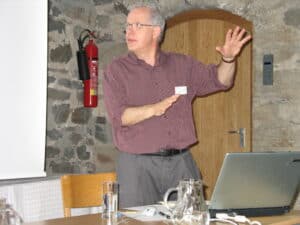
Professor Laird’s path to Denver was anything but linear. Raised in a small industrial town in Ohio, he began his academic journey studying physics at Middlebury College before continuing to graduate work at the Massachusetts Institute of Technology. Along the way, a formative year in Edinburgh and early research in astrophysics gave way to a broader set of questions about technology, society, and policy. That shift would define his career.
“I was trying to understand how big systems change,” Professor Laird reflected. “Technology was always the through line.”
That curiosity led him to political science and, eventually, to Korbel in 1987, where he would shape generations of students and scholars. At the time, the school was a fraction of its current size. Professor Laird recalls being one of roughly a dozen faculty members; today, that number has quadrupled. With that growth came not just scale but transformation.
“Both the undergrad and master’s programs have grown so much,” he noted. The Korbel School now reflects a faster-paced, professionally oriented environment, one where students arrive with ambition and depart quickly to make their mark in the world.
Throughout his tenure, Professor Laird’s early research interests on environmental policy and risk assessment evolved into historically grounded analyses of energy systems and public policy. Influenced in part by Deborah Stone’s Policy Paradox, Professor Laird developed a perspective that blended theory, history, and practice, an approach that resonated with students navigating complex global challenges.
Beyond his own scholarship, Professor Laird played a key role in building academic communities. He was a co-founder of a section within the American Political Science Association focused on science, technology, and environmental politics, helping to connect and mentor emerging scholars across the field.
In the classroom, Professor Laird found one of the most rewarding aspects of his career. “I remember one particular policy class,” he said. “We didn’t even get through a quarter of my notes. We got these discussions going, and we just roared ahead. The students were engaged, and they said interesting things. It was one of those moments where I thought, ‘Wow, this teaching stuff is really fun.’”
Professor Laird also served in leadership roles, including multiple terms as associate dean. Those experiences, while challenging, offered a valuable perspective. “I learned my strengths and weaknesses,” he reflected, emphasizing how administrative work deepened his appreciation for the complexity of running an academic institution.
As he prepares to retire, Professor Laird remains intellectually engaged. He is already working on a book manuscript on renewable energy policy and looks forward to exploring new writing projects. He envisions spending time in a local coffee shop, writing without distraction and revisiting ideas long set aside during the demands of academic life.
His advice to emerging scholars is both timely and optimistic. In an era of disruption, particularly in fields like climate and science policy, Professor Laird sees opportunity. “It’s a challenging time,” he acknowledged, “but also a chance to rethink assumptions and build something better.”
As the Korbel community celebrates his retirement, Professor Laird leaves behind not just a body of work, but a legacy of mentorship, curiosity, and thoughtful engagement with the world’s most pressing challenges. Korbel has been his home to develop those sides of himself, even as it has changed alongside him, too. “We shape institutions, but they also shape us,” he said. “I’ll always be really grateful for that.”
Students at Korbel often describe their community as more than just a shared academic space. It’s also a deliberate choice, a place where students arrive with intention. For Matthew Krieger (BA, International Studies, 2028), that sense of purpose is what ultimately drew them back to the classroom after years of professional and military experience.
Matt is an undergraduate international studies major who brings a depth of experience shaped by their time in the workforce and military, perspectives that distinguish their path to Korbel from others who start their bachelor's right after undergrad. Prior to moving to Denver, Matt spent four years in the U.S. Navy, followed by several years working in cybersecurity roles across federal agencies, including positions at the Pentagon, the Senate, and the State Department. While their career offered stability, “it wasn’t something that I was ever going to be passionate about,” Krieger said.
That realization, paired with the opportunity to use GI Bill benefits, prompted a turning point. After relocating to Colorado in 2021 during the COVID-19 pandemic, Krieger began reconsidering their future. Their longstanding interests in politics, travel, and global perspectives led them to explore programs at the University of Denver and ultimately to Korbel. “DU just made the most sense, and then I learned more about Korbel specifically, and saw how well regarded the international relations school was,” they said.
Krieger’s decision to pursue international studies was also shaped by their desire to better understand perspectives beyond the U.S. “It’s really easy to live in a bubble,” they noted. “I started feeling that way in my old cybersecurity career, and I really want to pursue a career that helps me understand different perspectives around the world.”
That global curiosity is grounded in lived experience. While their time in the Navy involved limited international travel, their later work and life in D.C. exposed them to foreign service professionals and global policy environments. At the same time, Krieger credits their military service, particularly time spent in the American South, with broadening their understanding of domestic perspectives often overlooked in policy conversations.
“If our laws and policies are exclusively written by people that have never known scarcity, we’re going to leave out the needs of people that know scarcity,” they said.
At Korbel, Krieger has found a community that encourages exactly this kind of reflection. While they acknowledge that the broader university culture can mirror that of other predominantly affluent institutions, they see Korbel as distinct. “Korbel does feel like a group of people that aspire to be more introspective,” they said. “People here tend to want to understand the way things work… and the real-life implications of the systems we operate in.”
That intentionality is what sets the school apart. “I don’t think people just find themselves in a place like Korbel. I think it is chosen,” Krieger added.
For Krieger, community at Korbel isn’t defined by clubs or traditional undergraduate social life, but by meaningful classroom conversations and shared purpose. As someone returning to school after years of professional experience, they initially worried about standing out, but quickly realized those concerns were largely internal. “No one cares,” they said. “You may be acutely aware of what makes your journey different, but that just helps you in the long run.”
Instead, their age and experience have become assets. Krieger feels more confident engaging with professors and contributing to discussions in a candid, informed way. “I’ve had a career. I’ve lived life, but I still recognize I have so much to learn,” they said.
Looking ahead, Krieger plans to focus on global health and hopes to continue into a master’s program through Korbel’s JumpStart program. Their interests lie in understanding systemic health challenges in developing nations, though they remain critical of traditional international development frameworks. “There’s a lot of neo-colonialism there that needs to be broken down,” they said.
Even as they describe themselves as “still new” to the Korbel space, Krieger points to alumni as a powerful reflection of the school’s impact. “An incredible example of the quality of a program is how alumni speak of it,” they said.
For Krieger, that enthusiasm is contagious and reinforces their decision to be part of a community that values curiosity, perspective, and purpose.
Learn more about what our undergraduate programs can offer here.
For Braxton Fuller (MA, International Studies, 2026), one of the defining moments of his graduate school journey took place far beyond Denver. In his first year, he traveled into the heart of Peru’s Amazon rainforest, working alongside Indigenous communities and international researchers in one of the most biodiverse places on Earth.
The experience was part of an internship with the Tree Foundation, a research nonprofit operating in Maijuna territory. Braxton found the lead through the Explorer’s Club, a national organization of scientists and adventurers with whom he’d worked as a speleologist and editor of a cave science publication. After finding the lead, he turned to Korbel’s Office of Career and Professional Development (OCPD) to help prepare his application materials. “OCPD is extremely helpful in everything they do,” Braxton said. “Jamie and Rae Ann are so encouraging and make things possible.”
Braxton ended up talking to Meg Lowman, the CEO and Founder of the Tree Foundation. She was going to the Amazon for work, and she offered Braxton the internship. Amongst his list of options, his reaction was immediate: “That one.”
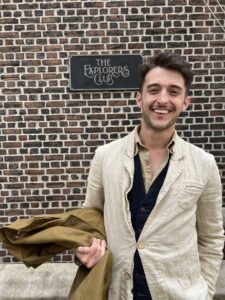
Braxton Fuller in front of an Explorer's Club sign
Life and Work in the Amazon
Within weeks, Braxton found himself traveling upriver by boat from the city of Iquitos. “We sailed for four days,” he said. “I couldn’t believe it. We were in a boat in the middle of the Amazon.”
The Tree Foundation operates in Maijuna territory, a region slightly larger than New Jersey and home to about 500 people across four settlements. The organization conducts canopy research while coordinating closely with local communities, medical teams, and eco-tourism organizations.
A major initiative of the Tree Foundation is to aid Indigenous people as they navigate increased traffic on the Amazon, a side effect of the Iquitos-El Estrecho Highway’s construction and it ecological impacts. Braxton’s efforts to aid that mission were different every day: helping transport supplies, setting up blood drives, and mapping canopy walkways the Maijuna tribe uses in the forest are just a few examples. From fishing with local families and navigating language barriers, each day required adaptability.
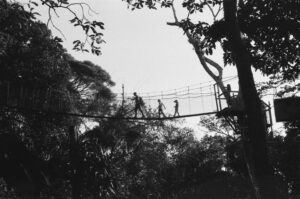
Canopy walkways in the Maijuna territory
“One of the most gratifying things happened with one family whose home I was staying at,” Braxton said. “They lived in an outdoor hut, and when it rained in the middle of the night, I woke up with the family. I helped them harvest a root for cooking, and once I was done, I noticed one of their boats was filled with rainwater. I discreetly bailed out the water so they could go into town later that day before they could stop me. It was a really gratifying moment. They paid me the kindness of letting a random guy stay in their house, and I paid them the small favor of getting them food and taking care of their boat.”
Experiences like these reinforced a key lesson Braxton will carry into his career: the importance of building genuine relationships.
Lessons in Leadership and Connection
Through his day-to-day, Braxton met humanitarian leaders from around the world. “There’s a Peruvian version of the Red Cross that we worked with to help set up the blood drives,” he said. “There are the other medical teams and the eco-tourism groups, too. There was one intern, like me, who was traveling from Duke, and we worked together a lot.”
These connections required Braxton to develop a new set of communication skills. “Caving prepared me for uncomfortable scenarios already,” Braxton said. “When you’re underground, it can get really cold and wet, and maybe you’re light on sleep. In that sort of state, a joke can really bring people together. But that’s not always appropriate when you’re working across cultures and language barriers.”
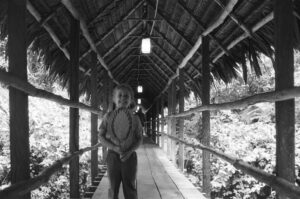
Meg taught him a different approach, but one that still built on his strengths. “I’m naturally good at being cheery and cooperative when things are hard. If you can make somebody laugh, you can make somebody feel that you’re having a genuine conversation with them, then you’ve done most of the work. Meg helped me tailor that for the international, humanitarian work we were doing together.”
Carrying the Amazon’s Lessons into a Global Career
Now nearing graduation, Braxton is exploring the next steps that build on his interests in communication, fieldwork, and global service. While his path may not be linear, his time in the Amazon has already shaped how he approaches both challenges and opportunities.
And, of course, it delivered on a lifelong expectation.
“I guess my whole life I have thought one day I’d see the Amazon,” he said. “But actually sticking my hand in the Amazon River was pretty crazy.”
To learn more about the Maijuna People and humanitarian interventions, read Braxton’s article with the Tree Foundation here.

The Josef Korbel School of Global and Public Affairs is proud to announce that Professor Deborah Avant has been recognized with the Distinguished Scholar Award by the International Studies Association’s International Security Studies Section (ISSS) and Interdisciplinary Studies Section (IDSS). This prestigious honor, awarded by an interdisciplinary community of scholars dedicated to addressing pressing global issues, recognizes her outstanding research, leadership, and influence in the field of international security.
Professor Avant is the Sié Chéou-Kang Chair and Distinguished University Professor at Korbel, where she is widely known for her expertise in global governance, security studies, and civil–military relations. As the award demonstrates, Professor Avant has built a truly exceptional career as a scholar, educator, and leader whose work has shaped how scholars and policymakers alike think about security and governance.
In the 2000s, Professor Avant broke new ground by studying private military and security companies and the prominent role they played in the U.S.-led wars in Iraq and Afghanistan. Her 2005 book The Market for Force: The Consequences of Privatizing Security earned widespread acclaim for exposing how outsourcing military power transforms conflict and global politics. Her analysis highlighted regulatory gaps and democratic risks.
In 2007, Avant testified before the U.S. Congress on the extensive role of private contractors to train Iraqi Security Forces, solidifying her reputation as a scholar whose research transcends the academy to shape strategic and impactful change. As the role of private military and security actors grew in scope and scale, her research and advocacy evolved in tandem, with Avant advancing pragmatic approaches to governance and accountability. For this pioneering work, she was later awarded an honorary doctorate by the University of St. Gallen.
"Through her distinguished career, the hallmark of Deborah's scholarship has been a remarkably broad-ranging intellect and an unusual comfort with complexity. Those attributes have made her work a model of engaged scholarship that seeks not only to understand an issue but also to inform those who would address it."
Frederick “Fritz” Mayer, Dean and Professor, Josef Korbel School of Global and Public Affairs
In 2011, Professor Avant became the Sié Chéou-Kang Chair and inaugural faculty director of the Korbel School’s Sié Chéou-Kang Center for International Security and Diplomacy (Sié Center). Under her leadership, the Center grew rapidly, welcoming new faculty, launching multiple initiatives, and becoming a model for engaged scholarship on security, peace, and governance. She built multidisciplinary programs and partnerships that brought together faculty and students on policy-relevant research projects.
Among other accomplishments, she and a team of faculty at the Sié Center secured a $1,000,000 grant from the Carnegie Corporation of New York in 2014 to research the peacebuilding role of nonviolent, non-state actors. This project became a centerpiece of the Sié Center’s research and scholarship.
Under Avant’s leadership, the Sié Center also became the first home of the Journal of Global Security Studies (JoGSS), a new journal launched by Avant under the auspices of the International Studies Association. As the founding Editor-in-Chief from 2016–2020, Avant shaped the journal around her vision of security as an interdisciplinary field, challenging scholars to examine security in broader global and societal contexts.
In 2016, she also published an edited volume The New Power Politics (with Oliver Westerwinter) which explored transnational security networks and illustrated how governance depends on actors like NGOs, businesses, and activists, as well as states. This was followed up by Civil Action and the Dynamics of Violence (edited with Marie Berry, Erica Chenoweth, Rachel Epstein, Cullen Hendrix, Oliver Kaplan, and Timothy Sisk), which showcases research stemming from the Carnegie Corporation-supported grant and examines how citizen-led non-violent efforts in conflict zones resist, reshape, and rebuild social order amid war.
Professor Avant has also held numerous leadership roles in the scholarly community. She served as ISA President from 2022–2023, guiding the profession during a time of renewed global challenges. In 2021, the University of Denver named her a Distinguished University Professor. Her service also includes editorial and advisory board roles. Outside the academy, she regularly advises governments, NGOs, and international organizations on security and governance. Through teaching and mentorship, Professor Avant has influenced a generation of students at Korbel and beyond.
“Dr. Avant was a fantastic professional role model, mentor, and scholar. She possesses a virtually unlimited capacity for scholarly and intellectual work, has built and leveraged a diverse network of professional colleagues to the advantage and edification of those around her, and can make the most unexpected connections between intellectual threads.”
Sarah Bakhtiari, PhD, (Colonel, retired), Korbel Class of 2016
The Distinguished Scholar Award from the ISSS and IDSS is more than an award. It signals recognition by the global community of scholars and practitioners that Avant’s work has moved the needle not just within international security studies but across disciplines and into real-world policy. For Korbel, it reinforces our position as a school where cutting-edge research, high-impact teaching, and global engagement come together.
“Deborah Avant is renowned for her path-breaking work in global governance, security studies, and civil-military relations. A hallmark of her scholarship, and central to its significance, is her interdisciplinary perspective, intertwined with her commitment to grappling empirically and conceptually with political phenomena that matter. In her many disciplinary roles — like serving as the founding editor-in-chief of the Journal of Global Security Studies — she has expanded the avenues for a broader conception of “security” within our discipline, encouraging cross-disciplinary approaches and bringing underrepresented voices into the scholarly conversation.”
Naazneen Barma, Professor and Director of the Scrivner Institute of Public Policy at the Josef Korbel School of Global and Public Affairs
The impact of Professor Avant’s work can be felt in classrooms, policy forums, and in the careers of the students she mentors. Korbel will continue building on that legacy: connecting students to global security practitioners, supporting interdisciplinary research, and convening dialogue on the great issues of our time. Her influence will guide the next generation of scholars, diplomats, and public leaders.
In Instructor Carla Canales’ Cultural Diplomacy class, students don’t just study diplomacy. They practice it.
Students learn about diplomacy from a world-renowned practitioner and create program proposals with budgets and full implementation plans. They leave not only with an understanding of the field but also a project portfolio, connections, and the confidence to start careers in diplomacy.
The course is offered through the Sié Chéou-Kang Center for International Security and Diplomacy’s Cultural Diplomacy Initiative, funded by a gift from the Bonfils Stanton Foundation. It is an intensive, 8-to-10 day class in the middle of the Spring Quarter, open to current Korbel students and influential community members. Together, Instructor Canales packages theory, practice, and networking into one experience.
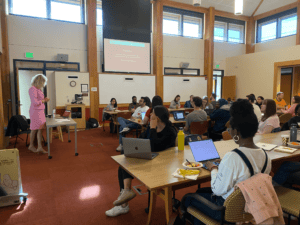
The Cultural Diplomacy class meets in the Sie complex
A Practitioner’s Perspective
To kick off her course, Instructor Canales pulls from her wealth of experience doing cultural diplomacy programming for 20 years. She was initially trained as a classical opera singer, and her passion for entrepreneurship eventually led her to work as an arts envoy for the State Department. She served the Biden Administration at the National Endowment for the Arts and later at the President’s Committee on the Arts and Humanities, as Senior Advisor and Envoy for Cultural Exchange. Through collaboration with the Biden-Harris White House and other institutions, she promoted the arts and humanities as bridges to foster dialogue, connection, empathy, and change-making.
“There are three key components to the class,” Instructor Canales shared. “The first pillar is looking at definitions, looking at the theoretical. Let’s define culture.”
She goes on to explain how essential this is for diplomats. “When a politician or diplomat gets in front of a group, the audience senses that the speaker wants something. When an artist gets in front of a group, we expect them to give us something. They’re going to share a piece of their heart. The superpower of this class, and of cultural diplomacy, is learning how to make those work together.”
For the second pillar, students look at case studies, analyze historical and global examples of cultural diplomacy, and explore successful programs and lessons learned. This middle component helps put cultural programs in context, which is an important prerequisite for understanding diplomacy’s modern landscape.
“The third pillar,” Instructor Canales said, “is to look at current events and the future. Let’s look at modern technology, like AI, which is such a game-changer. Let’s understand the global ecosystem. Then, we can learn how to intervene and make a meaningful difference.”
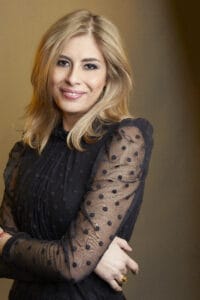
Instructor Carla Canales
Creating Programs in Community
The small, collaborative nature of the course is intentional. In past quarters, Instructor Canales has opened it to the public, allowing students to work directly with community members already well into their careers.
“Last year, we had high-level local art leaders,” Instructor Canales said. “These are people whom I consider my peers. They audit the class, and students get to work alongside them. That’s a huge networking opportunity.”
Instead of a final paper or an exam, students create a cultural diplomacy program in groups with industry leaders. “They’re given a very specific simulation,” Instructor Canales said. “That simulation includes a challenge in the real world that they can help solve. My goal is for every student’s solution to be an actionable program. They work with their group and make a PowerPoint with a spreadsheet, a budget, and projects that could be put into place and implemented the next day.”
The exercise pushes students to think beyond theory and toward real-world solutions they can carry into their careers, without sacrificing understanding of theory. “Denver is the perfect place for this sort of work,” Instructor Canales shared. “I spend a lot of time going back and forth between Cambridge and D.C., but it’s critical for folks in the Beltway to still have their ears to the ground with what’s going on in other parts of the country. Korbel gives you that distance and perspective, and I look forward to teaching here every year.”
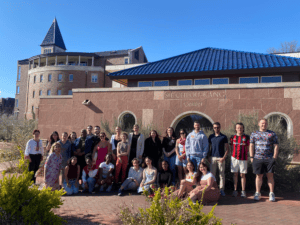
The Cultural Diplomacy Class meets outside the Sie complex
Rethinking Culture’s Role in Global Affairs
For students interested in diplomacy, international development, or global cultural exchange, the course offers a rare chance to test ideas in a practical setting while learning from seasoned professionals.
Instructor Canales hopes students leave with the confidence to act. “If you're looking to learn how to do this work in under a week, this is the course for you,” she said. “You'll come away with a full understanding of how to do cultural diplomacy.”
Read more about Instructor Carla Canales’ career here, and dive more into the Sié Center’s programming here.
The Josef Korbel School of Global and Public Affairs is proud to announce that it has joined the Network of Schools of Public Policy, Affairs, and Administration (NASPAA), a global association dedicated to advancing excellence in public service education.
For the Korbel School, NASPAA membership strengthens our connection to an international community focused on educating the next generation of public service leaders. Students will benefit from expanded opportunities to engage with peers from around the world through initiatives such as the Global Student Simulation Competition, as well as increased visibility within a network of leading public service institutions.
Membership also connects Korbel faculty and programs to a community dedicated to innovation in teaching, curriculum design, and professional development. By participating in this global network, the Korbel School continues to enhance opportunities for students to access career pathways, academic resources, and professional communities shaping the future of public policy and public affairs.
Joining the Network of Schools of Public Policy, Affairs, and Administration reflects the Korbel School’s ongoing commitment to preparing graduates with the analytical skills, global perspective, and practical understanding needed to serve communities and institutions around the world.
The Network of Schools of Public Policy, Affairs, and Administration is a nonprofit membership association representing more than 300 institutional members across 28 countries and serving more than 25,000 students worldwide. Through its global network, NASPAA brings together leading schools committed to preparing students for careers in public service, public policy, and public affairs.
Learn more about the Network of Schools of Public Policy, Affairs, and Administration:
https://www.naspaa.org/
As an undergraduate student, declaring a major is not always easy. Narrowing down career aspirations into one subject matter can feel overwhelming without the proper support. It’s no surprise that many students start college undeclared.
Lila Ash, a current sophomore and double major in International Studies and Criminology, was one of these students. She moved from Philadelphia and started college without declaring a major, but over the course of her first year, she took advantage of the Korbel School’s diverse class roster and flexibility to craft her ideal degree program.
Lila recently shared her journey from undecided to double major who studies abroad, hoping to help other students who are just starting their degrees.
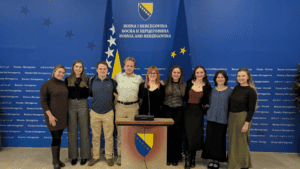
Lila Ash (pictured in the center) poses with her study abroad group on their trip to the Balkans.
Lila: Mountains. Nature. Access to the outdoors. I love Philly, but there wasn’t anything similar back home. DU’s study abroad program appealed to me, too, so all of the above made it a really easy decision to move out here.
Lila: I always knew I wanted to go to college because a lot of the jobs I was interested in required a bachelor’s degree. Criminology has always been an interest of mine, so I looked at schools with criminology programs. I waited to declare a major, though, because I wasn’t 100% positive that was my only path. I’ve also always been interested in politics and sociology. I’m curious how people interact with each other and with systems, especially with global politics.
Lila: I was looking at the class roster to register and saw a Global Politics course at Korbel. I was already interested in politics and global affairs, so it was the perfect class for me. I had a really great professor, and the class was amazing. I realized I have a genuine interest in this, and from there, I started learning more about Korbel and its programs.
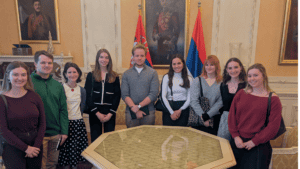
The undergraduate study abroad visits a government building
Lila: Professor Keith Gehring. It wasn’t until my first Spring Quarter that I declared my major in International Studies, and that was because of him. He's a fantastic professor and a great instructor, and he really pushed me to make that final step. He helped me realize just how valuable an experience at Korbel could be.
Lila: It's a lot more flexible than a lot of people think. A lot of people at Korbel have a very specific goal, and it's easy to feel intimidated. There are people ready to go to law school or to go into government work, but those aren’t the only paths. The degree is a lot more flexible. You can make it your own. Personally, I don't want to work for the government or become a foreign services officer, but the classes are still very relevant and interesting. It’s very easy to see how they’ll help my career, even if I don’t have my path 100% figured out yet. I think my experience is pretty common here, too.
Lila: There are lots of driven, dedicated people here, especially since there are lots of people here who have a specific career goal in mind. Other students help me stay on track and keep in mind why I'm doing this. It's a really great support system. Everybody's motivating themselves to be the best and most involved students they can be.
Lila: I’m still very interested in Criminology and Global Politics, so seeing how those two things overlap has been really helpful. After starting in International Studies, I looked back on my interests and realized that I was always interested in extremist behavior. Korbel helped me realize I want to pursue a career in counter-extremism through a non-profit or non-government agency.
Lila: Thankfully, there are lots of programs here that complement the International Studies degree. Criminology is one of them, as it’s sort of designed to be a double major. With the support of Korbel and different advisors in my programs, you really have all the support you need.
Lila: That was one of my main draws. They’re everywhere. This past Winter Interterm, I was in the Balkans: Serbia, Bosnia, and Croatia. We met with a lot of important figures and officials within those countries. There were some great reporters we met in Serbia who were discussing their work. We met with a bunch of different ambassadors and former ambassadors, as well as a representative at the Office of the High Representative in Bosnia. I met and learned from a lot of really important figures. If I’d gone to school anywhere else, I think I would’ve missed out. It feels unique to Korbel and its connections. Professor Gehring led that trip, and he made the whole experience possible. I’m already planning on more study abroad trips, I’m just not sure which ones yet.
Lila: If you have any kind of interest in politics or policy, whether domestic or on a grater scale, there is a place for you here. There's so much you can do with it. You have the five different concentrations, and there's a ton of different electives and courses. A lot of them can focus on global affairs or particular topics, like this terrorism class I’m taking right now that is super fascinating. As someone interested in counter-extremism, there's a wide range and a lot of depth to the major. Even though you may feel intimidated by the people who get all these fellowships and already know their careers, it doesn’t feel overwhelming or exclusionary once you’re here. There is a place for everybody in this major.
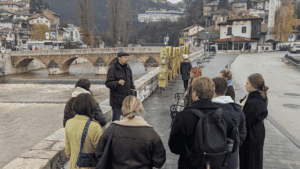
Undergraduate students go on a tour on their study abroad trip in the Balkans
The Korbel School offers two undergraduate majors and minors, International Studies and Public Policy, designed to give students the flexibility, global perspective, and hands-on experience to start impactful careers. With customizable concentrations, immersive study abroad opportunities, and close faculty mentorship, Korbel empowers students to shape a degree that aligns with their goals, even if those goals are still evolving.
Learn more about our degrees, concentrations, and certificates here, and contact our admissions team at [email protected] with any questions. Curious what a Korbel study abroad experience really looks like? Read one student’s firsthand perspective on the Balkans trip and see how learning extends far beyond the classroom.
This reflection was written by Maddison Schink (MA, International Studies, 2027).
Over the University of Denver’s unique winter interterm, I spent nearly two weeks with Dr. Tamra Pearson d’Estree, a Korbel professor of conflict resolution, and a group of my peers in the Netherlands for a course on climate resilience and governance.
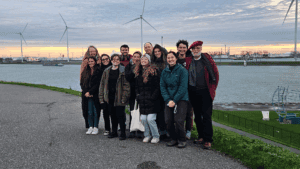
A group photo of participants in the Netherlands trip
Our group represented both first- and second-year students across Korbel’s graduate programs, from Global Environmental Sustainability to International Security and Global Economic Affairs, so a diversity of perspectives emerged and fostered deep questions during our site visits and rich conversations on the bus or over lunch. I am pursuing an M.A. in International Studies with a specialization in Environmental Conflict Resolution, so the part of the course that I found most interesting was visiting the House of Representatives and hearing about the Dutch polder model of governance, which is consensus-based and founded on ensuring that every party has a say in shaping the final decision. Considering the Netherlands’ long history of collectively contending with water, we realized the potential to draw upon their expertise to develop solutions to the international community’s growing challenges in the face of climate change.
For context, two of the Netherlands' top priorities are managing rising sea levels and shifting weather patterns that can result in inundation or drought. The country is a delta with many rivers, and much of the nation is below sea level. To help mitigate the dangers, the Netherlands has been engaging in centuries of land reclamation by using iconic windmills, which are now largely modern electric pumping stations that drain water and create arable plots of land called polders. Today, polders comprise around 20% of the country’s landmass.

The class explores renewable energy infrastructure
Throughout our travels, we repeatedly heard a phrase that summarizes the Dutch pride in their transformation efforts – God created the world, but the Dutch created the Netherlands. Without the Dutch people’s ongoing commitment to collaboration through the formation and cooperation of democratic regional water boards around the year 1200, the building of their nation would not have been possible.
Professor d’Estree arranged for us to visit four different cities throughout the country: Amsterdam, The Hague, Delft, and Groningen. Each location presented us with an opportunity to see firsthand the variety of old and new technologies that the Dutch are adapting — from dikes to giant moving storm surge barriers — to keep themselves safe from flooding. However, as leaders in engineering and spatial planning shared with us, infrastructure alone is not enough to keep everyone’s feet dry. The Dutch meaningfully involve the public in building community resilience and co-creating policies that will more equitably serve the Dutch people across rural and urban landscapes.
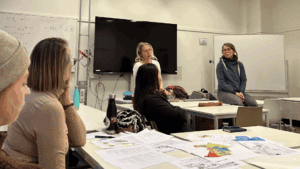
The class learns about community resilience and policy co-creation
In between lectures from local university professors and private tours to learn about the design and implementation of climate adaptation strategies, we enjoyed several festive Christmas markets, group coffee breaks to fuel us through lingering jet lag and writing our assigned journal reflections, scenic public transit adventures (I only nearly missed our train stop once!), and Dutch cuisine served on beautiful white and blue Royal Delft pottery at a traditional brown café.
We ended our time in the Netherlands reflecting on how we might carry what we learned into our continued studies at Korbel and our future careers. Growing up in Colorado and working at a nonprofit dedicated to convening diverse stakeholders around controversial environmental issues has shaped how I approach questions of governance and collaboration. In my final course paper, I am inspired to explore how elements of the Netherlands’ consensus-based approach to water governance, along with its emphasis on public engagement and education, might translate to an issue close to home: the complex and increasingly urgent renegotiation of the Colorado River Compact. Ultimately, this international travel course fulfilled its purpose by challenging Korbel students to think beyond borders and imagine new ways to address some of the most pressing global challenges, including climate change.
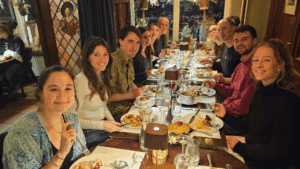
A group photo at dinner of participants in the Netherlands trip
At a moment when career trajectories in Washington, D.C. are shifting rapidly, students at the Josef Korbel School of Global and Public Affairs are demonstrating a renewed eagerness to understand and enter the nation’s government and policy hub. This fall, record-high interest in the school’s D.C. Career Connections trip brought 28 Korbel graduate students to the capital for four days of intensive career exploration.
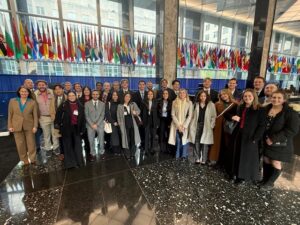
Participants in the D.C. Career Connections trip take a group photo
The D.C. Career Connections program centers on networking, informational interviews, and direct exposure to career paths that Korbel alumni have forged across government, multilateral institutions, think tanks, and the private sector. Through the opportunity to explore various careers and build connections during the trip, many alumni trace elements of their career growth — and the networks that enabled it — back to this formative experience.
“I got my first job in D.C. as a result of the Career Connections trip. Twenty years later, I am still thriving and having impact in the international relations and security space. So grateful to DU for setting me up for success!” said a 2004 graduate and alumni panelist (who wished to remain anonymous due to the nature of their position).
It's no surprise that Korbel alumni went out of their way to generously engage with students. In fact, over 70 alumni volunteered their time this year. Students participated in five group site visits and alumni-led panels, beginning with a visit to the U.S. Department of State, where alumni across the Department shared insights on diplomacy, policy analysis, and public service.
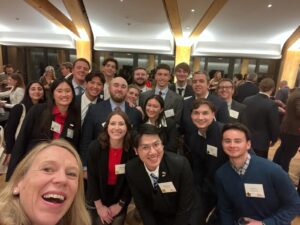
Alumni and current students take a group photo
Korbel alum Michael James, who has worked at the U.S. Department of State since 2008 and has participated in the trip almost every year, shared, “I've always seen it as an opportunity to pass along the advice that helped me grow in my career, especially as I was starting out fresh in the D.C. world. As I overcame challenges in new roles with more responsibilities, I could provide even more lessons learned for new students. Each year, I return to my desk smiling from a mix of nostalgia and gratitude.”
Another panel, hosted by Silverado Policy Accelerator, convened Korbel graduates working in think tanks, research institutions, and policy innovation organizations. Additional sessions at the World Bank (on U.S. defense and government career paths) and a panel of alumni in the private sector spotlighted the range of opportunities available to Korbel graduates in Washington’s many professional landscapes.
Beyond these structured engagements, students organized their own meetings with alumni, who shared their experiences getting into their positions and gave advice for students looking to land a job in D.C.
“Outside of the facilitated panels and conversations, the small conversations you have with people in D.C. really go a long way,” said Zach Odom, a Korbel student in the Global Economic Affairs. “It’s been really important for me.”
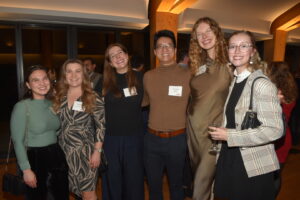
A picture taken at the D.C. holiday party
For many participants, the experience clarified the versatility of a Korbel degree. “My biggest takeaway has been realizing that a degree from Korbel applies and translates in so many different sectors and fields,” said Trevor Paulus, an International Studies student.
Others found newfound confidence in exploring professional identities across industries. Jenni Gutierrez Marquez, a Public Policy student, noted that the trip helped her think differently about “rebranding myself and really telling my story through my resume,” while Max Canfield, an International Security student, emphasized the importance of flexibility: “Just because something doesn’t seem to be in the realm of what you’re studying, don’t not pursue it.”
The impact of this alumni support extends well beyond a single week in D.C. “The time I spent there laid a foundation that benefitted me throughout the rest of my military career,” said General George Casey, retired four-star general and Korbel graduate (’80), reflecting on how his Korbel education shaped his service in Bosnia, Iraq, and Kosovo.
More recent graduates describe similar long-term benefits. “D.C. Career Connections helped establish a really firm network,” said Matthew Barrett, who graduated in 2023 and now works for the U.S. Department of the Navy. “There are people I still talk to and still see at Korbel events to this day.”
Some alumni have even returned to the program from the other side of the table. “I was a part of this trip two years ago,” said Shailyn Lineberry, a recent Korbel graduate from the class of 2024, now with Silverado Policy Accelerator. “It’s highly likely I wouldn’t have a full-time role without this fellowship and without this career connections trip.”
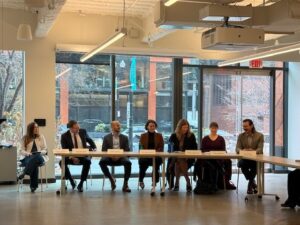
One of many panels on the trip
For this year’s cohort, the experience deepened both professional aspirations and confidence. “Don’t be afraid to ask for help,” said Gillian Dunn, a Korbel International Security student. “People are more willing to help us than we think.”
Public Policy student Banky Inthalucksa agreed: “If you hesitate to come, do not hesitate. Just come enjoy, and you will discover yourself.”
And as another Public Policy candidate, Brylee Grubb Erwin, summed up, “Our alumni have been super kind and willing to give in any way possible. I’m so happy to continue the relationships we’ve built.”
To see the trip through a student lens, explore the highlights captured by graduate student Brylee on our Instagram Story. Questions about D.C. Career Connections? Contact the Office of Career and Professional Development at [email protected].
Bridging the Gap (BTG) is a cornerstone of the Korbel School’s commitment to shaping impactful global leaders. Co-founded in 2005 by now Professor and Director of the Scrivner Institute Naazneen Barma, BTG was created to do exactly what its name promises: connect scholars and emerging practitioners to the policymaking world, ensuring their passion for international affairs can translate into careers with impact.
That mission is what first drew Catherine Carolan (BA, International Studies and Spanish, 2026) into the BTG orbit. Before she ever arrived on DU’s campus, Catherine knew she wanted a future in international affairs, but like many undergraduate students, she wasn’t yet sure what that future looked like.
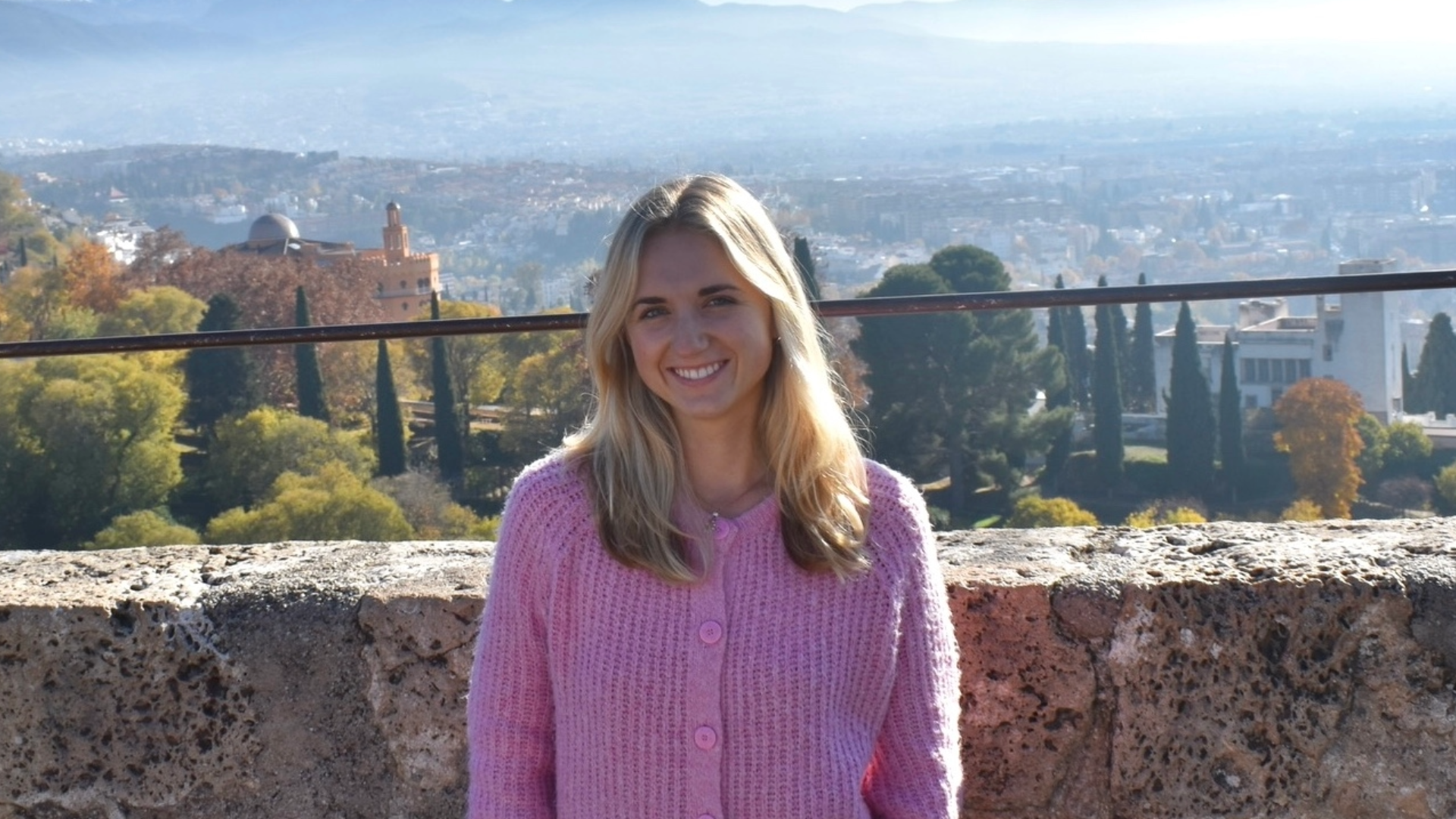
Current student Catherine Carolan
“The International Studies program really interested me. So I knew I wanted to start at Korbel. I wasn’t exactly sure what my career path would look like, so I started school with an open mind when I moved to Denver from Connecticut.” - Catherine Carolan
BTG’s undergraduate initiative, the Foundations of International Relations Studies & Training (FIRST) program, became her entry point into a community that not only fuels students’ curiosity about the world but also helps them imagine how they can shape it.
For Catherine, participating in FIRST offered clarity and possibility. It helped her see pathways she didn’t know existed and made a career in international studies feel both tangible and exciting. Catherine’s journey is one of many shaped by BTG’s mission, a mission that began years earlier when Professor Naazneen Barma and her colleagues set out to reimagine how scholars engage with the world.
As a student, Professor Barma imagined a career in engaged policy work. As a PhD candidate, she co-founded BTG to develop those skills and opportunities in her peers.
“Bridging the Gap is a labor of love,” Professor Barma shared. “A lot of people who work in international affairs enter the discipline because they want to make the world a better place. The whole goal of Bridging the Gap is to connect scholars with the policymaking and public spheres so they can share their work with the world.”

Professor Barma (far right) celebrates BTG's 20th anniversary
In the post–9/11 academic climate, when many international affairs scholars were urged to continue focusing on theory, Professor Barma and her co-founders believed that scholarship should inform the world beyond academia. That conviction remains the core of BTG’s mission today. While Bridging the Gap started at the University of California, Berkeley, it has since expanded to have multiple homes at universities across the nation, with one primary hub alongside Professor Barma at the Korbel School. At Korbel, the program’s Associate Director, Megan Lyons, helps shape its day-to-day work.
“We train PhD students and faculty to translate research into public communication,” Megan said. “And the FIRST program guides undergraduates toward international careers that might otherwise feel inaccessible.”
While the program focuses on building communication and networking skills for scholars, it’s also a vital support system for undergraduates starting out in the field. FIRST is BTG’s program that helps students see international affairs not as an abstract idea, but as a viable, rewarding career path.
When Catherine was introduced to the program, she immediately applied to take part. “At that point in college,” she shared, “I already loved international studies. I’ve always been passionate about learning how different countries work with each other, and also the conflict side of things. But when people asked me what I wanted to do with an International Studies degree, I had no idea. I just liked the classes. FIRST seemed like my chance to form a more concrete plan.”
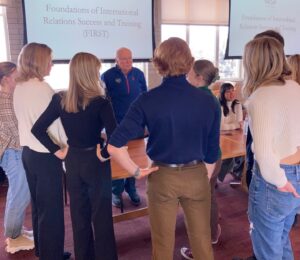
Students participate in the FIRST program
“The goal of FIRST is to help people who are just coming into our discipline and into our world of international affairs. It’s to help them imagine the possibilities for their careers and future education.” - Professor and Director of the Scrivner Institute Naazneen Barma
In Catherine’s sophomore year, Professor Debak Das hosted Korbel’s FIRST workshop at MSU Denver, aiming to bring in students from DU and minority-serving institutions. Over two days, students picked up the essentials in an introductory international affairs course and then applied those lessons in a hands-on simulation. Catherine remembers debating strategy in two case studies, one involving India, Pakistan, and China, and another centered on Russia and Ukraine. The exercise allowed students to navigate the complex realities of global politics, and the workshop concluded with a panel of six international studies professionals who showed what those skills look like in real careers.
“Everyone on the panel had the coolest jobs,” Catherine said. “One was a water lawyer and another a former diplomat. Hearing their paths was inspiring, and it helped me see my own. Since then, I’ve completed two internships in immigration law, and now I know I want to pursue law.”
Catherine shared that after the FIRST workshop, she connected with alumni on LinkedIn and built genuine relationships that furthered her career. “I got a lot of attention on my LinkedIn post about FIRST, and that turned into Zoom calls with them. In my sophomore year, that made me feel really confident in my degree. Now, I have the connections I need to feel confident starting my career in law.”
This year has marked a turning point for the entire Bridging the Gap team. Over the summer, they celebrated the program’s 20th anniversary, bringing alumni and participants together in Washington, D.C., to honor two decades of impact across BTG’s many university homes.
Building on the momentum of its 20th anniversary, BTG also received a significant new investment: another Carnegie Corporation of New York grant totaling one million dollars.
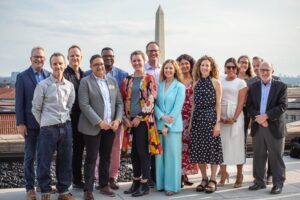
A group picture from BTG's 20th anniversary celebration
“It’s a really exciting time. The grant is for a two-year period, and it’s challenging us to think about BTG’s future, more broadly. What else can we do? We’re in a very interesting moment, and there are so many ways for us to leverage our network.” - Megan Lyons, Associate Director of Bridging the Gap
Though BTG is a multi-university initiative, establishing one home at the Korbel School was strategic. “It was a seamless transition for Bridging the Gap to find its home here in Denver,” Professor Barma said. “There are real benefits to being in Colorado and not in the Beltway. We have this opportunity to think from afar, and how we can best engage in the policy world.”
For Professor Barma, bridging academia and policy has never been optional. It’s the purpose of her work, and Korbel, with its tight-knit community, interdisciplinary orientation, and emphasis on engagement, is the right place to nurture that mission.
“We’ve historically engaged what you might call ‘elite’ policymakers with our Bridging the Gap work,” Professor Barma said. “We’d like to shift to reach the public, too, and Colorado is a great place for that. It’s an incredibly innovative policy space, and an exciting place to test out new initiatives.”
As BTG looks ahead, its home in Colorado positions the program to chart an ambitious next chapter. Rooted in Korbel’s culture of collaboration and innovation, BTG is poised to expand its reach, deepen its impact, and pave the way for the next 20 years of bridging scholarship and policy.
Professor Barma didn’t expect a bottom-up idea that she launched in graduate school would become a national network with hundreds of alumni. But through vision, persistence, and the support of institutions like Korbel and the Carnegie Corporation of New York, Bridging the Gap has become a meaningful engine connecting scholarship to practice.
And with FIRST, that engine is now sparking the ambitions of undergraduate students, helping them build networks, explore policy problems, and imagine themselves in global careers. As Catherine put it: “You don’t have to know everything about the world to be successful. It’s about finding your passion and making those connections to make your dream a reality.”
Read more about Professor Barma’s founding of BTG here. You can also learn more about the BTG program here.
Copyright ©2026 University of Denver | All rights reserved | The University of Denver is an equal opportunity institution