
Join us for Open House on November 13, 2026. Register now.

Menu

Menu
Join us for Open House on November 13, 2026. Register now.
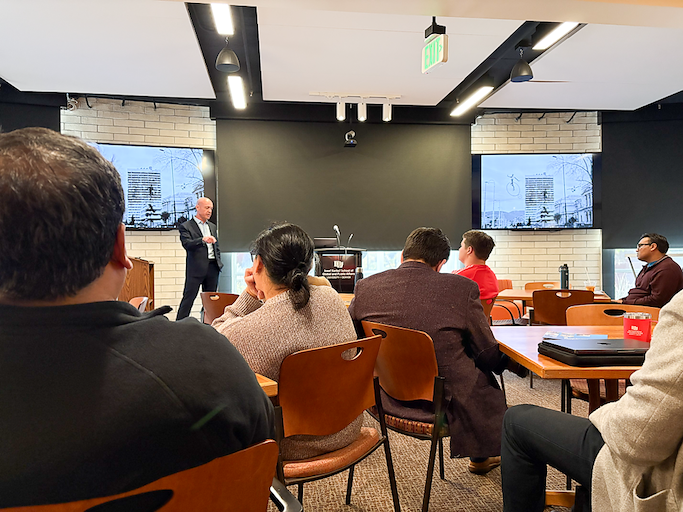
At the DU Faculty Fulbright Series event “Teaching in Serbia”, Keith Gehring described five months spent teaching policy strategy in Belgrade while his students were actively contesting their country’s direction. As a Fulbright scholar at the University of Belgrade’s Faculty of Political Sciences, he asked them to use International Futures (IFs), Pardee’s open-source, integrated assessment model, to look past the protests to a harder question: If their movement succeeded, what Serbia would they inherit?
Gehring is a teaching associate professor at the University of Denver’s Josef Korbel School of Global and Public Affairs and a faculty affiliate of the Pardee Institute for International Futures.
From a research question to a student movement
Gehring explained that his Fulbright proposal, “Serbia at the Crossroads: Modeling Political and Economic Futures,” submitted in September 2024, grew from a question he had pursued for years: How could Serbia’s educated, politically engaged population coexist with persistent corruption and weak government effectiveness?
About six weeks later, a railway station canopy collapsed in Novi Sad, killing 16 people. The tragedy sparked a student-led movement demanding government accountability. During his Fulbright interview, he recalled, embassy interviewers told him, “we wish you were here right now.” By the time he arrived in March 2026, students had occupied university buildings and mass demonstrations had filled Belgrade’s streets. His own classroom had recently housed students during the blockades.
"What if you win?”
When students doubted that political change would come, Gehring asked them, “what if you win?” Using IFs, they examined the economic, demographic, and political challenges a new government would face, and how it might choose among competing priorities.
Demography made those choices tangible. Students understood their country’s politics, Gehring said, but seeing the potential scale of population decline brought new pressures into focus. A smaller, younger generation would have to support an aging population, which raised questions about public spending and about sustaining opportunities for young people. Governance presented a different kind of challenge. Students could model stronger institutions, but Gehring noted that political change alone would not remove entrenched corruption. Building effective institutions would take sustained work. The classroom discussions weighed students’ ambitions against those structural realities, with decisions that reach beyond the next three to five years to the next 30 to 50.
An electoral breakthrough, with questions still open
By the time of his Fulbright Series talk, the movement had achieved an electoral breakthrough. In Gehring’s account, the student-backed list won roughly 140 of 250 seats in Serbia’s assembly. He expressed admiration for the movement and noted that questions about its governing priorities and cohesion remain open.
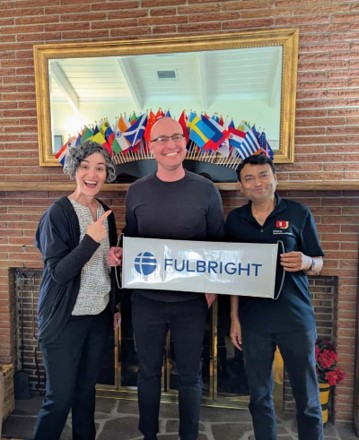
Gehring closed by encouraging faculty, students, and administrators in attendance to consider Fulbright opportunities.
During a five-month Fulbright residency in Belgrade, Keith Gehring worked with students to examine how Serbia’s policy choices could shape its future, using International Futures (IFs).
Gehring, a teaching associate professor at the University of Denver's Josef Korbel School of Global and Public Affairs and a faculty affiliate of the Pardee Institute for International Futures, spent his Fulbright residency at the University of Belgrade's Faculty of Political Science. His project, "Serbia at the Crossroads," brought him together with resident academics, students, and members of the wider community to examine Serbia's political landscape: how a society shaped by conflict approaches governance, and which alternative futures remain open to it.
The interest runs deep. Gehring first traveled to the region years ago, and it stayed with him. "The world moved on, and I never did," he told DU News before his departure.
Forecasting as a way into the conversation
IFs, Pardee's open-source, integrated forecasting platform, loomed large in Gehring’s teachings. IFs connects demographics, economics, education, governance, energy, and other systems for 188 countries, allowing students to examine how a change in one area carries through to the others over time. In the classroom, students used IFs to examine assumptions about their own country, build scenarios, and trace plausible pathways.
During one lesson, a student modeled a Serbia that prioritized security as regional threats rose, shifting investment away from research and economic development. In that scenario, slower economic growth eventually constrained the country’s capacity to sustain its security spending. The exercise gave students a concrete trade-off to examine how an immediate response to insecurity could affect the resources available for security over time.
Beyond the classroom
Gehring also came to know Serbia outside the lecture hall. In the first video of a Korbel series from his time abroad, he speaks with a Serbian resident about culture, politics, and daily life today. In another installment, he walks through Belgrade's graffiti and street art, where cultural identity, political expression, and the city's history sit in plain view on its walls.
Those encounters connect back to Gehring’s forecasting work, grounded in historical data and stated assumptions. Conversations with the people who live with a country's choices help anchor assumptions and directions in lived experience.
What comes next
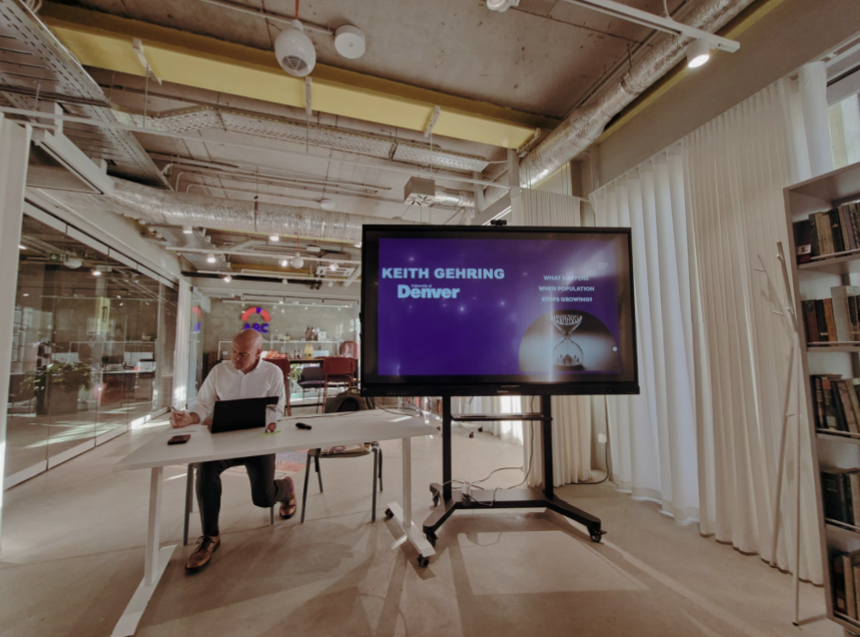
During his residency, Gehring taught IFs workshops and delivered curriculum at the University of Belgrade. Other academic units have since asked him to present, and he will lead those sessions when he returns to Belgrade in November.
Copyright ©2026 University of Denver | All rights reserved | The University of Denver is an equal opportunity institution