
There's still time to apply! Accepting applications for Fall 2026 with scholarship support available. Apply now!

Menu

Menu
There's still time to apply! Accepting applications for Fall 2026 with scholarship support available. Apply now!
Hughes, Barry B., Randall Kuhn, Cecilia M. Peterson, Dale S. Rothman, and José R. Solórzano. 2011.
“Projections of Global Health Outcomes from 2005 to 2060 Using the International Futures Integrated Forecasting Model.” Bulletin of the World Health Organization 89 (7): 478–86.
UNICEF. (2022). "Prospects for Children in 2022: A Global Outlook." Office of Global Insight and Policy, UNICEF.
Our 2022 outlook draws on the reflections and analysis of staff from
UNICEF’s Global Insight team, supported by the Atlantic Council and the Pardee Center for International Futures, two organizations with long track records and formidable reputations in risk analysis and foresight. Jointly, we revisited the longer-term trends examined in ‘Prospects for children’, identified those that we considered to be most relevant for children in 2022, and highlighted new trends or events to be brought to the attention of our readership. Our initial findings were debated and refined during a virtual consultation held with 18 experts, leaders and young activists from around the world on 16 November 2021.
The resulting analysis is organized around ten trends (Figure 1). Annual trends, such as the ten highlighted in this report, are inevitably highly interconnected. They emerge, in part, from megatrends such as
demographics, climate change, biodiversity loss and rapid technological changes, which will shape the world in which children live over the course of the next 30 to 50 years.
Hughes, Barry B. 2011. "Use of International Futures (IFs) on an Apple Macintosh." Working paper 2011.01.05. Pardee Center for International Futures, Josef Korbel School of Global and Public Affairs, University of Denver, Denver, CO.
Höhn, Karl Hermann. 2011. “Geopolitics and the Measurement of National Power.” PhD dissertation, University of Hamburg.
Gordon, Theodore, Barry B. Hughes, José R. Solórzano, and Mark Stelzner. 2011. “Producing State of the Future Indexes Using the International Futures Model.” Technological Forecasting and Social Change 78 (1): 75–89.
Roy Pearson. 2011. “Using the International Futures Global Modeling System (IFs) for Alternative Scenarios by the Numbers.” Foresight: The International Journal of Applied Forecasting, no. 22: 13–19.
Hughes, Barry B., Jonathan D. Moyer, and Timothy D. Sisk. 2011. “Vulnerability to Intrastate Conflict: Evaluating Quantitative Measures.” Peaceworks No. 72. United States Institute of Peace, Washington, DC.
Hughes, B.B, Irfan, M.T., Khan, H., Kumar, K.B., Rothman, D.S. (2015). Reducing global poverty: Forecasting the next 50 years (Patterns of potential human progress volume 1). Routledge.
The ambitious Patterns of Potential Human Progress series was inspired by the United Nations Human Development Reports, the United Nations Millennium Development Goals (MDGs), and other initiatives to improve the global human condition. The foundational element of those initiatives, reducing poverty worldwide, is the focus of this book, the first volume in the PPHP series.
Reducing Global Poverty uses a large-scale computer program called International Futures (IFs), developed over three decades and based and the Frederick S. Pardee Center for International Futures within the Josef Korbel School of Global and Public Affairs at the University of Denver. The book presents the most extensive set of forecasts of global and country-level poverty ever made, providing and exploring a massive multi-issue database and a wide range of scenarios. The forecasts are long term, looking 50 years into the future, thereby anticipating the need of the global community to think well beyond the MDGs.
Additional Resources:
Base Case End Tables Using IFs Version 7.02
Base Case End Tables
Alternate Scenario 1 End Tables Using IFs Version 7.02
Poverty Combined Domestic Interventions
Alternate Scenario 2 End Tables Using IFs Version 7.02
Poverty Combined International Interventions
Alternate Scenario 3 End Tables Using IFs Version 7.02
Poverty Combined Domestic and International Interventions
Summary Scenario Annotations, All PPHP Volumes
PPHP Summary Scenario Annotations
Detailed Scenario Annotations, All PPHP Volumes
PPHP Detailed Scenario Annotations
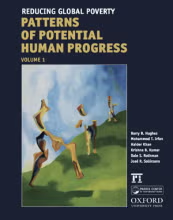
Hughes, B.H, Irfan, Mohammod, T., Khan, H., Kumar, K.B., Rothman, D.S. (2015). Reducing global poverty: Patterns of potential human progress volume 1. Routledge.
Use the 'Access Resource' link to view just the Alternate Scenario 1 End Tables Using IFs Version 7.02 for this volume. To access the full volume, visit the full volume's resource page.
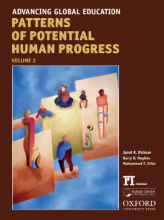
Dickson, J.R., Hughes, B.B., Irfan, M.T. (2010). Advancing global education: Forecasting the next 50 years (Patterns of potential human progress volume 2). Routledge.
Advancing Global Education is the second volume in the PPHP series. The questions it addresses are:
Additional Resources:
Base Case End Tables Using IFs 7.0.2
Base Case End Tables
Alternate Scenario End Tables Using IFs 7.0.2
Education Normative Scenario
Summary Scenario Annotations, All PPHP Volumes
PPHP Summary Scenario Annotations
Detailed Scenario Annotations, All PPHP Volumes
PPHP Detailed Scenario Annotations
Copyright ©2026 University of Denver | All rights reserved | The University of Denver is an equal opportunity institution