
There's still time to apply! Accepting applications for Fall 2026 with scholarship support available. Apply now!
Skip the wait: get your graduate admissions decision in 24 hours at Instant Decision Day, July 15. Register today.
There's still time to apply! Accepting applications for Fall 2026 with scholarship support available. Apply now!
Skip the wait: get your graduate admissions decision in 24 hours at Instant Decision Day, July 15. Register today.
Celebrating a Career of Curiosity, Mentorship, and Impact: Professor Frank Laird Retires After Nearly Four Decades at Korbel
After nearly 40 years at the Korbel School, Professor Frank Laird is retiring, closing a chapter defined by intellectual curiosity, institutional growth, and a deep commitment to students and scholarship.
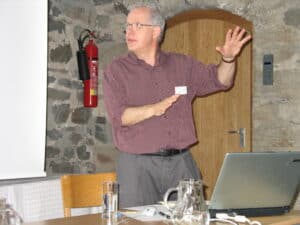
Professor Laird’s path to Denver was anything but linear. Raised in a small industrial town in Ohio, he began his academic journey studying physics at Middlebury College before continuing to graduate work at the Massachusetts Institute of Technology. Along the way, a formative year in Edinburgh and early research in astrophysics gave way to a broader set of questions about technology, society, and policy. That shift would define his career.
“I was trying to understand how big systems change,” Professor Laird reflected. “Technology was always the through line.”
That curiosity led him to political science and, eventually, to Korbel in 1987, where he would shape generations of students and scholars. At the time, the school was a fraction of its current size. Professor Laird recalls being one of roughly a dozen faculty members; today, that number has quadrupled. With that growth came not just scale but transformation.
“Both the undergrad and master’s programs have grown so much,” he noted. The Korbel School now reflects a faster-paced, professionally oriented environment, one where students arrive with ambition and depart quickly to make their mark in the world.
Throughout his tenure, Professor Laird’s early research interests on environmental policy and risk assessment evolved into historically grounded analyses of energy systems and public policy. Influenced in part by Deborah Stone’s Policy Paradox, Professor Laird developed a perspective that blended theory, history, and practice, an approach that resonated with students navigating complex global challenges.
Beyond his own scholarship, Professor Laird played a key role in building academic communities. He was a co-founder of a section within the American Political Science Association focused on science, technology, and environmental politics, helping to connect and mentor emerging scholars across the field.
In the classroom, Professor Laird found one of the most rewarding aspects of his career. “I remember one particular policy class,” he said. “We didn’t even get through a quarter of my notes. We got these discussions going, and we just roared ahead. The students were engaged, and they said interesting things. It was one of those moments where I thought, ‘Wow, this teaching stuff is really fun.’”
Professor Laird also served in leadership roles, including multiple terms as associate dean. Those experiences, while challenging, offered a valuable perspective. “I learned my strengths and weaknesses,” he reflected, emphasizing how administrative work deepened his appreciation for the complexity of running an academic institution.
As he prepares to retire, Professor Laird remains intellectually engaged. He is already working on a book manuscript on renewable energy policy and looks forward to exploring new writing projects. He envisions spending time in a local coffee shop, writing without distraction and revisiting ideas long set aside during the demands of academic life.
His advice to emerging scholars is both timely and optimistic. In an era of disruption, particularly in fields like climate and science policy, Professor Laird sees opportunity. “It’s a challenging time,” he acknowledged, “but also a chance to rethink assumptions and build something better.”
As the Korbel community celebrates his retirement, Professor Laird leaves behind not just a body of work, but a legacy of mentorship, curiosity, and thoughtful engagement with the world’s most pressing challenges. Korbel has been his home to develop those sides of himself, even as it has changed alongside him, too. “We shape institutions, but they also shape us,” he said. “I’ll always be really grateful for that.”
Copyright ©2026 University of Denver | All rights reserved | The University of Denver is an equal opportunity institution

