

Menu

Menu
Korbel Career Journey: David Fridland, Master of Public Policy 2017
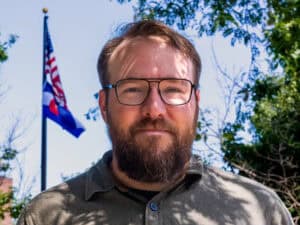
David Fridland (Master of Public Policy, 2017) moved from Memphis, Tennessee, to Colorado at age 10, and though he's tried a few times, he's never been able to leave for long. Colorado has been home ever since, and where he's built his career. What began as a summer job running a recycling education effort door-to-door in Boulder County has evolved into a sustainability career that spans the nonprofit, corporate, and public sectors. Today, he is a key member of the Environmental Sustainability team at Denver International Airport, a place he calls its own little city. He also serves as a City Councilor in Lafayette and sits on Colorado's Solid and Hazardous Waste Commission, and he's wrapping up seven years serving on the board of Recycle Colorado, two of them as president. Through all of it, he's done the same thing: kept adding tools to his tool belt, from waste diversion to corporate sustainability, climate, air permitting, hazardous waste, and more.
Tell us about yourself. Who are you, and where are you from?
I was born in Memphis, Tennessee, home of the king, Elvis. I lived there for the first 10 years of my life or so, then moved to the Boulder area with family when my father came here to manage a cancer research lab for Gilead Sciences. I’ve tried to leave Colorado a few times, but it hasn’t stuck. It keeps pulling me back. I’m not a native, but I feel like it! I’ve started to build a family here, and looking back, the economic opportunity it afforded me to grow up here, come of age here, and enter the job market here has all been a real blessing.
I do a variety of things now. I’d call myself a sustainability and environmental compliance professional. Some people call me a politician, which I don’t love as a label, but it’s certainly well-earned. I live in Lafayette and serve as a City Councilor here. I work at Denver International Airport doing sustainability and environmental compliance, and I was appointed by Gov. Polis to the State Solid and Hazardous Waste Commission. I’m also ending my term on the board of Recycle Colorado after seven years. So, I do a lot of different things.
What brought you to Korbel, and was there a professor or moment that helped shape your career?
When I first started the MPP program, it was actually part of the College of Arts, Humanities, and Social Sciences. It was the Institute for Public Policy Studies, co-led by former Governor Richard Lamm. We became part of Korbel my second year, so I was right there when it happened, and it was certainly the right fit. It let us connect with other graduate students who had similar ambitions, and it’s been nice to be part of the Korbel alumni network since.
What brought me to the program was the work I was doing for an environmental nonprofit, Eco-Cycle. I was doing a lot of municipal advocacy and city policy around waste diversion, recycling, curbside composting, and sustainability plan adoptions, plus some state policy. I liked it. Local advocacy was interesting to me, and I started looking for programs that would let me work on that interest. The MPP is what came up.
While I was there, I got to work for Governor Lamm as a research assistant, which was really unique. He really focused on how to make the lives of people in Colorado better. It was special to learn from him.
I also had a professor that I remember fondly, Dr. Lapo Salucci. At the time, if you’d asked me if he was my favorite, I probably would have said no. He was a tough grader, very energetic, and he liked to debate pretty much anything you would say. But looking back, I really appreciate his approach: he pushed me on almost every position I’d take to understand the “why” behind it. Now, on the state commission, on the city council, or advocating for multi-million dollar projects at the airport, you have to justify, you have to push, you have to be thoughtful in your evidence. He pushed me out of that easy path of just having a position because it’s what I’d heard or was conditioned to say, and pushed me to go deeper. I’m really appreciative of that. He also connected us with great local people through a week-long class around Denver Metro, and I still have some of those contacts today.
After earning your MPP, you built your career in sustainability. How do those two fit together, and where does the policy side show up most in your work?
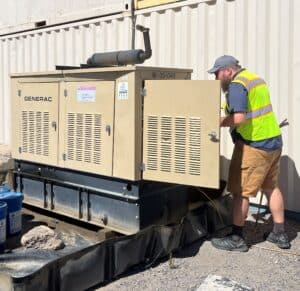
A lot of what we do in sustainability is, at its core, a form of policy work. We’re thinking about trade-offs, about what problem we’re trying to solve, and about how we bring people with us, whether at a municipal, organizational, or state level. What I learned at DU was absolutely critical to everything I do. At the airport, I strive to solve hard problems, and that is purely a matter of problem identification and then finding a pathway through it, which I learned during my time at DU.
The airport is really like a little city. We have hundreds of thousands of people coming through a day. In that ecosystem, you have to put policy and processes in place that work at scale, so it really is a policy exercise all the time. At the City of Lafayette, we’re passing local policy. On the state commission, we’re working on rulemaking and its implementation. So, I see it all the time. My path has been a little different from some of my classmates who went fully into the policy space, but what I learned at DU has been really valuable in the sustainability field.
You started your sustainability career with grassroots zero waste organizing at Eco-Cycle. What drew you to that work early on?
During undergrad, I was more focused on international politics, comparative politics, and social issues. I did an internship in DC working on solitary confinement advocacy, and another back here in Boulder with then-Congressman Jared Polis’ office. But I found the social issues hard to work on. They hurt my heart. As I graduated, I was looking for something more in the environmental space. I took some time off and was a ski bum in the mountains for a while, running a ski rental shop, which was fantastic.
When I came back, I kind of fell into the position at Eco-Cycle. They needed somebody to help run their educational canvasses door-to-door, teaching people how to recycle and compost in Boulder County. I ran that for a summer, and then I just kept saying yes to different projects. My seasonal position turned into a full-time one, and I started working on the municipal and state advocacy pieces. They gave me a lot of opportunities to learn new things and keep adding tools to my tool belt.
One thing I learned there is that sustainability is a big field. I started on the waste and recycling side, which I always tell people is kind of the red-headed stepchild of sustainability. It’s not renewable energy or water issues, the kind of big pieces of sustainability. But it’s a really special field, and once you’re in it, it’s hard to get out. People love it and stay forever. One of the folks at Eco-Cycle, Marti Masch, framed the zero waste and circularity movement as a social movement. When we use resources faster than we can replenish them, we get resource scarcity. Resource scarcity leads to conflict, and conflict leads to social strife. That helped me ground my new environmental path in the social foundation I already had.
I call recycling the gateway drug of sustainability. When you come to the waste bin, you have a decision. You can put your item in the trash or in the recycling. It gives people agency, and it helps them see that sustainability doesn’t have to be this big thing that’s too hard to make an impact on. You truly can make a difference right there by putting your aluminum can in the recycling bin. Over time, I just kept adding, from waste and recycling and composting to corporate sustainability at Eco-Products, and then at the airport I added more and more to my toolbelt.

Between the airport, the Lafayette City Council, and the State Waste Commission, you’re working on sustainability from several angles at once. How do those roles play into each other?
The rulemaking we do at the commission level impacts the regulated community, which the airport is part of. Understanding how things work on the ground at the airport helps me make good decisions at the commission and bring that perspective into the conversation. City council is its own beast, but passing policy there that can actually be implemented teaches you that understanding how the ordinance works matters.
When we have conversations about policy in a vacuum and don’t think about the impact on the regulated community or the economy, we sometimes make bad decisions. A lot of our regulations have been made in good faith, and each of them on its own makes sense. But when you look at them in sum, you have to start thinking about the other impacts. The road to hell is paved with good intentions. A policy might seem great on its face, but what’s the impact on a small local business in Lafayette, or on a landfill in rural Colorado that raises costs for ratepayers in a small town? What’s the trade-off?
Being in both the decision-making and the implementation roles, I’ve started to grapple with that. Sometimes I’ll bring up questions at the city council that my fellow counselors look at funny, questions I don’t necessarily believe in myself, but that I think need to be said so we’re looking at the full picture. Having those varied experiences helps me ask the right questions, even the uncomfortable ones, so we get to a better outcome.
What advice would you give to Korbel students considering an MPP or a career in sustainability?
First, if you’re thinking about an MPP, I highly recommend it. There are a lot of sustainability-focused graduate programs you can consider, too, and MPAs are valuable as well, but for me, the MPP has been extremely valuable and helps me think about things in a different way than I did before.
More specifically, for people trying to get into sustainability, things have contracted, and even in what felt like a golden age of sustainability career openings a few years ago, there were very few jobs with sustainability in the title, and they were super competitive. Not everyone is going to get one, especially right out of school. But you can find organizations whose mission you agree with and support them with a hard skill, in accounting, finance, policy, or wherever. You can absolutely still be involved in sustainability even if you don’t have it in your title.
The other piece is more general. With AI and everything changing so quickly, the biggest thing I tell people is to be nimble. Evolve and adapt and add tools to your tool belt as you go, just like I did, from waste and recycling, to corporate sustainability, to climate change mitigation and adaption, to air permitting. The skill you most want to hone is the ability to add those new tools. The way knowledge is accessible now, you can learn things all the time, so be really good at it and at communicating how you can do that. It’s both scary and exciting. We can shrink away from it, or we can lean in and take advantage of the opportunity to thrive in our careers.
Copyright ©2026 University of Denver | All rights reserved | The University of Denver is an equal opportunity institution