
Join us for Open House on November 13, 2026. Register now.

Menu

Menu
Join us for Open House on November 13, 2026. Register now.
Hughes, B. B., Solórzano, J., & Rothman, D. S., Irfan, R. I., Sahadevan, D. (2025, November 11). IFs energy model documentation. Pardee Center for International Futures, Josef Korbel School of Global and Public Affairs, University of Denver. https://pardeewiki.du.edu/index.php?title=Energy
Hughes, Barry B., José R. Solórzano, and Dale S. Rothman. 2014. "IFs Energy Model Documentation." Working paper 2014.10.17. Pardee Center for International Futures, Josef Korbel School of Global and Public Affairs, University of Denver, Denver, CO.
Dale S. Rothman, Hughes, Barry B., and Kanishka Narayan. 2017. "IFs Agriculture Model Documentation." Working paper 2017.07.04. Pardee Center for International Futures, Josef Korbel School of Global and Public Affairs, University of Denver, Denver, CO.
Link: https://pardeewiki.du.edu/index.php?title=Agriculture
Kuhn, Randall, Dale S. Rothman, Sara Turner, José Solórzano, and Barry Hughes. 2016.
"Beyond Attributable Burden: Estimating the Avoidable Burden of Disease Associated with Household Air Pollution." PLoS ONE 11(3): e0149669. PLOS, San Franciso, California. doi:10.1371/journal.pone.0149669
Hedden, Steve, Barry B. Hughes, Dale S. Rothman, Alanna J. Markle, Joel Maweni, and Ibrahim A. Mayaki. 2016.
"Ending Hunger in Africa: The Elimination of Hunger and Food Insecurity on the African Continent by 2025: Conditions for Success." Invited Research Paper for The New Partnership for African Development Planning and Coordinating Agency. Frederick S. Pardee Center for International Futures, Josef Korbel School of Global and Public Affairs, University of Denver. Denver, CO.
Hughes, Barry B., Randall Kuhn, Eli S. Margolese-Malin, Dale S. Rothman, and José R. Solórzano. 2015. “Opportunities and Challenges of a World with Negligible Senescence.” Technological Forecasting and Social Change 99: 77–91.
O’Neill, Brian C., Elmar Kriegler, Kristie L. Ebi, Eric Kemp-Benedict, Keywan Riahi, Dale S. Rothman, Bas J. Van Ruijven, et al. 2015.
“The Roads Ahead: Narratives for Shared Socioeconomic Pathways Describing World Futures in the 21st Century.” Global Environmental Change. Currently available online at https://www.journals.elsevier.com/global-environmental-change; print version will appear in September 2015 issue.
Hughes, Barry B., Cecilia M. Peterson, Dale S. Rothman, and José R. Solörzano. 2017.
"IFs Health Model Documentation." Working paper 2014.09.01. Pardee Center for International Futures, Josef Korbel School of Global and Public Affairs, University of Denver, Denver, CO.
https://pardeewiki.du.edu/index.php?title=Health
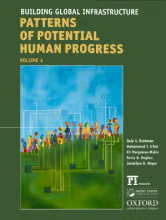
M.T., Hughes, B.B., Dale S. Rothman Margolese-Malin, E., Moyer, J.D. (2014). Building global infrastructure: Forecasting the next 50 years (Patterns of potential human progress volume 4). Routledge.
Volume 4 in the PPHP series tells a story of possible futures for basic infrastructure (access to all-season roads, electricity, improved water and sanitation, and information and communication technologies) across the globe. Questions addressed by Building Global Infrastructure are:
Additional Resources:
Base Case End Tables Using IFs 7.0.2
Base Case End Tables
Alternate Scenario 1 End Tables Using IFs 7.0.2
Infrastructure Good Performance 2050 Targets
Alternate Scenario 2 End Tables Using IFs 7.0.2
Infrastructure Universal 2050 Targets
Summary Scenario Annotations, All PPHP Volumes
PPHP Summary Scenario Annotations
Detailed Scenario Annotations, All PPHP Volumes
PPHP Detailed Scenario Annotations
Birkmann, Joern, Susan L. Cutter, Dale S. Rothman, Torsten Welle, Matthias Garschagen, Bas J. Van Ruijven, Brian O’Neill, et al. 2013.
“Scenarios for Vulnerability: Opportunities and Constraints in the Context of Climate Change and Disaster Risk.” Climatic Change. doi:10.1007/s10584-013-0913-2.
Copyright ©2026 University of Denver | All rights reserved | The University of Denver is an equal opportunity institution