

Menu

Menu
According to UN investigators in late 2018 and early January 2019, genocide against the Rohingya Muslims in Myanmar has hardly stopped.
Venezuela is dangerously close to a civil war with the real possibility of direct US intervention upping the ante.
The Venezuelan crisis is festering. For the moment the elected President Maduro has hung onto power against the machinations of Bolton and his crew. However the pressure from the imperialists continues with the propaganda machines of the “liberal” North in full operation.The situation for the Venezuelan people is bleak but a right wing coup will not settle this problem.
Although many Iranians hate the regime of the Islamic Republic, the threat of a foreign invasion with memories of 1953, will present them with a cruel dilemma at best.
With the further recent escalations involving US and Saudi accusations of Iran’s involvement in damaging four commercial carriers in the Persian Gulf, and the US military plans to send 120, 000 troops, the US has raised the stakes in the dangerous game of trapping Iran to take steps that can justify US attack on Iran. Some US politicians like the Republican senator Tom Cotton from Arkansas talk about “two strikes—the first strike and the last strike,” that will presumably lead to the end of the current detestable rulers of Iran. How plausible is this scenario and what is likely to happen geopolitically if and when the US belligerence leads to an actual military confrontation with Iran? Furthermore, even if an Iraq-like initial scenario results— not a sure bet, to say the least— will ordinary Iranians greet the North American invaders as liberators?
Trump and his gang may have met more than their match in Chinese leadership under Xi. Such is also the verdict of experts in psychological warfare.
With the most recent spat between China and the US—not uncharacteristically if unintentionally engineered by Trump’s announcement of increasing tariffs from ten per cent to twenty five percent unless China agrees to his “deal”whatever that may be we seem to be back to the drawing board in the ongoing US-China trade war. Last week I received news from many experts including our own China watchers that a deal was imminent. Although my esteemed colleague Prof. Zhao was also in this group, he sagely pointed out even such a deal and seeming end of the trade war will not resolve the fundamental rivalries between US, the status quo power and China, the rising power. Now it seems that he had left out of the equation the unpredictable nature of Trump’s behavior.
With the recent military moves announced uncharacteristically by the White House first, the world is witnessing with grim fascination what could turn out to be the early moves towards a war against Iran.
It seems that US has just dropped the other shoe now by banning those countries still importing Iranian oil from doing so after early May.
Sophocles in his tragedy Antigone has the line “evil[folly] appears as good in the minds of those whom god leads to destruction”. First came the US unilateral exit from the historical Joint Comprehensive Plan of Action (JCPOA without the consent from our European allies with the resulting division between the US and Europe regarding policies towards Iran. US also restored sanctions against Iran but gave some time for energy-needy allies to import energy from Iran against a deadline. Some like Japan have complied grudgingly with the US orders. Others, particularly China and India have gone on importing Iranian energy.
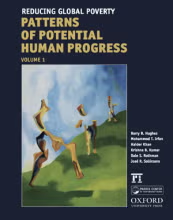
Hughes, B.B, Irfan, M.T., Khan, H., Kumar, K.B., Rothman, D.S. (2015). Reducing global poverty: Forecasting the next 50 years (Patterns of potential human progress volume 1). Routledge.
The ambitious Patterns of Potential Human Progress series was inspired by the United Nations Human Development Reports, the United Nations Millennium Development Goals (MDGs), and other initiatives to improve the global human condition. The foundational element of those initiatives, reducing poverty worldwide, is the focus of this book, the first volume in the PPHP series.
Reducing Global Poverty uses a large-scale computer program called International Futures (IFs), developed over three decades and based and the Frederick S. Pardee Center for International Futures within the Josef Korbel School of Global and Public Affairs at the University of Denver. The book presents the most extensive set of forecasts of global and country-level poverty ever made, providing and exploring a massive multi-issue database and a wide range of scenarios. The forecasts are long term, looking 50 years into the future, thereby anticipating the need of the global community to think well beyond the MDGs.
Additional Resources:
Base Case End Tables Using IFs Version 7.02
Base Case End Tables
Alternate Scenario 1 End Tables Using IFs Version 7.02
Poverty Combined Domestic Interventions
Alternate Scenario 2 End Tables Using IFs Version 7.02
Poverty Combined International Interventions
Alternate Scenario 3 End Tables Using IFs Version 7.02
Poverty Combined Domestic and International Interventions
Summary Scenario Annotations, All PPHP Volumes
PPHP Summary Scenario Annotations
Detailed Scenario Annotations, All PPHP Volumes
PPHP Detailed Scenario Annotations
Copyright ©2026 University of Denver | All rights reserved | The University of Denver is an equal opportunity institution