

Menu

Menu
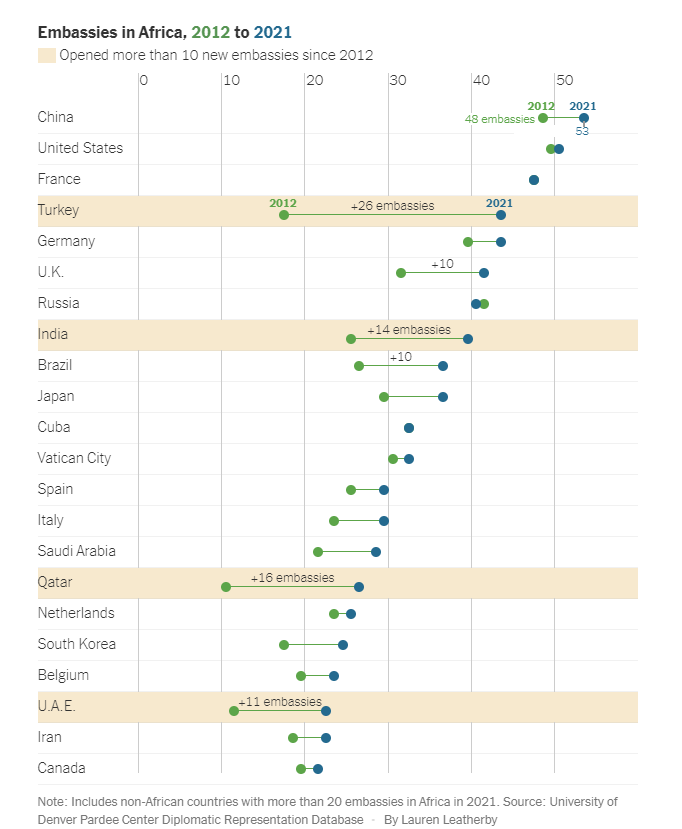
Congratulations to the Core Diplometrics Team at The Pardee Institute for their diplomatic representation data featured in a recent New York Times article titled “The World Is Becoming More African.” This infographic illustrates the growth in the number of non-African countries with more than 20 embassies in Africa since 2012. Check out the article and the infographic below.
This article introduces a new dyadic dataset measuring formal diplomatic relations. These data were coded from the Europa World Yearbook annually from 1960 to 2013 for 18,317 unique country dyads, and include the level of diplomatic representation (whether the diplomatic connection is focused on a single or multiple target countries) as well as a summary measure that captures both directed and shared dyadic level of representation. We compare the new data with data gathered previously by the Correlates of War project and find significant specific discrepancies in the period between 1970 and 1985. We then test the new data by replicating Neumayer (2008) generally validating those findings: distance, power, and ideological affinity each matter when sending and receiving formal diplomatic relations. However, using the new annual diplomatic representation data, we demonstrate a different relationship between power, affinity, and probability of diplomatic connection: dyadic foreign policy affinity is a more important driver of diplomatic exchange if both the sending and receiving countries have average relative material capabilities and matters little if one or both countries in the dyad are very powerful or very weak relative to previous model results.
The article questions the claim that China had become the world’s dominant diplomatic power simply because it surpassed the United States in the number of embassies and other diplomatic posts. The authors argue that counting diplomatic missions captures only one dimension of influence and can overstate what those facilities actually mean in practice. Using Pardee’s Country and Organization Leader Travel (COLT) dataset, the piece looks at diplomatic influence through another lens: where heads of state and government travel and which countries attract high-level visits. This broader measure suggests that diplomatic “pull” depends not just on the size of a country’s overseas network, but also on its ability to attract and maintain important political relationships.
Access, here.
The article examines Africa’s growing strategic importance to outside powers and the intensifying competition for political, economic, and diplomatic influence across the continent. It describes how countries including China, Russia, Turkey, India, the United States, and European states have expanded their presence through embassies, trade, investment, infrastructure projects, military cooperation, and development partnerships. A key theme is that African governments have more potential partners than in previous decades, giving them greater room to diversify relationships and negotiate among competing powers rather than relying on a single external bloc. The article also highlights the rapid expansion of diplomatic representation in Africa as evidence of the continent’s rising geopolitical importance.
The Pardee Center’s team of research assistants has made significant progress on its data collection of “diplometrics,” which include a variety of diplomacy measures. The team, so far, has compiled four different databases. One measures the number and location of foreign embassies by country over time. Another shows each country’s involvement in intergovernmental organizations (IGOs). We will also have a database on each country’s voluntary contributions to the UN as well as one on the UN’s professional staff. Our RAs are now carefully vetting the data, and these databases should be ready to integrate into the IFs system soon. Our team hopes to collect additional data on diplomacy throughout the year, including measures of bilateral alliances, staff and budget contributions to all international organizations, and on issues related to measuring sovereignty.
Copyright ©2026 University of Denver | All rights reserved | The University of Denver is an equal opportunity institution