

Request more info

Welcome to the Pardee Institute for International Futures

Building a more knowable future

See our researchUse International Futures
The future is uncertain, but not unknowable. Pardee helps people see the structure within uncertainty by studying the long-term trends, system relationships, and human choices that shape how global change may unfold.

Our Research

International Futures

International Futures (IFs) is Pardee’s open-source integrated modeling platform. IFs brings together data, system relationships, and scenario assumptions to study long-term change across 188 countries. It helps researchers, analysts, policymakers, multilateral organizations, development practitioners, students, and others seeking a clearer understanding of the future examine how human, social, economic, environmental, and geopolitical systems may interact over time.

Explore

Development Analysis

Development analysis at Pardee studies interconnected global systems using International Futures (IFs). Through scenario-based analysis, we connect assumptions, policies, and structural trends to plausible outcomes across sectors, countries, and time horizons. This work supports researchers, governments, multilateral organizations, and others seeking a rigorous basis for understanding long-term development pathways.

Explore

Geopolitical Analysis

Many of the most consequential changes in international affairs are difficult to see clearly in the moment. Diplomatic behavior often escapes notice unless it appears in a summit, a crisis, or a headline. Through data-building, tool-building, and analysis, Pardee’s geopolitical work makes some of those harder-to-see dynamics more legible.

Explore
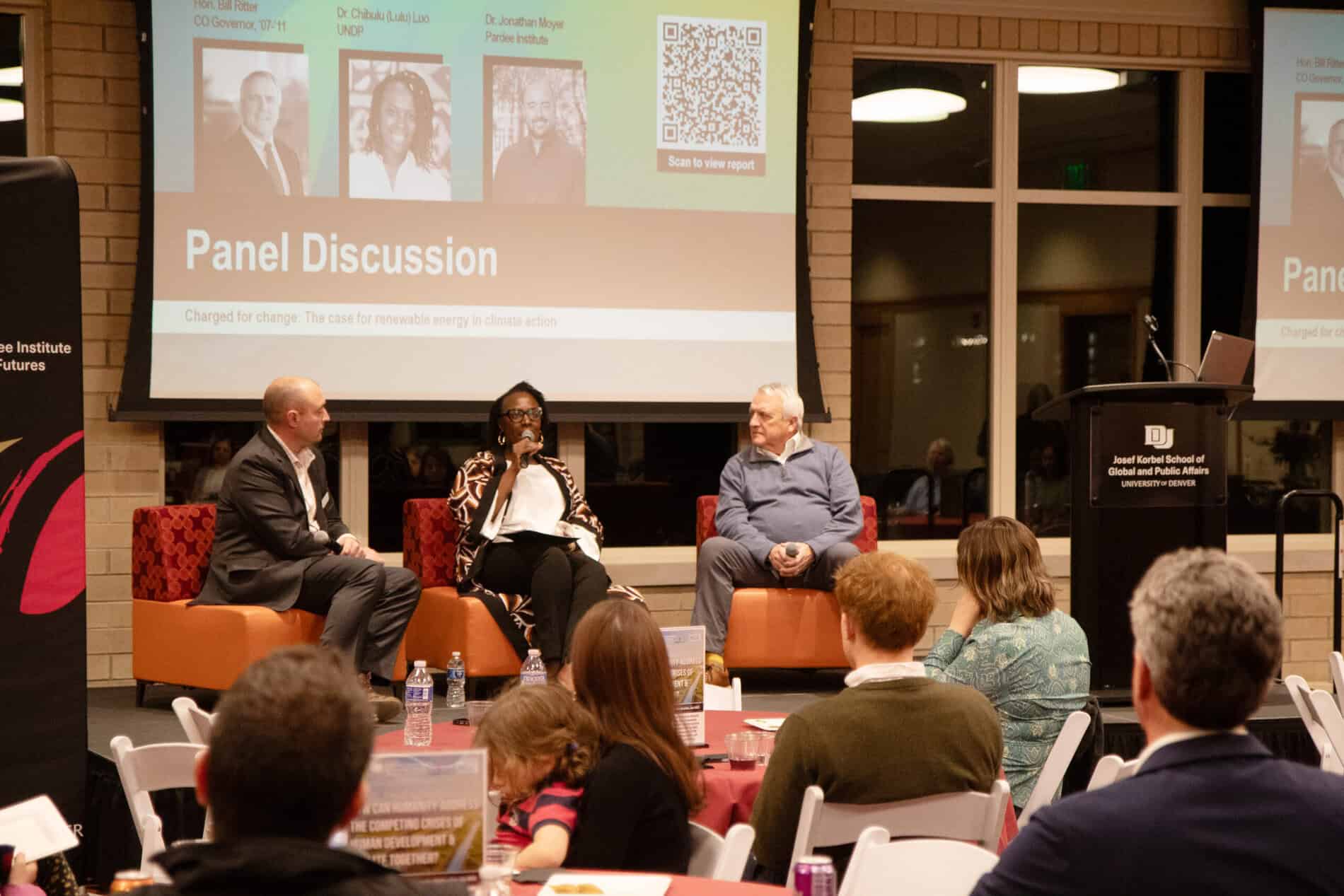
News & Events

Keep up with the latest from The Frederick S. Pardee Institute for International Futures.

Find News

Find Events

Publications

Sharing our body of work is central to the Pardee Institute's mission to build a more knowable future and democratize access to it.

Explore

With IFs, users can examine how assumptions, structural trends, and policy choices may shape development, climate, governance, and international systems over time.

Our Research Approach

Finding structure in uncertainty.

The future cannot be reduced to a single path. But long-term trends can reveal patterns, constraints, and possibilities. Pardee uses integrated modeling and scenario analysis to study how those trends interact, where uncertainty matters most, and how different assumptions may shape plausible futures. In a world shaped by overlapping pressures, short-term analysis is often not enough. 

Long-horizon, systems-based analysis helps:

Clarify which trends are durable

Some long-term patterns are more durable than others. We study historical data and structural relationships to identify trends that can provide context for research, analysis, and planning.

Trace how change moves across systems

We examine how changes in one area may shape outcomes elsewhere, including trade-offs that emerge across sectors, countries, and time horizons.

Compare plausible pathways

Scenario analysis using International Futures  allows users to compare how different assumptions, conditions, or interventions may shape future outcomes.

We use “what if” questions to study how global systems may change and unfold over time under different assumptions.

Building a more knowable future is the throughline of our research.

We work at the intersection of foresight and forecasting, using empirical analysis and integrated modeling to examine how global systems interact and change over time. Rather than predict a single future, we test assumptions and illuminate plausible pathways for long-term change.

At the center of this work is International Futures (IFs), our flagship modeling platform. Built over more than 40 years, IFs is grounded in social science methods and an extensive, integrated data infrastructure. Historical data series, many beginning in 1960, help us study past trends, understand current trajectories, and examine how human, social, economic, and environmental systems interact over time.

Our research also includes dataset building, analytical tools, and methods for studying bilateral and multilateral relationships. By measuring political, diplomatic, economic, security, and cultural ties between countries, this work helps make international system dynamics more visible. Some of these datasets and tools are integrated with IFs; others stand alone as public research infrastructure.
We serve a global community of policymakers, researchers, international organizations, development practitioners, students, and others seeking a clearer understanding of the global future.

Discover thHelp us support a global community tackling today's most consequential issuese Pardee SupportA

Give to Pardee

Stay connected with Pardee

Follow new research and ideas that help make the future more knowable. Subscribe for insights.

Subscribe

Contact us
Copyright ©2026 University of Denver | All rights reserved | The University of Denver is an equal opportunity institution

Website Accessibility
crossmenuchevron-downcross-circle