

Request more info

Pardee About

The Frederick S. Pardee Institute for International Futures uses empirical analysis and integrated modeling to reason across systems, time horizons, and uncertainty.
Based at the Josef Korbel School of Global and Public Affairs at the University of Denver, Pardee builds open-source tools, datasets, and analyses that help researchers, students, policymakers, and partner organizations explore plausible futures across connected human, social, natural, economic, and geopolitical systems.

Pardee’s work does not predict a single future. It helps users examine how different assumptions, choices, and structural forces may shape possible pathways over time.

Use this page to learn how Pardee’s work, guiding principles, and institutional history shape its approach to long-term global analysis.

What the Pardee Institute does

Pardee’s research is organized around three connected areas of study. Each uses data, models, and scenarios to examine change across time, sectors, and systems.
IFs does not predict the future. It helps users compare plausible futures under different assumptions and examine how changes in one system may affect outcomes in others.

Meet the team

Learn about our Fellows program

Because Pardee’s work connects so many systems, IFs is more than a technical platform. It is the infrastructure behind much of the Institute’s research, teaching, and partner-facing analysis.

That philosophy still shapes Pardee’s work: use models not as predictions, but as tools for clarifying assumptions, comparing pathways, and improving how people reason about uncertainty.

Why International Futures matter

International Futures helps users ask “what if?” questions about the global future. What if fertility rates change more quickly than expected? What if education access expands? What if conflict, climate stress, migration, or investment patterns shift over time?

IFs brings many of these relationships into one integrated platform. Users can examine historical data, compare countries and regions, create scenarios, and explore how changes in one part of the system may affect outcomes elsewhere. That integration matters because many long-term challenges do not fit neatly inside one sector. Poverty, health, education, energy, governance, climate, infrastructure, trade, migration, and security interact over time.

The value of IFs is not that it tells users exactly what will happen. Its value is that it makes assumptions visible, helps users compare plausible pathways, and gives researchers and decision-makers a structured way to think about uncertainty.

See how the model works

All models are simplifications of reality and therefore inevitably wrong...Understanding of that unpredictability is, however, the reason that those of us who develop or use IFs...think of computer models as tools to help us think about and hopefully somewhat improve our own mental models. 

There is no alternative to choice and action, even if the choice is inaction. Let’s enhance our mental models and explore and shape our desired future as best we can.

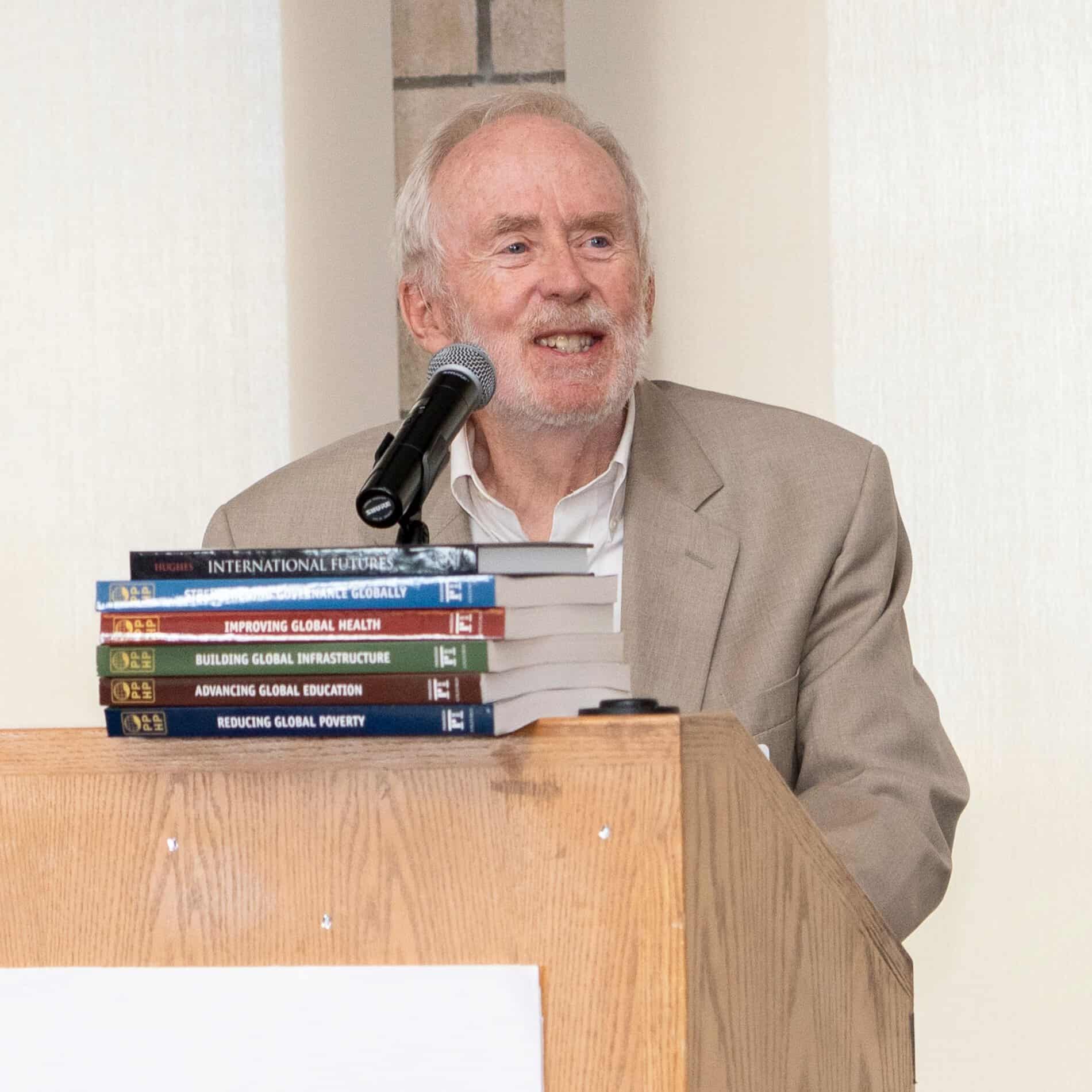
-  Barry B. Hughes, Founding Director, Pardee Institute
(excerpted from Chapter 1: Action in the Face of Uncertainty, from Exploring and Shaping Alternative Futures)

How Pardee's work is organized

Pardee’s research connects model development, development analysis, and geopolitical analysis. Each area has its own questions and methods, but they share a common foundation: using data, integrated modeling, and scenario analysis to understand how structural forces shape plausible futures.


IFs methodology & development

Pardee maintains and improves International Futures (IFs), the open-source, integrated platform that supports much of the Institute’s research, teaching, and partner-facing analysis. This work includes updating data, refining model structure, improving documentation and usability, and developing new ways to represent emerging global dynamics.

Explore


Development analysis

Pardee uses IFs to study long-term development questions, including poverty, education, health, infrastructure, energy, governance, food security, climate risk, and progress toward development goals. This work helps users examine how policy choices and structural conditions may affect human and social development over time.

Explore


Geopolitical analysis

Pardee studies relationships among countries, institutions, economies, security systems, and people through original datasets, tools, and scenario-based analysis. This work helps users examine diplomacy, conflict, national power, influence, and geopolitical risk over time.

Explore

Explore our research by topic

Explore our research collaborations

Read about our year in review

Our strategic direction

Pardee’s mission, vision, values, and strategic goals guide how we build tools, conduct research, work with partners, and communicate uncertainty. They reflect a commitment to open access, integrated analysis, and long-term thinking that remains useful beyond any single project or partnership.

Mission
To understand the long-term dynamics of durability and change using an open-source, integrated macrosystems approach to develop data, tools, and strategies for people seeking understanding about the global future.
Vision
A more 
knowable 
future
Vision
Interconnectedness | Bringing together ideas and people to build knowledge

Curiosity | Pursuing ideas and knowledge with empathy and initiative

Transparency | Openness in approach and open access to the long-term future

Read our Strategic Plan

Our history

Pardee’s roots reach back to the development of global modeling work by Barry B. Hughes, who brought his model to what is now the Josef Korbel School of Global and Public Affairs in 1980. That work became International Futures, the open-source platform that continues to anchor much of Pardee’s research.

A major turning point came through Hughes’s partnership with Frederick S. Pardee, whose support helped establish the Frederick S. Pardee Center for International Futures at the University of Denver in 2006. The Center grew over time through model development, publications, applied research, and partnerships with organizations working on long-term global questions.

In 2023, the Center became the Frederick S. Pardee Institute for International Futures, reflecting the growth of its research portfolio, partnerships, tools, and contributions to DU’s research community. In February 2026, the Pardee Institute received DU’s Research, Scholarship, and Creative Works Impact Award, recognizing the growing breadth of its research, tools, partnerships, and public-facing analysis.

Learn more about our founding and evolution here.

Help support a global community working toward a more knowable future

Pardee’s open tools, research, and training resources support students, researchers, policymakers, and practitioners around the world. Your gift helps keep that work accessible and strengthens the public research infrastructure behind it.

Give to Pardee

Stay connected with Pardee

Follow Pardee research, publications, events, and tools that help people reason more clearly about possible futures.

Subscribe

Contact us

Copyright ©2026 University of Denver | All rights reserved | The University of Denver is an equal opportunity institution

Website Accessibility
crossmenuchevron-downarrow-rightcross-circle