


Request more info

IFs Model Areas

International Futures (IFs) examines long-term change through connected systems, not isolated indicators.

IFs does not predict a single future; it helps users compare plausible futures under different assumptions. 
Its model areas, also known as submodules, help users understand what the platform includes and where to begin when building or interpreting a scenario. Broader system categories help show how those model areas relate to one another.

Use this page to understand how IFs is organized, choose a model area to explore, and see why system connections matter when working with scenarios.

How IFs is organized

IFs represents relationships across major human, social, and natural systems.

The model connects historical data, equations, parameters, assumptions, and scenario tools across multiple model areas. Users can begin with one area, such as education or energy, then consider related systems that may shape the outcome.

For example:
  • Education may affect fertility, income, health, productivity, and poverty.
  • Energy demand may affect emissions, investment, prices, and economic growth.
  • Governance may affect conflict, public spending, infrastructure, and development outcomes.

Next: explore model areas

Explore areas of the model

Start with the model area closest to your question. Then add related systems only when they help explain the result.

The blocks are color-coded to indicate the broader global systems housing these model areas. Blue cards represent human systemsteal cards represent social systems, and gray cards represent natural systems.

Narrow your focus

Because IFs connects many systems, users do not need to begin with the whole model. Start with the model area closest to your question, then expand only when other systems help explain the outcome.

If your question is about:
Poverty
Start with economics and human development. Then consider education, demographics, governance, health, and infrastructure.
Food security
Start with agriculture. Then consider demographics, income, trade, climate effects, infrastructure, and governance.
Energy transitions
Start with energy. Then consider economics, environment, technology, investment, and demand.
Conflict or geopolitical influence
Start with governance, international relations, economics, demographics, and conflict-related variables.

See model linkages in the Network Diagram

Understand system connections

A high-level overview
IFs uses connected model areas because long-term outcomes rarely come from one system alone.

A change in one part of the model may affect another through stocks, flows, feedbacks, and time delays. These relationships help users examine how assumptions may shape outcomes over years or decades.
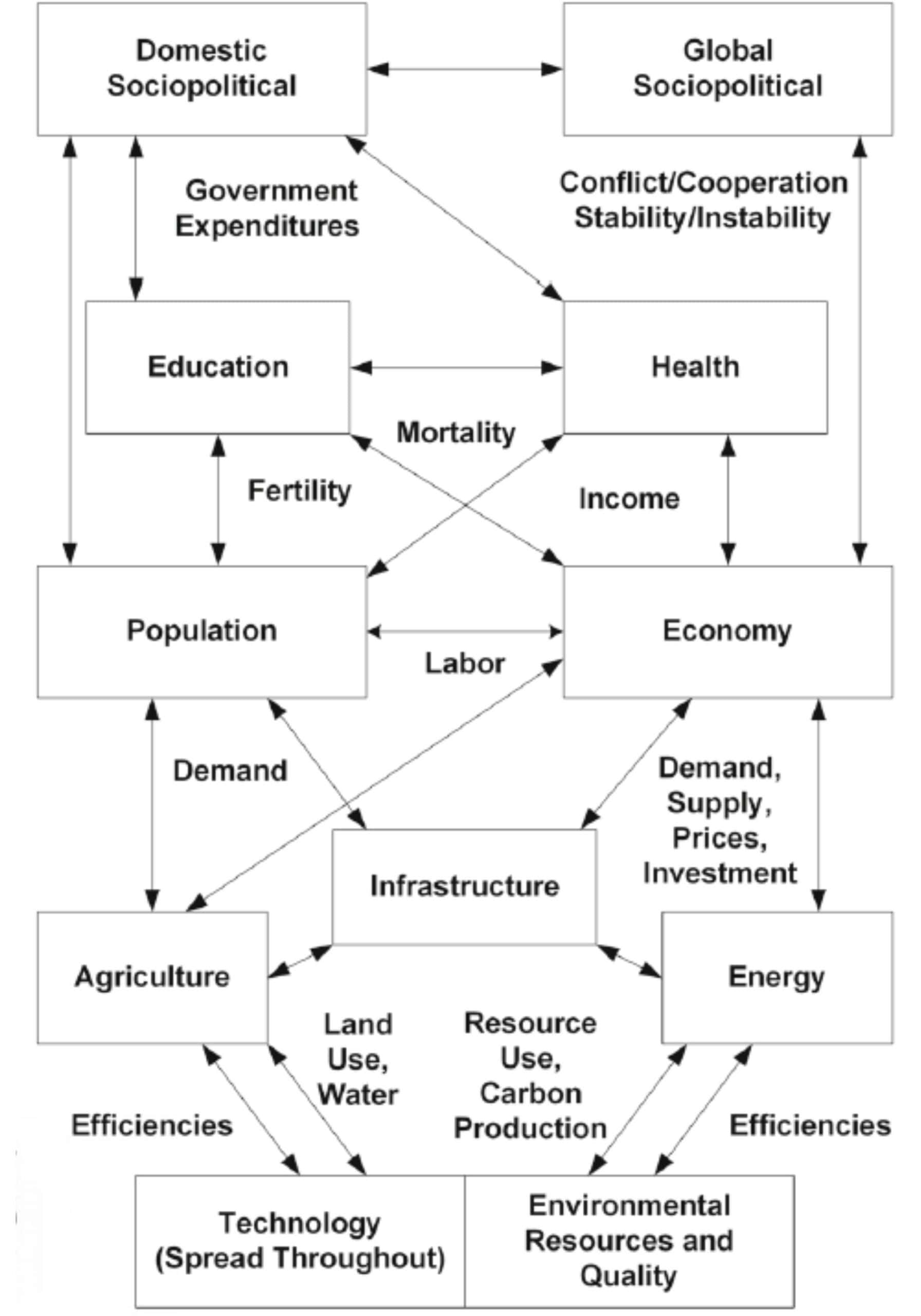
A simplified map of system connections
Figure 3.8, to the left and excerpted from the founding Director Barry B. Hughes's Exploring and Shaping International Futures, Fifth Edition, | New Windowprovides a high-level overview of IFs model areas and relationships. It should be read as a simplified map of system connections, not a complete technical diagram.
provides a high-level overview of IFs model areas and relationships.

This diagram is a teaching aid, not a complete representation of the model.
Stocks and flows: a mini explainer
IFs represents change over time. Some variables describe a condition at a point in time, such as population or capital stock. Others describe movement over time, such as births, deaths, investment, emissions, or migration.

Feedbacks occur when a change in one area affects another system, which may then affect the original area over t

See full linkages in the IFs network diagram

Use model areas in scenario analysis

Model areas help users decide which assumptions to examine.

A basic scenario workflow includes:

  1. Define the question.
  2. Review the Base Case.
  3. Choose the most relevant model area.
  4. Identify related systems.
  5. Change assumptions carefully.
  6. Compare results against the Base Case.
  7. Explain what changed, why it changed, and what assumptions shaped the result.

Next: get started

Help support a global community working toward a more knowable future

Pardee’s open tools, research, and training resources support students, researchers, policymakers, and practitioners around the world. Your gift helps keep that work accessible and strengthens the public research infrastructure behind it.

Give to Pardee

Stay connected with Pardee

Follow Pardee research, publications, events, and tools that help people reason more clearly about possible futures.

Subscribe

Contact us

Copyright ©2026 University of Denver | All rights reserved | The University of Denver is an equal opportunity institution

Website Accessibility
crossmenuchevron-downarrow-rightcross-circle