
There's still time to apply! Accepting applications for Fall 2026 with scholarship support available. Apply now!

Menu

Menu
There's still time to apply! Accepting applications for Fall 2026 with scholarship support available. Apply now!
Shepherd, Andrew, Lucy Scott, Chiara Mariotti, Flora Kessy, Raghav Gaiha, Lucia da Corta, Katharina Hanifnia, et al. 2014.
“The Chronic Poverty Report 2014−2015: The Road to Zero Extreme Poverty.” Report of the Chronic Poverty Advisory Network. Overseas Development Institute, London.
United States Agency for International Development (USAID). 2013. “Getting to Zero.” A Discussion Paper on Ending Extreme Poverty.”
Shepherd, Andrew, Tom Mitchell, Kirsty Lewis, Amanda Lenhardt, Lindsey Jones, Lucy Scott, and Robert Muir-Wood. 2013. “The Geography of Poverty, Disasters and Climate Extremes in 2030.” Overseas Development Institute, London.
Cali, Massimiliano, and Nicola Cantore. 2011. “The Impact of Circular Migration on Source Countries: A Simulation Exercise.” International Economic Development Group Research Report. Overseas Development Institute, London.
Hillebrand, E. (2011). “Poverty, Growth, and Inequality over the Next 50 Years.” In Conforti, P. ed., Looking Ahead in World Agriculture: Perspectives to 2050. Rome: Food and Agriculture Organization of the United Nations, 159-190.
Global poverty has fallen dramatically over the last two centuries, and the fall has intensified in recent decades, raising hopes that it could be eliminated within the next 50 years. As industrialization, specialization, and trade raised economic growth and living standards in Western Europe and the European offshoots in the 19th century, much of the rest of the world also started growing rapidly after 1950.
Poverty reduction, however, has been very uneven across countries. Since 1980, China alone accounted for most of the world’s decline in extreme poverty. Even though there has been a huge rise in income inequality within China, economic growth has been so strong that hundreds of millions of people have risen out of extreme poverty and the poverty ratio has plummeted. Sub-Saharan Africa, at the other extreme, has seen its poverty headcount continue to rise; the negative impact of low economic growth has far outweighed modest improvements in within-country income inequality.
Strong economic growth is the key to future poverty reduction. If the lagging non-OECD2 (Organisation for Economic Co-operation and Development) countries are able to transition to a sustainable higher growth path, the global poverty ratio will fall from about 21 percent in 2005 to less than 2.5 percent in 2050 and the number of people living in absolute poverty will decline another billion people. While the historical record is clear that market-friendly policies and competent governance are critical to growth, few economists are bold enough to claim they know the precise combination of policies, and how to implement and sustain those policies, to achieve this economic transition. Forecasts of future economic growth rates and poverty rates are necessarily speculative and depend on a large number of assumptions about human behavior and policy decisions that are impossible to know in advance.
In a less optimistic scenario, I assume that the regions that have been lagging, especially sub-Saharan Africa, do not improve upon their growth rates of the last 25 years. This results in much higher poverty levels— almost 900 million more people living in absolute poverty in 2050 than in the optimistic scenario. I have also considered, but not explored empirically, even more depressing scenarios. Resource constraints, if not met by technological solutions, will surely make the poverty estimates shown here worse. A breakdown of the world capitalist system or even a gradual turning away from the system that has done so much to reduce global poverty over the last two centuries would be disastrous.
Cantore, Nicola. 2011. “Future Paths of Poverty: A Scenario Analysis with Integrated Assessment Models.” Chronic Poverty Research Centre Working Paper No. 200. Overseas Development Institute, London.
UNICEF. (2022). "Prospects for Children in 2022: A Global Outlook." Office of Global Insight and Policy, UNICEF.
Our 2022 outlook draws on the reflections and analysis of staff from
UNICEF’s Global Insight team, supported by the Atlantic Council and the Pardee Center for International Futures, two organizations with long track records and formidable reputations in risk analysis and foresight. Jointly, we revisited the longer-term trends examined in ‘Prospects for children’, identified those that we considered to be most relevant for children in 2022, and highlighted new trends or events to be brought to the attention of our readership. Our initial findings were debated and refined during a virtual consultation held with 18 experts, leaders and young activists from around the world on 16 November 2021.
The resulting analysis is organized around ten trends (Figure 1). Annual trends, such as the ten highlighted in this report, are inevitably highly interconnected. They emerge, in part, from megatrends such as
demographics, climate change, biodiversity loss and rapid technological changes, which will shape the world in which children live over the course of the next 30 to 50 years.
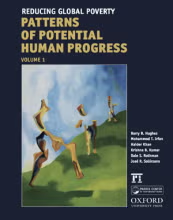
Hughes, B.B, Irfan, M.T., Khan, H., Kumar, K.B., Rothman, D.S. (2015). Reducing global poverty: Forecasting the next 50 years (Patterns of potential human progress volume 1). Routledge.
The ambitious Patterns of Potential Human Progress series was inspired by the United Nations Human Development Reports, the United Nations Millennium Development Goals (MDGs), and other initiatives to improve the global human condition. The foundational element of those initiatives, reducing poverty worldwide, is the focus of this book, the first volume in the PPHP series.
Reducing Global Poverty uses a large-scale computer program called International Futures (IFs), developed over three decades and based and the Frederick S. Pardee Center for International Futures within the Josef Korbel School of Global and Public Affairs at the University of Denver. The book presents the most extensive set of forecasts of global and country-level poverty ever made, providing and exploring a massive multi-issue database and a wide range of scenarios. The forecasts are long term, looking 50 years into the future, thereby anticipating the need of the global community to think well beyond the MDGs.
Additional Resources:
Base Case End Tables Using IFs Version 7.02
Base Case End Tables
Alternate Scenario 1 End Tables Using IFs Version 7.02
Poverty Combined Domestic Interventions
Alternate Scenario 2 End Tables Using IFs Version 7.02
Poverty Combined International Interventions
Alternate Scenario 3 End Tables Using IFs Version 7.02
Poverty Combined Domestic and International Interventions
Summary Scenario Annotations, All PPHP Volumes
PPHP Summary Scenario Annotations
Detailed Scenario Annotations, All PPHP Volumes
PPHP Detailed Scenario Annotations
Turner, S., Cilliers, J., and Hughes, B.B. (2014). “Reducing Poverty in Africa: Realistic Targets for the Post-2015 MDGs and Agenda 2063.”
African Futures Paper No 10 (using 2005 as the currency reference year). Institute for Security Studies and Frederick S. Pardee Center for International Futures, Josef Korbel School of Global and Public Affairs, University of Denver. Pretoria, South Africa, and Denver, CO, USA.
The eradication of extreme poverty is a key component of the post-2015 MDG process and the African Union’s Agenda 2063. This paper uses the International Futures forecasting system to explore that goal, and finds that even with aggressive interventions, many African states are unlikely to make the target by 2030. In addition to the use of country-level targets, this paper argues in favour of a goal that would see Africa as a whole reducing extreme poverty to below 20% by 2030 using 2005 as the currency reference year (15% using 2011 purchasing power parity), and to below 3% by 2063.
Hillebrand, Evan E. 2008. “The Global Distribution of Income in 2050.” World Development 36 (5): 727–740.
Copyright ©2026 University of Denver | All rights reserved | The University of Denver is an equal opportunity institution