

Menu

Menu
Moyer, J. D., Hughes, B. B., Irfan, M., Solórzano, J., Petry, C. L., Xiong, Y., Hanna, T., Meisel, C. J., Sahadevan, D., & Sullivan, E. (2026). Broadly quantifying SSP elements for 188 countries to 2150 in international futures. Nature Communications, 17(1). https://doi.org/10.1038/s41467-026-73836-0
How can researchers better connect the social, economic, and governance dynamics that shape long-term climate futures?
New research from the Frederick S. Pardee Institute for International Futures, published in Nature Communications, expands the socioeconomic foundation available to researchers using the Shared Socioeconomic Pathways (SSPs)—the community-developed framework that underpins much of today's long-term climate and sustainable development research.
Using International Futures (IFs), Pardee's integrated assessment model, the research team developed open-source SSP projections spanning 188 indicators across 188 countries through 2150. The projections connect population, economic development, governance, conflict, infrastructure, health, education, public spending, and other interconnected systems within a single, internally consistent modeling framework.
By bringing these assumptions together, the research addresses a longstanding challenge in scenario analysis: many long-term projections rely on separate models with different underlying assumptions. The new IFs-based projections provide researchers and practitioners with a transparent foundation for exploring risks, trade-offs, adaptive capacity, and policy choices whose effects may unfold over decades.
African Union Commission. (2024). Second ten-year implementation plan of Agenda 2063 (2024–2033). African Union. https://au.int/sites/default/files/Agenda%202063%20STYIP%20Feb%202024%20Launch%20Version.pdf
The Frederick S. Pardee Institute for International Futures contributed the futures modeling that informed the African Union’s Second Ten-Year Implementation Plan of Agenda 2063 (2024–2033). Using the International Futures (IFs) model, Pardee researchers supported analysis of plausible development pathways across Africa’s 55 countries, integrating factors including demographics, education, agriculture, economics, energy, environment, governance, health, infrastructure, and technology. The modeling helped inform development priorities, target-setting, and cost estimates for advancing Agenda 2063’s goals—illustrating how integrated futures analysis can support long-term planning and policy choices. [Source: African Union, Second Ten-Year Implementation Plan of Agenda 2063 (2024–2033)]
Bennett, N., Bloom, D., de la Vega, R., Hanna, T., Lavopa, A., & Prettner, K. (2026, March 23). The future of jobs in an era of demographic and technological transformation. United Nations Industrial Development Organization.
United Nations Industrial Development Organization has released a new policy brief, The Future of Jobs in an Era of Demographic and Technological Transformation, co-authored by Pardee’s Taylor Hanna. The brief serves as a follow-up to UNIDO’s latest Industrial Development Report, which was supported by Hanna and Pardee Research Associate Bido Ibrahim. Drawing on projections from the International Futures model, the analysis explores how demographic change and automation will reshape global employment by 2050. It highlights stark regional differences, with developing economies facing growing job creation pressures and advanced economies confronting higher risks of automation-driven displacement. Under a moderate automation scenario, global demand for new jobs could grow to one billion—underscoring the need for forward-looking, context-specific policy responses.

On February 25, 2026, the Frederick S. Pardee Institute for International Futures received the University of Denver's inaugural Research, Scholarship, and Creative Works (RSCW) Impact Award, recognizing research and creative work that makes a demonstrable difference beyond the University.
The award honors the Institute's commitment to producing research that helps governments, international organizations, and development partners make better long-term decisions in the face of complex global challenges.
The recognition highlights the Pardee Institute's work using its International Futures (IFs) integrated assessment model to support the African Union in developing Agenda 2063's Second Ten-Year Implementation Plan. This work helped shape the African Union's Second Ten-Year Implementation Plan for Agenda 2063 by providing data-driven targets and supporting the development of the plan's seven "Moonshot" priorities. The Pardee Institute has also used IFs to study important issues across Africa, including trade, food security, COVID-19 recovery, and long-term development.
The Pardee Institute conducted scenario analysis with the United Nations on sustainable development and global risk. The IFs platform has become a foundational tool for strategic planning, helping the world’s largest development agencies analyze post-pandemic recovery, the climate-poverty nexus, and the invisible economy of unpaid care.
The research quantified the long-term human costs of conflict and climate change in Yemen. The research shifted how people talked about the conflict by providing evidence of the depth of the humanitarian crisis that defined the conflict for the UN Security Council, the United States Congress, and the global press. From the canonical finding of 377,000 deaths to the projection of $93 billion in climate losses, the research demonstrated the far-reaching human and economic consequences of Yemen’s crisis. Together, these efforts demonstrate how integrated, long-term modeling can help clarify policy choices, reveal hidden tradeoffs, and identify levers to support more resilient futures.
The award reflects years of collaboration across the Institute and with partners around the world. Letters of support from partner organizations emphasized the practical value of Pardee's research and its role in informing policy planning and long-term decision-making.
The Research, Scholarship, and Creative Works Impact Award reinforces the tangible value of the Institute's work to translate long-term analysis into practical guidance. Through the International Futures (IFs) system and close collaboration with global partners, the Institute develops evidence-based insights that help decision-makers better understand the future and the choices available today.
United Nations Environment Programme. (2025). Global Environment Outlook 7: A future we choose. United Nations Environment Programme. https://www.unep.org/geo/global-environment-outlook-7
What is the real price tag of delaying climate and nature action by another year—or another decade?
The United Nations Environment Programme’s Global Environemnt Outlook 7: A future we choose (GEO-7) explores this question. Launched on December 9, 2025, at the seventh UN Environment Assembly (UNEA-7) in Nairobi, Kenya, GEO-7 is the most comprehensive scientific assessment of the global environment to date. Produced by 287 multidisciplinary scientists from 82 countries and reviewed by more than 800 experts and 56 review editors worldwide, the report reflects an effort of remarkable scale, ensuring scientific credibility and global representation.
The price tag – measured in human and economic costs – of failing to achieve transformative change is steep. GEO-7 finds that continued environmental degradation will drive growing economic losses and could cost tens of millions of lives over the coming decades. Pollution, climate change, biodiversity loss, and land degradation are already leading to devastating environmental, economic, and human impacts. The outlook emphasizes that these crises are deeply interconnected and that addressing them will require integrated, system-wide solutions across regions and within national governments and societies.
Crucially, GEO-7 underscores that this future is not inevitable. The report maps out two “Transformation Pathway” scenarios – alternative ways that societies might achieve global environmental goals while supporting economic prosperity. The technology-focused transformation focuses on technological development and efficiency gains. The behavior-focused transformation illuminates how shifts in values and material consumption patterns could drive change. Together, these pathways explore how structural change in energy, food systems, land use, materials and waste, and finance could alter long-term outcomes.
Taylor Hanna, Associate Director of Development Analysis at the Pardee Institute, and Jonathan Moyer, Director of the Pardee Institute, served as lead authors on Chapters 10 and 11. These chapters map the global implications of the continuation of current trends (Chapter 10) and the pursuit of transformation pathways (Chapter 11). They draw on the Pardee Institute’s International Futures (IFs) model, used alongside other global environmental and economic models, to explore long-term trajectories for economic, agricultural, and energy indicators.
The Sustainable Development Goals (SDGs) call for global partnerships, recognizing that ending poverty is linked to progress in education, energy, and health. The IFs model suggests that under current trends, the world will achieve only modest well-being improvements and miss many SDG targets. Many will still lack basic needs, and disparities between high-income countries and others persist. This highlights an opportunity for countries to align strategies with sustainability and improve well-being. Scenario analysis shows where integrated policies can close gaps and foster inclusive progress.
By contrast, the Transformation Pathways mapped out in GEO-7 suggest meaningful progress is possible –not only toward global climate goals and stronger economic growth, but also toward improved human well-being worldwide. In the modeling, these pathways lift more than 100 million people out of extreme poverty, 200 million out of hunger, and prevent 9 million premature deaths relative to Current Trends.
This is the third GEO assessment to which the Pardee Institute and the IFs model have contributed, following earlier involvement in GEO-4 and GEO-6. By contributing to successive GEO assessments, the Pardee Institute continues to provide systems-based long-term analysis as part of a wider international effort to link environmental science with policy decisions. You can access the full GEO-7 report here and view background information, including press releases and the report timeline.
United Nations Industrial Development Organization. (2026). Industrial Development Report 2026: The future of industrialization: Building future-ready industries for sustainable development. UNIDO. https://www.unido.org/publications/industrial-development-report-series
On November 26, 2025, the United Nations Industrial Development Organization (UNIDO) launched its Industrial Development Report (IDR), "Industrial Development Report 2026: The future of industrialization: Building future-ready industries for sustainable development," at the Global Industry Summit in Riyadh. The Pardee Institute supported IDR 2026 by providing forecasts and scenario analysis to explore industrial development scenarios out to 2050 and assess how developing countries could leverage an Industrial Push to advance economic and human development. The following Pardee Institute experts supported the production of this edition of the report: Taylor Hanna, Abdelrahman Ibrahim, Collin J. Meisel, José Solórzano, Yutang Xiong, Solikha Makhmatova and Victoria Pepera.
Hughes, B. B. (2025, July 22). Analysis of integrated global SDG pursuit: Challenges and progress. Sustainability, 17(15), 6672. https://doi.org/10.3390/su17156672
How can we more fully analyze potential progress toward the 17 Sustainable Development Goals, globally and by country? Methodological challenges include (1) the comprehensiveness of issue coverage, integration of causal elaboration, and geographic detail in available models; (2) clear quantification of goal targets; and (3) specification of scenario interventions that connect meaningfully to the potential leverage of agents. This study uses a large-scale, global but country-based analytical system that tightly integrates multiple issue-area models to push against methodological challenges. It explores the prospects for progress toward selected quantified targets across all goals, using scenarios that consider potential agency-linked interventions relative to the Current Path (CP). The scenarios distinguish interventions focused on Human Development (HD) and natural system sustainability (NSS) plus a Combined SDG scenario (CSDG). Even with a large, integrated push through 2030 and 2050, the world in aggregate will fail to reach many targets, and a great many of the 188 countries represented will fall short. Also of interest is possible tension between the underlying thrusts of HD- and NSS-oriented interventions. Both the Current Path of key variables and intervention leverage constraints make NSS goals harder to reach than HD goals. Because synergies of action considerably outweigh trade-offs, however, complementarity better characterizes the two intervention sets.
Sahadevan, D., Irfan, M. T., Luo, C., Moyer, J. D., Mason, C., & Beynon, E. (2025). Charged for change: The case for renewable energy in climate action. UNDP; Pardee Institute for International Futures; Octopus Energy.
Unlocking the Potential of AfCFTA for Africa’s Young Population. (2025, May). Unicef.org. https://www.unicef.org/innocenti/reports/unlocking-potential-afcfta-africas-young-population
UNICEF and the Pardee Institute recently launched a collaborative report on the African Continental Free Trade Area (AfCFTA) and its implications for Africa’s young population, led by Pardee researchers, including Deva Sahadevan, Taylor Hanna, and Jonathan Moyer.
Using our International Futures (IFs) model, the report compares three paths: no AfCFTA, AfCFTA as agreed, and AfCFTA plus strategic investments in education, welfare transfers, and research & development, all the way to 2063. The report recommends that countries put children at the center by investing AfCFTA revenue in education, health, nutrition, and green jobs, while building strong social safety nets. They also need to manage risks like job shifts, environmental impacts, and child protection issues.
March 2025 | Skopje, North Macedonia
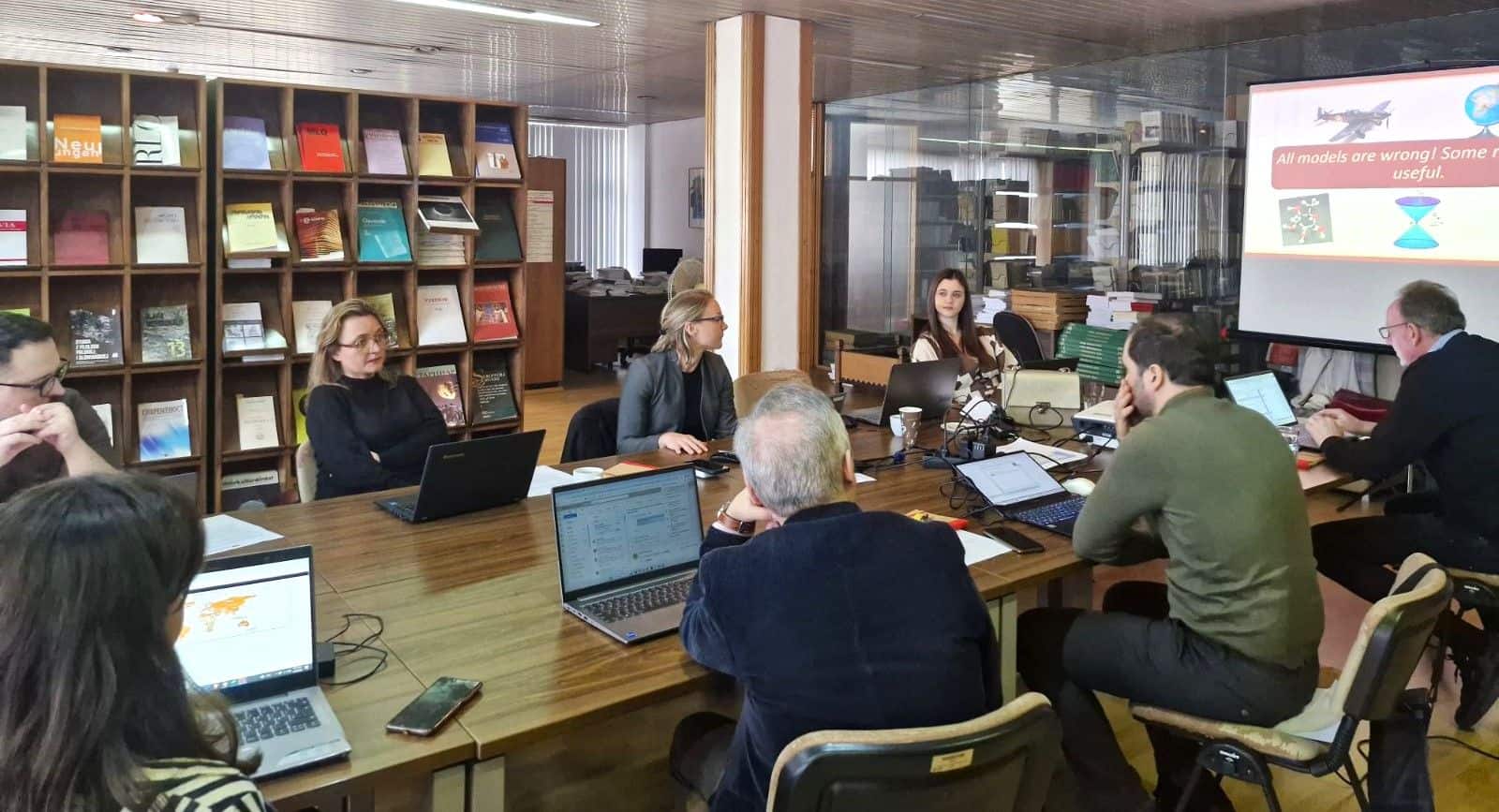
The Frederick S. Pardee Institute for International Futures at the University of Denver recently led a week-long training in Skopje, North Macedonia. The training helped government officials, researchers, and development practitioners use the Institute’s flagship International Futures (IFs) forecasting system to support the country’s National Development Strategy (2024–2044).
Taylor Hanna, Associate Director of Development Analysis at the Pardee Institute, led the training. Eleven participants joined from the Macedonian Academy of Sciences and Arts, the Faculty of Economics in Skopje, the Ministry of Finance of the Republic of North Macedonia, the General Secretariat of the Government, and the United Nations Development Programme (UNDP) North Macedonia. In addition, Aleksandar Stojkov of Ss. Cyril and Methodius University provided local support for the workshop.
The training builds upon Pardee's longstanding collaboration with UNDP North Macedonia. After supporting the development of the country's National Development Strategy using the International Futures model, the Institute returned to help ensure that local institutions have the capacity to use IFs independently for evidence-based planning, policy analysis, and long-term forecasting.
Throughout the week, participants received hands-on instruction covering installation of the IFs platform, data review and validation, scenario development, and policy analysis. They also updated North Macedonia’s national data in the model. Then, working together, they refined development scenarios based on feedback and discussion during the workshop.
As a result, government and academic partners can better monitor progress toward the goals in the National Development Strategy. They can also explore alternative development pathways and bring long-term forecasting into public decision-making.
The activity was conducted in partnership with UNDP North Macedonia as part of the "Support to Public Finance Management Reform" project, funded by the Ministry of Finance of the Slovak Republic through the "Public and Private Finance for Development Programme."
Copyright ©2026 University of Denver | All rights reserved | The University of Denver is an equal opportunity institution