

Menu

Menu
Beyond the Games: How Sport, Politics, and Diplomacy Intersect at the Korbel School and the Winter Olympics
From Day 1, Korbel students are never siloed into their individual degree programs. Faculty have interdisciplinary research interests that cut across programs, and as Korbel Professor Timothy Sisk recently explained, this is especially true for sport and sports diplomacy.
The Winter Olympics are in just five days, and Prof. Sisk is hosting an event on February 5 titled, “The Future of International Sport in the Shadow of Milan Cortina.” A rapidly evolving international context has created high stakes for this year’s competition, and Prof. Sisk is a foremost expert on the subject who sheds light on all the global excitement and controversy.
Ahead of his event, Prof. Sisk discusses studying sport at Korbel, the current international context in sport, and the careers of distinguished Korbel alumni in sport and diplomacy.
Prof. Sisk: It really cuts across several of our programs and specializations, particularly in the Master's of Public Policy. MPP students look at using sport for peace building, the safety of athletes, and securing sport venues. In the world of diplomacy, sport is a longstanding part of foreign affairs and international relations. In the field of peace and conflict studies, a lot of students in the course examine how sport can prevent extremism or encourage peacebuilding and social cohesion. For development students, sport is used for personal development in terms of early childhood education and childhood access to sport, all the way through to how sports affect national development policies. We’ve had a long-standing focus on democracy, and we think about the role of sport organizations and of athletes in terms of democracy.
Prof. Sisk: We have a flagship course that looks at sport from a comparative perspective globally. There are very complex questions that are exciting to tackle with students. How is sport governed in the international community? How do international organizations like the International Olympic Committee relate to the sport federations, which relates further to national structures, and all the way down to the role of individuals and athletes in this system?
Prof. Sisk: I’ve got two major projects right now. One of them looks at the role of sport in humanitarian action. Globally, there are 29 million children who are displaced by conflict and climate effects, and the project looks at how sport is used to address trauma in early childhood experiences. It examines sport-based interventions for children in humanitarian action. Another project looks at the role of sport organizations in building inclusive national identities. It looks at six different countries and the role of their institutions like national Olympic committees.
Prof. Sisk: Absolutely. One is currently working on the sustainability of ice rinks. They research the production process for producing a sheet of ice for ice skating and discuss its potential environmental impacts. That touches on public policy regarding safe access to indoor sports. Another student is examining performing arts and circus acts as a form of sport and how performances have been used for psychosocial rehabilitation.
Prof. Sisk: Our event happening later this week has two great examples. One panelist is Matt Ferner, who works in sports diplomacy at the Department of State. He earned his MA in International Studies from Korbel in 2012 and has worked in sport and international affairs since 2013. Then there’s Nicole Johnson, who is a former student of mine and a specialist in sport and human rights. She graduated in 2023 with an MA in International Human Rights and currently works at Kroenke Sports & Entertainment as the Safeguarding Director. It’s a role she largely crafted herself at the intersection of sport and human rights.
Prof. Sisk: Sport has always been seen as a separate sphere of international activity. It's culture, it's people coming together. It's about having fun and seeing who's best in this or that sport. But the truth is that sport today, like always, is highly politicized. For better or for worse, many people look at international sport to show how good the country is, to show how strong they are, to show how much better they are than their rivals. Many argue that sport reflects the international system rather than shapes it. That's what we study here from an international relations and comparative politics perspective.
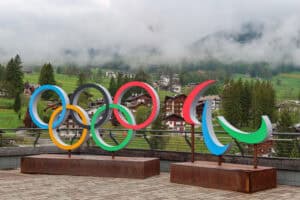
Prof. Sisk: Of course. Let’s start with the location in Cortina d’Ampezzo in northern Italy. The 1956 Olympic Games were held there. It was the first time that the Soviet Union appeared in the Winter Olympics, and they won a gold medal, beating Canada in ice hockey. Today, the Winter Olympics always prompt environmental concerns. Only about 95 cities worldwide have the geographic conditions to host the Winter Olympics. By 2050, only 35 cities are expected to meet those conditions.
Prof. Sisk: We're in a situation like we've been previously with the Olympics, where different countries are in conflict, like the Russian invasion of Ukraine in 2022. That leads to boycotts or their expulsion from the Olympic Games. And that's one thing that we're seeing regarding the United States. There are some concerns, not so much about whether the U.S. would go to Milan, but whether fans and teams will be coming for the FIFA World Cup in the United States later this year. We'll likely see many challenging situations in which athletes want to represent the United States and be patriotic but have qualms about representing the country given the autocratic behavior of this administration.
Prof. Sisk: The event will look at the future of international sport. We've got three great speakers to discuss sports diplomacy and how the State Department is working to build friendly relationships with other countries through sport. We also have insights from the United States Olympic and Paralympic Committee on the importance of athletes' mental health. At the same time, there's a lot of global tension going on and a lot of turbulence. We’ll discuss Sporting Human Rights with Korbel alumnus Nicole Johnson, whom I mentioned earlier, and who is a former student of mine.
Prof. Sisk: The games will run from February 6th through the 22nd in Milan, Cortina. The top event I'm looking at is on February 22nd. This is the 50K women's cross-country race. And if anybody's ever thought about what it takes to ski 50 kilometers, it's a huge effort. This is a grueling race that will happen right at the end of the Olympics and will be a real test of endurance. The distance for women was extended from 30k to 50k for parity with the men’s event.
As the world prepares for an exciting Winter Olympics, Prof Sisk shows how deeply sport is woven into today’s political, humanitarian, and diplomatic landscapes. At the Korbel School, studying sport means grappling with real-world challenges, from human rights and environmental sustainability to peacebuilding and global governance, all while building a skillset for careers at the intersection of athletics and international affairs.
Interested in reading more about sport and international affairs? Register for Professor Sisk’s upcoming event here.
Copyright ©2026 University of Denver | All rights reserved | The University of Denver is an equal opportunity institution