

Menu

Menu
Inside Korbel’s Cultural Diplomacy Intensive: Where Students Design Real-World Global Programs
In Instructor Carla Canales’ Cultural Diplomacy class, students don’t just study diplomacy. They practice it.
Students learn about diplomacy from a world-renowned practitioner and create program proposals with budgets and full implementation plans. They leave not only with an understanding of the field but also a project portfolio, connections, and the confidence to start careers in diplomacy.
The course is offered through the Sié Chéou-Kang Center for International Security and Diplomacy’s Cultural Diplomacy Initiative, funded by a gift from the Bonfils Stanton Foundation. It is an intensive, 8-to-10 day class in the middle of the Spring Quarter, open to current Korbel students and influential community members. Together, Instructor Canales packages theory, practice, and networking into one experience.
A Practitioner’s Perspective
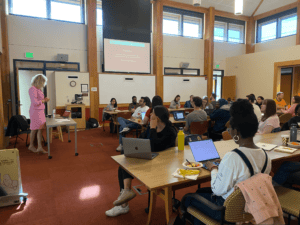
To kick off her course, Instructor Canales pulls from her wealth of experience doing cultural diplomacy programming for 20 years. She was initially trained as a classical opera singer, and her passion for entrepreneurship eventually led her to work as an arts envoy for the State Department. She served the Biden Administration at the National Endowment for the Arts and later at the President’s Committee on the Arts and Humanities, as Senior Advisor and Envoy for Cultural Exchange. Through collaboration with the Biden-Harris White House and other institutions, she promoted the arts and humanities as bridges to foster dialogue, connection, empathy, and change-making.
“There are three key components to the class,” Instructor Canales shared. “The first pillar is looking at definitions, looking at the theoretical. Let’s define culture.”
She goes on to explain how essential this is for diplomats. “When a politician or diplomat gets in front of a group, the audience senses that the speaker wants something. When an artist gets in front of a group, we expect them to give us something. They’re going to share a piece of their heart. The superpower of this class, and of cultural diplomacy, is learning how to make those work together.”
For the second pillar, students look at case studies, analyze historical and global examples of cultural diplomacy, and explore successful programs and lessons learned. This middle component helps put cultural programs in context, which is an important prerequisite for understanding diplomacy’s modern landscape.
“The third pillar,” Instructor Canales said, “is to look at current events and the future. Let’s look at modern technology, like AI, which is such a game-changer. Let’s understand the global ecosystem. Then, we can learn how to intervene and make a meaningful difference.”

Creating Programs in Community
The small, collaborative nature of the course is intentional. In past quarters, Instructor Canales has opened it to the public, allowing students to work directly with community members already well into their careers.
“Last year, we had high-level local art leaders,” Instructor Canales said. “These are people whom I consider my peers. They audit the class, and students get to work alongside them. That’s a huge networking opportunity.”
Instead of a final paper or an exam, students create a cultural diplomacy program in groups with industry leaders. “They’re given a very specific simulation,” Instructor Canales said. “That simulation includes a challenge in the real world that they can help solve. My goal is for every student’s solution to be an actionable program. They work with their group and make a PowerPoint with a spreadsheet, a budget, and projects that could be put into place and implemented the next day.”
The exercise pushes students to think beyond theory and toward real-world solutions they can carry into their careers, without sacrificing understanding of theory. “Denver is the perfect place for this sort of work,” Instructor Canales shared. “I spend a lot of time going back and forth between Cambridge and D.C., but it’s critical for folks in the Beltway to still have their ears to the ground with what’s going on in other parts of the country. Korbel gives you that distance and perspective, and I look forward to teaching here every year.”
Rethinking Culture’s Role in Global Affairs
For students interested in diplomacy, international development, or global cultural exchange, the course offers a rare chance to test ideas in a practical setting while learning from seasoned professionals.
Instructor Canales hopes students leave with the confidence to act. “If you're looking to learn how to do this work in under a week, this is the course for you,” she said. “You'll come away with a full understanding of how to do cultural diplomacy.”
Read more about Instructor Carla Canales’ career here, and dive more into the Sié Center’s programming here.
Copyright ©2026 University of Denver | All rights reserved | The University of Denver is an equal opportunity institution