
Join us for Open House on November 13, 2026. Register now.

Menu

Menu
Join us for Open House on November 13, 2026. Register now.
Korbel Career Journey: Dianna Almanza, MA in International Human rights, 2017
Alumna Dianna Almanza (Master of Arts in International Human Rights, 2017) has built a career at the intersection of human rights, technology, and policy. From fieldwork in conflict-affected regions across Latin America and Sub-Saharan Africa to the Web3 industry, she has focused on making sure the people most affected by emerging systems have a say in how they are designed. Most recently, that work brought her to the stage as an official featured speaker at a United Nations summit on women in the Web3 and blockchain industry.
We sat down with Dianna to talk more in-depth about her time at Korbel, her path from human rights fieldwork to Web3, and her advice for current students.
What drew you to Korbel and international human rights?
When I decided to pursue my master’s degree, I knew I wanted to focus on international human rights. The rigor and depth of the program at the Josef Korbel School of Global and Public Affairs stood out immediately, and it became the deciding factor in my choice to attend from 2015 to 2017.
 How did your experience at Korbel shape the way you approach human rights?
Faculty like Teaching Professor Claude d’Estrée pushed me to sit with discomfort rather than avoid it. My courses in human rights and conflict resolution, and the Human Rights Clinic I joined, centered on open dialogue about topics many would consider controversial outside academia. Professor d’Estrée allowed all of us to raise questions about whatever seemed controversial at the time. That really helped me do a deeper reflection on international human rights.
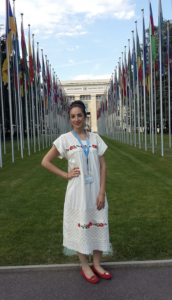
I also studied abroad in Geneva, Switzerland, working inside the Office of the United Nations High Commissioner for Human Rights (OHCHR). That top-level view of the international system helped me realize my heart was in the field.
How did you go from human rights fieldwork to blockchain?
As soon as I graduated, I went straight into human rights fieldwork in conflict-affected regions across Latin America and Sub-Saharan Africa, beginning in Colombia. That’s where I first encountered blockchain technology. I watched entrepreneurs and small businesses in fragile and conflict-affected states (FCS) use it to track agricultural goods, move money across borders without relying on banks, and route around systems that had failed them. As a human rights researcher already embedded in these communities, I couldn’t ignore the intersection. That observation led me to conduct and publish research on blockchain in FCS.
What does your work look like today?
I’m fully immersed in the Web3 industry and, more recently, have extended into healthcare, applying a core Web3 principle: that people should own and control their own data. There’s a lot of intersection between AI, blockchain, and Web3, and when it comes to innovation and policy, there are intersections there too.
You were recently named a featured speaker at a United Nations summit. What was that experience like?
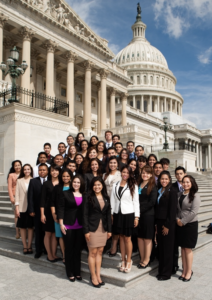
That intersection of technology, policy, and human rights recently led me to speak at a United Nations summit on women in the Web3 and blockchain industry. I was nominated anonymously, alongside women in the field from around the world, and after a second round of selection, was named an official featured speaker. It was an absolute dream to represent the voices of the women I met in the field in armed conflict, the women who were innovating on the ground, and the women I met while working for the U.S. Congress.
What did you speak about?
My remarks centered on a theme that has carried through every chapter of my career: women, especially those from underrepresented and conflict-affected backgrounds, need to move from beneficiaries of systems to co-designers and governors of them, or society will just rebuild the same old exclusion in new architecture.
Because emerging technology is advancing so fast, we’re not able to properly evaluate whether these new technologies are creating new gaps, or exacerbating the ones that already exist. We need to put underrepresented women and FCS more in the forefront of that.
What advice would you give to current Korbel students?
To current students, particularly women, first-generation students, and those who don’t yet see themselves represented in the spaces they want to enter: be bold, stay curious, and treat the absence of representation as an opening rather than an obstacle. If you don’t see your own representation in certain spaces, disciplines, or career paths, that’s an opportunity for you to begin paving that way.
Copyright ©2026 University of Denver | All rights reserved | The University of Denver is an equal opportunity institution