

Menu

Menu
Korbel Career Journey: Rhiannan Price, MA International Human Rights 2012
Rhiannan Price (MA International Human Rights, 2012) has built a career at the intersection of humanitarian action, science, and technology, driven by the conviction that access to information is inseparable from justice, dignity, and human security. As the architect and Principal Investigator of NASA Lifelines, she transformed how satellite data is understood and used in humanitarian contexts, building a global community of over 1,000 practitioners across 140 countries who now use Earth observation to respond to disasters, displacement, food insecurity, and conflict. Her work has never been about technical novelty for its own sake; from the start, she centered ethics, equity, and real-world outcomes, making questions of harm, consent, and responsible use foundational rather than afterthoughts.
That same clarity of purpose led her to co-found Common Space, an ambitious nonprofit working to launch the world's first independently governed humanitarian satellite. In a landscape where most Earth imagery serves defense or commercial interests, Rhiannan is building something different: a community-governed resource designed for accountability, protection, and the people who need it most. Recognized with the 2025 Kluz PeaceTech Prize, Rhiannan brings to all of her work a rare combination of technical fluency, ethical courage, and genuine care for people, whether she is advising NASA, mentoring early-career humanitarians, or volunteering on a domestic violence crisis hotline.
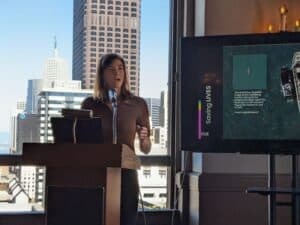
What drew you to the Master of Arts in International Human Rights at Korbel?
When I was a Peace Corps volunteer considering graduate school, I was looking for a program that was practical and hands-on rather than focusing on theory and the abstract. For someone who wants to go into human rights, there's a lot of that out there. Korbel stood out to me as different because of the types of classes it offered and the different focus areas you could engage with. I pursued not only human rights, but also a certificate in humanitarian assistance. For me, that felt like moving toward a program that would give me tangible skills I could apply in a job where I could make a difference and help people realize their rights. It was a great choice, I'm glad I did it!
Was there a class, professor, or experience at Korbel that shifted how you think about the relationship between technology and human rights?
There are a few that stand out. I was lucky enough to be at Korbel when Chiara Lepora was there, who had worked and still works for Doctors Without Borders. Global health wasn't really in my background, but I sought out her class because of how amazing she was and what I'd heard about it. She did such an amazing job of conveying how easy it is to sit in an academic setting and talk about interventions while people are suffering, and to distance ourselves from it. When you're in human rights or grad school, it's easy to treat things as textbooks, things you're reading and learning about, instead of thinking about whose life is actually affected. She did a fantastic job of almost calling us out for trying to be that distant and pushing us to put ourselves in the shoes of people in those communities experiencing the crisis.
One other professor I should give a shout-out to is Luis Esparza. At the time, I was really excited about social movements, especially in conflict-affected or post-conflict societies, and he was glad to take me on as a research assistant. It evolved into research on protest movements around the Vancouver Olympics, examining the different constituencies that were mobilized, the coalitions that formed, and what made those movements significant. For me, it was another incredible opportunity to work alongside experts with deep experience while also feeling encouraged to innovate and explore areas my professors hadn't fully mapped yet, with their support.
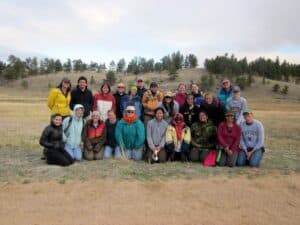
Can you walk me through your first role after graduating from Korbel?
I'll call it a bit of a stutter step. I took a Boren Fellowship before I graduated, living in Tanzania and then Uganda to learn Swahili, then landed a part-time job at a Denver startup called aWhere just before I finished. They did agricultural weather intelligence for smallholder farmers globally, and that role introduced me to food security and to data and technology in a very applied sense. It turned full-time after graduation and through our work with the Gates Foundation, I got a behind-the-scenes look at some of the best organizations in the field, getting my hands dirty with their data even as someone fresh out of grad school. I learned a ton, and it very much set me on the trajectory I've been on ever since.
You went on to lead NASA Lifelines. Can you explain what that is and how you came into that role?
NASA Lifelines was a program I helped design and propose to NASA in 2020. The whole idea was community building, bridging the gap between humanitarians on one hand and the science, research, and technology community on the other, to accelerate the use of satellite data for humanitarian action. NASA saw a real disconnect between where their science was and where practitioners actually needed it to go, and they wanted to close that gap.
We built some really creative programs. One was what we called scientist speed dating, pairing humanitarian organizations with the exact expertise they needed, then helping them break down barriers: finding the right data, unlocking funding, and learning to make the business case to funders. We also ran a first-of-its-kind virtual global humanitarian simulation, inspired in large part by my time at Korbel and Peter Van Arsdale's class. And through a pitch accelerator program, we helped humanitarian teams make the case for collaboration to a panel of funders, which ultimately unlocked millions of dollars for that work.
I left NASA Lifelines in January, which was bittersweet, but I left it in great hands. By that point, the program had reached participants in over 140 countries. Given everything the world has been through these past couple of years, the fact that our community not only held together but really rose to the occasion made it that much more meaningful to be a part of.
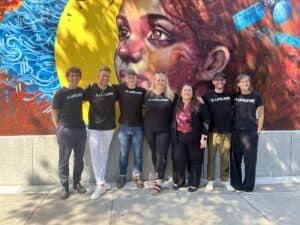
After building NASA Lifelines into a globally respected program, what moved you to co-found Common Space and take on the challenge of building the world's first independent humanitarian satellite?
This idea had been brewing for years. Before NASA, I worked for a satellite imagery company leading our humanitarian and sustainable development portfolio. I got to interface with NGOs, research institutes, civil governments, social entrepreneurs, and private sector organizations all using satellite imagery for public good. But for those companies, those use cases and stakeholders are largely an afterthought. Their customers are defense and intelligence, and anybody else is a lower priority.
The data has incredible value for humanitarian purposes, whether that's disaster response or monitoring nuclear sites for disarmament. A lot of times there simply is no other option. But we couldn't get it into the hands of the people who needed it most because everything had been designed for defense: the licensing, the pricing, the business models. It was really painful. We fought and fought, and even our biggest initiatives, which were groundbreaking at the time, like digitizing all of Africa off satellite imagery with the Gates Foundation, still fell short of where we could be.
Then in spring 2024, at an event I co-host called SatSummit, I threw out the concept of debating a humanitarian satellite. It felt like exactly the right forum: industry in the room, humanitarian leaders in the room. Let's put the idea out there and see what happens. I got a former colleague of mine, now my co-founder Bill Greer, to debate on my team. We polled the room before and after, and Bill and I actually convinced people this was worth pursuing.
Then January 2025 arrived, and the world looked very different. USAID was dissolved, humanitarian and science funding was gutted, and a lot of organizations that had relied on US government-sponsored access to satellite imagery suddenly found themselves cut off. At that point, nobody was pushing back anymore. Everyone said yes, I'm 100% behind you.
Bill went full-time, and I started part-time while we got it off the ground. We surveyed 250 practitioners across humanitarian, human rights, climate and environmental justice, journalism, and research communities, and kept hearing the same pain point: we cannot get access to high-resolution satellite imagery to do our jobs, and we know how valuable it is. What emerged was a clear mandate. It made sense to step back from NASA Lifelines and go all in.
Where do you see this work going in the years ahead, and what role do you hope to play in shaping its future at Common Space?
I see us building and launching a humanitarian satellite constellation, and if all goes well, it will be up and operational in around two years. For me, the real measure of success won't be the launch itself. It will be when we start hearing the stories back from users across this really diverse set of applications. When we can actually measure the difference satellite data makes in expediting disaster response, evacuations, and search and rescue. When UN partners can better understand what populations are in need and how to reach people with life-saving services.
If we're successful, I think we will completely shift the power paradigm around this kind of data. For so long it has been controlled by very few actors, most of whom are not thinking about humanitarian action, human rights, or sustainability. An open, trusted, community-governed source of this data is something that has never existed before. And I do fear that if something like Common Space doesn't happen, we'll see this data continue to be co-opted as a tool for misinformation and narrative control. We're already seeing that with holdbacks over the Middle East and the geopolitics between the US and China playing out in real time.
I'm cautiously optimistic that when we succeed, it will not only unlock direct applications but also show people that this technology is really a reflection of us. If we want it to serve defense and intelligence, it will. But if we're willing to do something disruptive, the impact can be enormous. Right now I'm deep in governance work with our task force, figuring out who gets to task the satellite, who gets access, and what a real do-no-harm framework looks like. These are not small questions. But we have an incredible community behind us, and I know it'll happen.
What would you say to Korbel students today who want to build careers at the intersection of technology and human rights?
I know it is a really tough time to be graduating and entering the job market, and I feel that even as someone who is mid-career. A few things come to mind.
The strength of your network is so important, and you often don't know who is going to come through for you or when. My advice is to be a genuine, curious person who makes thoughtful connections with peers, professors, and even the folks you meet through a practicum or work experience, even if it doesn't feel directly related to where you want to go. It's a small world, and people look out for each other when they feel a meaningful connection. That's what gets you past the filters and the screening, but more importantly, it exposes you to worlds you hadn't considered for yourself.
I would also say that I could never have envisioned, sitting at Korbel, being on this journey or doing the work I do today. Satellites were not on my radar. That was a learning curve that came after grad school. So my advice is to create your own world to some degree. Otherwise, you end up with the sad statistics: there's not a lot of funding in human rights, you won't get paid well, you'll have to go to big tech or law school or something more traditional. I want to push back on that. Even if you don't see the thing out there that you want to walk toward, you can be the person who creates it. There's probably a reason you feel drawn to it, because maybe you're the one who can solve that problem or be the mind behind the next great idea. Connect with other humans and believe in yourself.
Copyright ©2026 University of Denver | All rights reserved | The University of Denver is an equal opportunity institution