

Menu

Menu
One Korbel Student's Journey in Supporting Global Development Research
This reflection was written by recent Korbel graduate, Adam Dettmer (MA International Development, 2026)
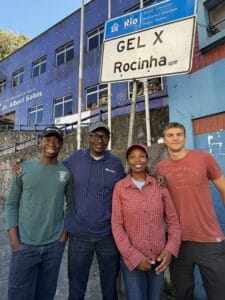
Standing at the top of a massive bowl filled with cement buildings, it didn’t feel like we were looking at thousands of houses in the favela (an informal, densely populated neighborhood built on the outskirts of a city in Brazil). The beautiful and lively community was exciting to see, even with armed gang members keeping watch over the area nearby. To them, Rocinha wasn't a place to explore but a community to guard from rivals. Dr. Singumbe Muyeba and I had just met with Rocinha’s Residents’ Association to confirm our research project for the following week and were exploring more of Rocinha to understand the process our data collectors would face.
When I came to the Josef Korbel School of Global and Public Affairs in 2024, I expected a solid educational experience at a top international relations school before I kick-started a life in international development. Then, following the 2024 election, the development landscape was uprooted. Despite the purging of USAID, I found my development courses interesting, the professors engaging, and I was hopeful the development field would be revived in the next few years. In preparation for an uprooted development space, I increased the scope of my coursework by not just taking courses concentrated on financial development and economic development, but also on the humanitarian network, econometrics, and environmental tipping points.
I first met Dr. Muyeba in his Sustainable Development of Sub-Saharan Africa course in the 2025 winter quarter. My first impression of him was that he was a likeable and friendly teacher, mostly because many of my classmates had taken the travel course to Kenya with him a few weeks earlier. After a few weeks, it became clear to me that he was a development and research genius, so naturally, I became jealous of my peers who had already formed relationships with him from the travel course. Eventually, I joined an indoor soccer league with him and his friends. One night, he told me about the research he was beginning, and it sounded very interesting to me, so when he posted that he was looking for a research assistant, I applied and got it. Now I like to think of Dr. Muyeba as a mentor, boss, and friend.
In summer 2025, my first task with this project was to use AI to list all the informal settlements globally with their geolocations. Since the list was created in April 2026, we began confirming these settlements by viewing the geolocations using satellites and defining the boundaries. Once we knew where the boundaries of these settlements were, we could calculate the number of houses and multiply this by the average household size for these areas to find the total population. However, since buildings in informal settlements rarely make it clear how many houses there are, we designed a step to check our results and produce a conversion factor for our satellite results and ground truth count.
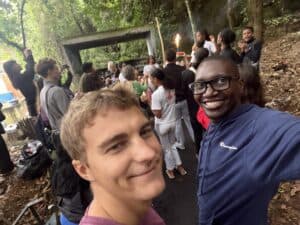
For this step, we went to Kibera in Nairobi, Kenya for 6 days during the spring quarter and trained 20 data collectors to count the number of households in the settlement. Then, before returning to Denver, we went to Azerbaijan for five days to attend the World Urban Forum 13. Here, we made connections with researchers doing work in informal settlements and community officials who would be interested in collaborating to conduct household censuses in their communities to better refine the data we are gathering using satellites. Eventually, Dr. Muyeba wants to create an open-source dashboard, publish numerous academic papers and a book displaying the findings of this project to those responsible for future global development goals and anyone who would like to use the knowledge responsibly.
After graduation, Dr. Muyeba asked me to accompany him to Brazil so we could do similar research in Rocinha. We decided, since neither of us had done research in South America, that we would need more time to guarantee the success of our study, so we stayed in Rio de Janeiro for 6 weeks. In Brazil, we visited Rocinha multiple times, met people at the Federal University of Fluminense, and had time to explore the city. I am very grateful to Korbel and Dr. Muyeba for this opportunity to work, travel, and learn in many countries during and shortly after my master’s program.
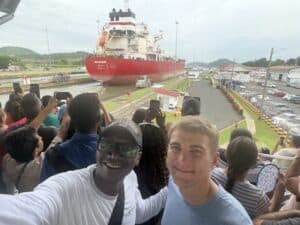
Korbel has provided me with many opportunities to gather theoretical, quantitative and qualitative research, leadership, and organizational skills through coursework, internships, student employment, international travel, and extracurricular activities. While I didn't take advantage of many networking trips or travel courses during my time, I was lucky to travel as a research assistant to Kenya, Brazil, and Azerbaijan for work, and Turkey, the United Arab Emirates, and Panama for long exploratory layovers. As I leave Korbel, I trust the connections I made, the knowledge I gained, and the experiences I’ve had will continue to guide me on my professional journey.
Copyright ©2026 University of Denver | All rights reserved | The University of Denver is an equal opportunity institution