
There's still time to apply! Accepting applications for Fall 2026 with scholarship support available. Apply now!

Menu

Menu
There's still time to apply! Accepting applications for Fall 2026 with scholarship support available. Apply now!
The Student Engine Behind Pardee’s Global Vision
At the Korbel School’s Frederick S. Pardee Institute for International Futures, research is more than an academic exercise; it’s about supporting a global community that tackles today’s most consequential issues - from climate and conflict to development and security.
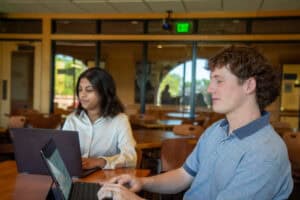
The Pardee Institute collaborates with people who are invested in our global future, including officials in governments, intergovernmental organizations, and international agencies, as well as practitioners who carry out their decisions and those with a stake in the downstream effects of those decisions.
At the heart of this work is the International Futures integrated assessment model, a one-of-a-kind global forecasting tool that helps identify and analyze the fundamental forces driving change over the coming decades, informing smarter policy decisions and more resilient planning. This powerful forecasting platform simulates how changes in one system - like health or energy - ripple across others, from governance to education to the environment.
But behind the sophistication of IFs and the breadth of Pardee’s research portfolio is a driving force that helps bring it to life: students. In the 2024-25 academic year, 88 University of Denver students, primarily from the Korbel School, played an essential role in advancing the Institute’s work. Organized into six specialized teams, these students contributed to everything from data modeling and diplomacy research to communications and operations - bringing both depth and agility to Pardee’s global initiatives.
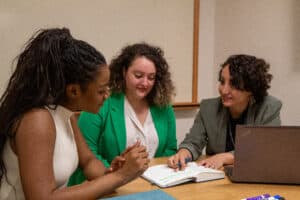
“The projects I worked on include Multilateral Treaties, UNGA, Embassies, and the IGOs. For each of these projects, I coded and vetted data, strengthening my attention to detail and improving my ability to work with complex datasets.”
-Maya Rai, Core Diplo
Some students work directly with the Pardee Institute’s flagship tool, the International Futures (IFs) model, contributing to both internal development and external research collaborations. Pardee Fellows - selected graduate students from the Korbel School - support scenario design, literature reviews, and client projects with global partners. Alongside them, the IFs Data Team maintains the model’s vast database, ensuring its accuracy and usability through technical work that supports long-term forecasting and real-world policy analysis.
Other teams focus on building the Institute’s empirical foundations. The Country and Organization Leader Travel (COLT) team, Pardee’s largest student cohort, maintains a one-of-a-kind dataset tracking the international travel of global leaders. Students gather and code open-source data, transforming it into structured insights that support diplomacy research. The Core Diplometrics team compiles data on international treaties, diplomatic representation, and organizational memberships, while the Perceived Mass Atrocities Dataset (PMAD) team contributed to a multi-year effort documenting mass atrocity events worldwide.
Meanwhile, the Institute’s communications and business operations are also student-powered. From managing Pardee’s web presence and writing research summaries to supporting HR, payroll, and event logistics, students help shape how the Institute functions and how its work is shared with the world. Their contributions ensure that Pardee’s insights reach diverse audiences - from policymakers to the public - with clarity, consistency, and professionalism.
Across all teams, students describe their experience at Pardee as transformative. They gain technical skills in data analysis, coding, and modeling; they refine their writing and communication abilities; and they learn to navigate the demands of collaborative, deadline-driven research. More than that, they find themselves contributing to projects with real-world relevance - projects that influence policy, inform global institutions, and shape public understanding.
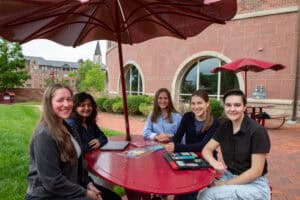
“The Pardee Institute has encouraged me to step out of my comfort zone and nurture my curiosity. My work here has refined my writing and critical thinking skills, equipping me for the professional world.”
-Wara Irfan, Marcom
As Director of Analysis Collin Meisel explains, this impact runs both ways. “Simply put, some of our research, like the COLT project, would not exist without our student research aides. Across this and many other projects, the unique perspectives that students bring, the questions they ask, the big and small suggestions they make, and the hard work they put in improves the work we do together in immeasurable ways. In turn, we aim to improve their professional lives and set our students up for future success, whether that be at a think tank, in government, an NGO, or whichever path they choose to carve in their career after Pardee.”
At the Pardee Institute, students don’t just get to join the conversation - they gain the skills to lead it, equipped with tools that last well beyond graduation. Their contributions are not auxiliary; they are essential. And in the process, these students are not only preparing for their futures - they’re helping to shape the future of global affairs.
For an in-depth look at the work taking place at the Pardee Institute, check out their 2024-2025 Annual Review.
Copyright ©2026 University of Denver | All rights reserved | The University of Denver is an equal opportunity institution