

Menu

Menu
This reflection was written by Jennifer (Jenni) Gutierrez Marquez (Master of Public Policy, ’27) and Leticia (Lety) Madrigal-Tapia (MA International Human Rights, ’27)
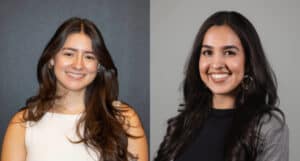
Pictured left to right: Leticia (Lety) Madrigal-Tapia and Jennifer (Jenni) Gutierrez Marquez
As students at the Josef Korbel School of Global and Public Affairs, we have an ongoing emphasis on experiential learning and civic engagement, which is uniquely magnified and refocused within each program. Despite each program having its own distinct curriculum, the pressing issues of international and global affairs impact every program. The pressing global issue of immigration has long been a matter of contention for public policy, human rights, and security, while pushing on the implications of development. Within the context of the United States, immigration and immigration enforcement efforts have been at the forefront of national, state, and local public policy decisions. Over the past two years, there has been an exponential number of changes and moving pieces in the immigration system that has quickly become a political and social maze, placing itself in a position to be studied to truly understand the nature of what is happening and what is at stake. And it's this complexity of issues that Korbel has pushed students to engage with, and the Court Transparency Project has made that possible for students such as Jennifer (Jenni) Gutierrez Marquez (Master of Public Policy, ‘27) and Leticia (Lety) Madrigal-Tapia (MA International Human Rights, '27), who both have an interest in advocating for and upholding the basic human rights of immigrants in the U.S.
As the immigration system changed, particularly from 2022 to 2024, Korbel Professor Rebecca Galemba and students, along with community partners, recognized the need to observe court hearings. Initial court observation began under the Biden Administration’s dedicated docket but shifted with federal changes, leading to the current Court Transparency Project. This current version of the project focuses on tracking and understanding key issues in immigration court, particularly within the Denver Immigration Court (non-detained cases) and the Aurora Detention Center (detained cases), including motions to dismiss, pretermissions under Asylum Cooperative Agreements (ACA)–this occurs when a judge grants the Department of Homeland Security’s motion to dismiss an asylum case before considering all the evidence. Instead of allowing the case to be heard in the U.S., the judge orders the individual to be sent to a “safe third country,” a country that has an agreement with the United States to review asylum claims there, and jurisdiction concerns in bond hearings. Reflecting on how this project has developed, it is overwhelmingly shocking to see the complexities of the immigration system and the potential that different initiatives, such as this one, have to understand it, address injustices, voice human experiences, and ensure due process. In this article, Jennifer and Lety will explore some of these complexities, sharing what this work has meant to them personally and how it has influenced their learning and shaped their understanding of human rights and public policy.
Lety’s Reflections: Motivation, Experience, and Insights
Since October 2025, I have served as a lead research assistant with the CourtWatch Project. When I began my Master's in International Human Rights at Korbel, I aimed to find opportunities to develop practical skills, deepen my understanding of public service, and expand my academic knowledge, which this role allowed me to do. As a Mexican immigrant, my interest in immigration stems from lived experience as well as academic study. I grew up in the Barnum/Westwood neighborhood of Denver, a community that is home to immigrant families, with almost 80% of residents identifying as Latino. I began my master's program during a period of heightened immigration enforcement, which left many in my community, and across the country, fearful for their loved ones who are immigrants and uncertain of their futures. This climate of uncertainty motivated me to gain a comprehensive on-the-ground understanding of the system.
Through this project, I have observed the complexity and fragility of due process for both detained and non-detained individuals. This experience has underscored the importance of monitoring immigration proceedings, particularly in detention centers. I have witnessed immigrants forced to represent themselves due to the lack of a right to counsel; I have listened to detainees describe conditions so severe that many would rather abandon their cases than remain detained; and, in cases of self-deportation, I have witnessed multiple family separations within the courtroom. These observations have clarified that the rights of detained immigrants reveal the vulnerability of human rights and due process when they are dependent on legal status. It is clear that if due process can be revoked for one social group, it is not a universal right, but a privilege extended only to those accepted by the system. On a global scale, I recognize that migration driven by political instability, insecurity, gender-based violence, and climate change will continue to rise. Addressing this multifaceted issue through criminalization or by denying individuals their dignity will not help address such a pressing and urgent issue. All of these insights have been made clear to me both as a research assistant and as a graduate student.
As I continue my time at Korbel, I am committed to deepening my engagement with the complexities of immigration both in the U.S. and globally. The knowledge and perspective I am gaining at Korbel and through the Court Transparency Project are equipping me to advocate for migrant rights with empathy and resolve. I aspire to contribute to a future where policies are shaped by compassion and justice, and where the protection of human rights is truly universal.
Jenni’s Reflections: Motivation, Experience, and Insights
I joined the team as a lead research assistant in November of 2025. When I decided to pursue my Master of Public Policy, I hoped to not only learn about the fundamentals of creating policy and focus on immigration policy, but also take part in a meaningful experiential learning component that would expose me to the complexities of the immigration system. I ultimately wanted to gain an understanding of how I could make an impact on an area of policy extremely personal to me during such a contentious time. This project has exposed me to more than I could’ve imagined by truly challenging my perspective and expanding my knowledge.
Immigration policy has always been of interest to me because of my second-hand experiences through my parents’ journey to citizenship. From a young age, I spent hours in meetings with paralegals and attorneys advising my parents on their case and joined them at immigration court a handful of times, answering what felt like the same questions repeatedly. Through this experience, I often acted as a translator for my parents, clarifying confusing information that was inaccurately translated by an interpreter or adding important pieces of information that were omitted or lost in translation. The confusion that accompanies the immigration system became all too familiar to me and my family, and this, paired with a lingering sense of entering a lost battle, is what motivated me, and continues to do so. I aim to be part of the immigration system’s evolution, working toward policy-based change that creates meaningful improvements in how decisions are made about who is detained and why, as well as in the support provided to individuals and their families during detention and while seeking legal pathways.
Through this project, I have had to witness some of the most heartbreaking stories of migration. I’ve listened to language be used as a tool of exclusion, and real accounts of how a system’s inefficiencies harm individuals. These experiences have revealed how policies and executive orders can be manipulated, exposing the delicate nature of basic human rights and due process. Witnessing a system that often falls short has shown me the urgent need for reform, making it clear that safeguarding human rights requires vigilant, intentional policy-making and a commitment to justice that goes beyond mere procedure.
I’ve also learned how language gaps not only exacerbate confusion for individuals, but intentionally create a political limbo and cause an underservement of justice. When people can’t fully understand what’s happening in their own cases, it’s not just about confusion, it’s about being left out of the process entirely. These language barriers stack on top of restrictive policies and the system’s inefficiencies, making an already tough situation even harder. It’s become clear to me that language isn’t just a tool for communication; it’s also used as a tool for exclusion and control. Seeing how all these factors of policy, procedure, and language, work together has shown me that real justice isn’t possible without making our systems truly accessible and intentional in serving everyone.
As I prepare for my second year and beyond, I will carry with me the stories I have heard and the experiences I have gained through this project. They remind me that human experience is at the heart of advocacy for fair and accessible policies. These stories should guide policy decisions, shaping them to better serve the majority and uplift underserved communities, helping to bridge the longstanding gap of inequity and migration.
A special thank you Dr. Rebecca Galemba and our project manager, Ella Iveslätt, for leading our team with commitment and care. As well as our fellow student researchers, Jasmine Salgado Simental, Sheki Tsanglao, and Sophia Worth. Lastly, a huge thank you to Christina A. Brown (Founder, Executive Director, and Board Chairperson of the Colorado Asylum Center) and the Colorado Asylum Center for providing many of our court observation training sessions, supporting our data analysis, and connecting us with community partners to expand our research efforts.
The CourtWatch project and its team of student researchers have been featured in multiple local and national news networks, including Univision, the leading Spanish-speaking television network in the United States. CTP in the media.
Learn more about the DU Courtwatch Project here: https://ducourtwatch.wordpress.com/
The Korbel professor on heavy topics, sustainable careers, and the question she asks every student who wants their work to mean something.
For years, Dr. Kaitlyn Sims assumed her high school's ban on shorts from October through April was just a strict dress code. Only later did she learn it was a quiet welfare measure, meant to make sure all kids were dressed warmly enough for the winter, and looking out for students whose parents might not have been. That idea of looking past the surface of a rule and asking who it actually serves is the kind of thinking that inspires her work today.
With a background in economics, Sims brings her skill set to subjects that traditional economists often don't address: domestic violence, housing insecurity, jails, and the emotional toll of poverty. Those topics can feel far removed from a field like economics, but her role at the Josef Korbel School of Global and Public Affairs allows her to apply the discipline through a policy lens, giving her room to apply her training to tough issues that benefit from it.
Before finding her way to Korbel, Sims knew she wanted to teach but didn’t see herself in a traditional economics department. Her interests were too interdisciplinary, and her methods were too varied to fit into the mold of a traditional economist. Conveniently, Korbel was looking for an economist who thought about the world from a policy angle. The fit was immediate. It let her build a career around one guiding question: "What are the pressing policy challenges that I want to have an impact on?”
However, choosing meaningful problems is only half of it. Economists tend to chase the questions their data can already answer, and Sims is wary of that pull. Her work on jails is a case in point. Most incarceration research focuses on prisons, where the data is cleaner, even though most people who touch the criminal legal system pass through a jail, not a prison. With collaborators in the Jail Justice Initiative, she studies what they call "jailization," the way the wider carceral system has reorganized itself around the jail as its first point of contact. Jails are their own kind of environment, she points out: stays are short, the population is always turning over, and the services attached to them look nothing like a prison's. More recently, the group has traced the historical roots of jailization and the part that cash bail and bond systems play in keeping people there.
In addition to her work on jails, Sims founded the SHAPE Lab (Systems, Housing, and Anti-Violence Policy Evaluation) in 2024, a home for her policy evaluation work and a place to train graduate researchers. The lab studies how people make decisions under conditions of poverty, domestic violence, and instability, and tests whether the policies meant to help them actually do. Its projects run across much of the social safety net, from emergency domestic violence shelters to the Earned Income Tax Credit, Section 8 housing vouchers, public insurance, and Housing First. The recurring question is whether a given program changes the choices available to someone in crisis, and by how much.
The same concern with measurement is a focal point of her upcoming book, expected in. It asks what happens when metrics-driven policymaking meets services that cannot be measured that way, with domestic violence shelters as its central case. Most abuse goes unreported, handled privately or through confidential services, so the data funders rely on captures only a sliver of the problem.
On reform, she rejects the usual either/or. Radical change and marginal improvement are not a choice between two camps, she argues, but two processes that have to happen at once. "Big radical change is hard, and it's lumpy, and it takes a really long time." Marginal change is what makes the world better while that larger shift is underway. Just as important, she says, is not trying to be an army of one. You make a change in your area and see yourself as part of a larger movement.
That same philosophy shapes how she teaches. As director of Korbel's Bachelor of Arts in Public Policy, Sims mentors students who arrive wanting to change the world but lacking the tools to make it happen. She treats the study of public policy as the applied toolset to make a real difference: break a problem into its root causes, its limits, its levers, then ask what you can actually do, locally or nationally, large or small.
Her advice for students who want a career that means something starts with a question: What are the nouns you're thinking of? A student who says they want to work in criminal justice gets a list back: attorney, judge, corrections officer, youth court advocate, courtroom navigator, housing navigator for people leaving prison, so the abstract goal becomes something concrete enough to picture. Ruling the paths a student doesn’t want to take matters just as much as finding what lights their fire. An internship that turns out to be a bad fit can be as clarifying as one that clicks. Then comes the honest part: if the thing you choose is heavy, how will you build the stamina to do it for the long haul? "I can't do everything," she tells them, "but I can do that, and that's what really matters for me."
At the Josef Korbel School of Global and Public Affairs, global challenges are not abstract. They are lived, debated, researched, and translated into action. A shining example of this real-world approach is Korbel’s Sié Chéou-Kang Center for International Security and Diplomacy, a research hub born from a vision that ideas, when supported and connected, can move the world toward greater peace, security, prosperity, and justice.
Thanks to a transformative endowment from the Anna & John J. Sié Foundation, the Sié Center was dedicated in 2009 and named in honor of John Sié's father, Ambassador Sié Chéou-Kang, an extraordinary diplomat, educator, author and playwright, who spent much of his adult life in Europe forging relationships on behalf of China. Inspired by Ambassador Sié Chéou-Kang’s legacy of bridge-building, the Center was designed to bring scholars together across disciplines and perspectives.
This generous gift created more than a physical space; It established a durable intellectual infrastructure designed to support interdisciplinary research and elevate scholarship that bridges security and diplomacy across sectors and borders.
Korbel Distinguished University Professor Deborah Avant became the center’s inaugural director, and under her leadership, the center launched important, policy-relevant initiatives and brought in its first faculty and students. Over time, the Center has evolved through different leadership eras, partnerships, and major grants, including multiple iterations of Carnegie Corporation funding.
“As it exists today, the Sié Center serves as a dynamic hub to support faculty whose research interests span the spectrum of security and diplomacy – from nuclear strategy and military security to cultural diplomacy, gender and security, conflict studies, and climate governance,” said Ashten Scheller, program manager of the Sié Center. “We want to be responsive to global events as they happen.”
Today, the Sié Center is led by Korbel Professor Rachel Epstein, who continues Sié’s ambition to keep communities informed through pathbreaking faculty research and programming on ongoing global issues, from the recent elections in Bangladesh to nuclear non-proliferation efforts to understanding limits on immigrants' and asylum seekers' legal access in the United States.
“In our programming, we connect faculty research to events unfolding in real time,” Dr. Epstein said. Faculty expertise puts world developments in historical perspective and illuminates the deeper sources of conflict and cooperation across many regional settings.”
The Sié Center brings research to light to ensure scholarship serving the public good reaches the public itself. Through its primary engagement initiatives, the center explores how academics and policymakers can engage ethically and effectively:
Beyond these initiatives, Sié hosts more than two dozen events and programs each year, including new “Policy Pop-Ups” that bring faculty together for informal conversations about pressing global events, giving students direct access to expertise beyond the classroom.
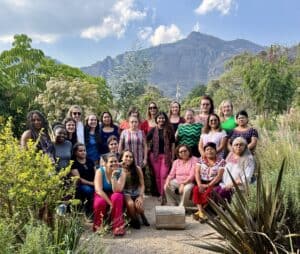
IGLI travels to New Mexico
“We want to be a hub for research and also a gathering hub for community,” Scheller shared, an ethos that is visible in how the center supports both faculty and students.
Faculty Support
From its earliest days, the center’s intention was clear: build an interdisciplinary body of research that cuts across silos, enabling faculty within Korbel and across DU departments such as the College of Arts, Humanities & Social Sciences, along with visiting scholars and practitioners, to collaborate in an ongoing exchange of ideas.
Supporting such research and collaboration means more than administrative coordination. It means working directly with faculty who secure external grants, offering frequent feedback, connecting research opportunities with available funding, and brainstorming programming ideas.
For example, Sié staff coordinate with affiliated faculty like Dr. Hilary Matfess, who leads a team of 14 research assistants as part of a grant on Women’s Mobilization Within Armed Groups During and After War, and support other leading projects on nuclear security, democratic erosion, climate transitions, and global economic restructuring. The center provides the backbone that allows these projects to scale.
Sié’s small staff team has always had an outsized impact. The centralized structure — typically a director and program manager partnership — creates a focused research support unit within the larger school.
“It allows us to specialize more in our program and, in some ways, be more creative with our programming,” Scheller explained. This tight coordination enables faster idea generation, more constructive brainstorming, and targeted administrative support for research projects, she said.
In addition, while high-level research often happens behind the scenes, the Sié Center ensures it does not stay there.
“Because we understand the wide-ranging research outputs of all faculty, we also try to support them in communicating to the public via social media and newsletter announcements to increase their exposure,” Scheller added.
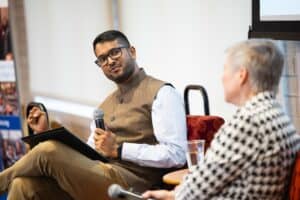
Faculty affiliate Debak Das hosts an event on nuclear arms and armament.
“The Sié Center is also about providing research resources to outstanding students,” said Scheller.
Between 30 and 40 students support affiliated faculty each academic year and do much more than research alone. Assistants develop skills in data collection, literature review curation, analytical writing, and subject-matter mastery, often working one-on-one with faculty in intensive mentorship relationships. Among these research assistants are the highly competitive Sié Fellows, who receive full scholarships that help remove financial barriers and embed students directly in active research.
These unique research experiences and direct line to Sié faculty affiliates have shaped many careers during students’ time at Korbel and after graduation. Here are just a few of many Sié student stories:
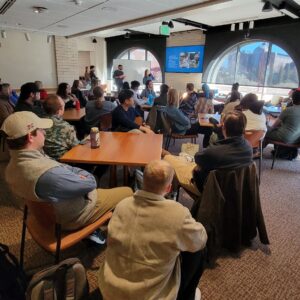
Korbel students attend one of the Center's many events
Universities produce important research, but that research does not always travel on its own. Centers and institutes create a structure that allows scholarships to thrive, even beyond academia.
“Centers provide increased research support and reduce systemic barriers for our faculty,” Scheller said. “As we are able to focus on our specific faculty’s research and needs, Sié allows resources to be allocated more specifically and efficiently to research clusters.”
Without that structure, research can happen more slowly, more sporadically. A center provides organizational scaffolding around research, bringing visibility to work already underway while helping faculty balance scholarship with public engagement, student mentorship, and grant development.
Beyond faculty initiatives, centers and institutes allow opportunities for greater student engagement “because they centralize research projects into both clear and tangible opportunities within the school,” Scheller added.
At the Sié Center, that structure translates into measurable impact that reframes traditional divides in global affairs and contributes to real-world understanding and experience.
The world of security and diplomacy is not static. Neither is the Sié Center.
“Times have always been tumultuous. But today’s foreign policy landscape moves quickly — and the public wants clarity,” Scheller said. “The Sié Center exists to ensure that when global events unfold, the experts are ready, the research is visible, and the next generation of scholars and practitioners is already engaged in the work.”
In the 2025–2026 academic year, programming highlights the human costs and policy dilemmas of Russia’s war in Ukraine; the restructuring of the global economic order under renewed U.S. tariffs; the power of cultural diplomacy through sports and the arts; and the domestic and international implications of a second Trump presidency, among many other pressing topics.
Student simulations, data workshops, and spring programming on nuclear proliferation, democratic erosion, genocide, and the global energy transition are already underway.
The center’s priority remains constant even as topics shift, as staff at Sié continue working directly with faculty to support their most impactful research and ensure that expertise informs public conversation.
“By linking faculty research to analysis of developments in world politics, the Sié Center highlights the importance of deep and free inquiry, independent of any given political wind,” said Dr. Epstein. “Our faculty and students remain committed to seeking the truth, no matter how unpopular or controversial it may be.”

The Josef Korbel School of Global and Public Affairs is proud to announce that Professor Deborah Avant has been recognized with the Distinguished Scholar Award by the International Studies Association’s International Security Studies Section (ISSS) and Interdisciplinary Studies Section (IDSS). This prestigious honor, awarded by an interdisciplinary community of scholars dedicated to addressing pressing global issues, recognizes her outstanding research, leadership, and influence in the field of international security.
Professor Avant is the Sié Chéou-Kang Chair and Distinguished University Professor at Korbel, where she is widely known for her expertise in global governance, security studies, and civil–military relations. As the award demonstrates, Professor Avant has built a truly exceptional career as a scholar, educator, and leader whose work has shaped how scholars and policymakers alike think about security and governance.
In the 2000s, Professor Avant broke new ground by studying private military and security companies and the prominent role they played in the U.S.-led wars in Iraq and Afghanistan. Her 2005 book The Market for Force: The Consequences of Privatizing Security earned widespread acclaim for exposing how outsourcing military power transforms conflict and global politics. Her analysis highlighted regulatory gaps and democratic risks.
In 2007, Avant testified before the U.S. Congress on the extensive role of private contractors to train Iraqi Security Forces, solidifying her reputation as a scholar whose research transcends the academy to shape strategic and impactful change. As the role of private military and security actors grew in scope and scale, her research and advocacy evolved in tandem, with Avant advancing pragmatic approaches to governance and accountability. For this pioneering work, she was later awarded an honorary doctorate by the University of St. Gallen.
"Through her distinguished career, the hallmark of Deborah's scholarship has been a remarkably broad-ranging intellect and an unusual comfort with complexity. Those attributes have made her work a model of engaged scholarship that seeks not only to understand an issue but also to inform those who would address it."
Frederick “Fritz” Mayer, Dean and Professor, Josef Korbel School of Global and Public Affairs
In 2011, Professor Avant became the Sié Chéou-Kang Chair and inaugural faculty director of the Korbel School’s Sié Chéou-Kang Center for International Security and Diplomacy (Sié Center). Under her leadership, the Center grew rapidly, welcoming new faculty, launching multiple initiatives, and becoming a model for engaged scholarship on security, peace, and governance. She built multidisciplinary programs and partnerships that brought together faculty and students on policy-relevant research projects.
Among other accomplishments, she and a team of faculty at the Sié Center secured a $1,000,000 grant from the Carnegie Corporation of New York in 2014 to research the peacebuilding role of nonviolent, non-state actors. This project became a centerpiece of the Sié Center’s research and scholarship.
Under Avant’s leadership, the Sié Center also became the first home of the Journal of Global Security Studies (JoGSS), a new journal launched by Avant under the auspices of the International Studies Association. As the founding Editor-in-Chief from 2016–2020, Avant shaped the journal around her vision of security as an interdisciplinary field, challenging scholars to examine security in broader global and societal contexts.
In 2016, she also published an edited volume The New Power Politics (with Oliver Westerwinter) which explored transnational security networks and illustrated how governance depends on actors like NGOs, businesses, and activists, as well as states. This was followed up by Civil Action and the Dynamics of Violence (edited with Marie Berry, Erica Chenoweth, Rachel Epstein, Cullen Hendrix, Oliver Kaplan, and Timothy Sisk), which showcases research stemming from the Carnegie Corporation-supported grant and examines how citizen-led non-violent efforts in conflict zones resist, reshape, and rebuild social order amid war.
Professor Avant has also held numerous leadership roles in the scholarly community. She served as ISA President from 2022–2023, guiding the profession during a time of renewed global challenges. In 2021, the University of Denver named her a Distinguished University Professor. Her service also includes editorial and advisory board roles. Outside the academy, she regularly advises governments, NGOs, and international organizations on security and governance. Through teaching and mentorship, Professor Avant has influenced a generation of students at Korbel and beyond.
“Dr. Avant was a fantastic professional role model, mentor, and scholar. She possesses a virtually unlimited capacity for scholarly and intellectual work, has built and leveraged a diverse network of professional colleagues to the advantage and edification of those around her, and can make the most unexpected connections between intellectual threads.”
Sarah Bakhtiari, PhD, (Colonel, retired), Korbel Class of 2016
The Distinguished Scholar Award from the ISSS and IDSS is more than an award. It signals recognition by the global community of scholars and practitioners that Avant’s work has moved the needle not just within international security studies but across disciplines and into real-world policy. For Korbel, it reinforces our position as a school where cutting-edge research, high-impact teaching, and global engagement come together.
“Deborah Avant is renowned for her path-breaking work in global governance, security studies, and civil-military relations. A hallmark of her scholarship, and central to its significance, is her interdisciplinary perspective, intertwined with her commitment to grappling empirically and conceptually with political phenomena that matter. In her many disciplinary roles — like serving as the founding editor-in-chief of the Journal of Global Security Studies — she has expanded the avenues for a broader conception of “security” within our discipline, encouraging cross-disciplinary approaches and bringing underrepresented voices into the scholarly conversation.”
Naazneen Barma, Professor and Director of the Scrivner Institute of Public Policy at the Josef Korbel School of Global and Public Affairs
The impact of Professor Avant’s work can be felt in classrooms, policy forums, and in the careers of the students she mentors. Korbel will continue building on that legacy: connecting students to global security practitioners, supporting interdisciplinary research, and convening dialogue on the great issues of our time. Her influence will guide the next generation of scholars, diplomats, and public leaders.
This reflection was written by Maddison Schink (MA, International Studies, 2027).
Over the University of Denver’s unique winter interterm, I spent nearly two weeks with Dr. Tamra Pearson d’Estree, a Korbel professor of conflict resolution, and a group of my peers in the Netherlands for a course on climate resilience and governance.
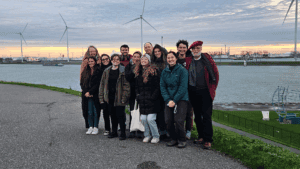
A group photo of participants in the Netherlands trip
Our group represented both first- and second-year students across Korbel’s graduate programs, from Global Environmental Sustainability to International Security and Global Economic Affairs, so a diversity of perspectives emerged and fostered deep questions during our site visits and rich conversations on the bus or over lunch. I am pursuing an M.A. in International Studies with a specialization in Environmental Conflict Resolution, so the part of the course that I found most interesting was visiting the House of Representatives and hearing about the Dutch polder model of governance, which is consensus-based and founded on ensuring that every party has a say in shaping the final decision. Considering the Netherlands’ long history of collectively contending with water, we realized the potential to draw upon their expertise to develop solutions to the international community’s growing challenges in the face of climate change.
For context, two of the Netherlands' top priorities are managing rising sea levels and shifting weather patterns that can result in inundation or drought. The country is a delta with many rivers, and much of the nation is below sea level. To help mitigate the dangers, the Netherlands has been engaging in centuries of land reclamation by using iconic windmills, which are now largely modern electric pumping stations that drain water and create arable plots of land called polders. Today, polders comprise around 20% of the country’s landmass.

The class explores renewable energy infrastructure
Throughout our travels, we repeatedly heard a phrase that summarizes the Dutch pride in their transformation efforts – God created the world, but the Dutch created the Netherlands. Without the Dutch people’s ongoing commitment to collaboration through the formation and cooperation of democratic regional water boards around the year 1200, the building of their nation would not have been possible.
Professor d’Estree arranged for us to visit four different cities throughout the country: Amsterdam, The Hague, Delft, and Groningen. Each location presented us with an opportunity to see firsthand the variety of old and new technologies that the Dutch are adapting — from dikes to giant moving storm surge barriers — to keep themselves safe from flooding. However, as leaders in engineering and spatial planning shared with us, infrastructure alone is not enough to keep everyone’s feet dry. The Dutch meaningfully involve the public in building community resilience and co-creating policies that will more equitably serve the Dutch people across rural and urban landscapes.
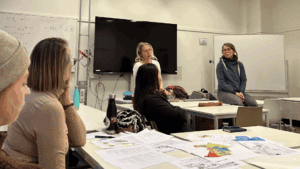
The class learns about community resilience and policy co-creation
In between lectures from local university professors and private tours to learn about the design and implementation of climate adaptation strategies, we enjoyed several festive Christmas markets, group coffee breaks to fuel us through lingering jet lag and writing our assigned journal reflections, scenic public transit adventures (I only nearly missed our train stop once!), and Dutch cuisine served on beautiful white and blue Royal Delft pottery at a traditional brown café.
We ended our time in the Netherlands reflecting on how we might carry what we learned into our continued studies at Korbel and our future careers. Growing up in Colorado and working at a nonprofit dedicated to convening diverse stakeholders around controversial environmental issues has shaped how I approach questions of governance and collaboration. In my final course paper, I am inspired to explore how elements of the Netherlands’ consensus-based approach to water governance, along with its emphasis on public engagement and education, might translate to an issue close to home: the complex and increasingly urgent renegotiation of the Colorado River Compact. Ultimately, this international travel course fulfilled its purpose by challenging Korbel students to think beyond borders and imagine new ways to address some of the most pressing global challenges, including climate change.
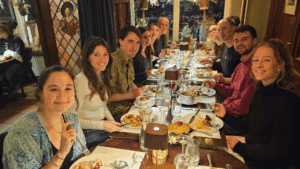
A group photo at dinner of participants in the Netherlands trip
At the Korbel School’s Frederick S. Pardee Institute for International Futures, research is more than an academic exercise; it’s about supporting a global community that tackles today’s most consequential issues - from climate and conflict to development and security.
The Pardee Institute collaborates with people who are invested in our global future, including officials in governments, intergovernmental organizations, and international agencies, as well as practitioners who carry out their decisions and those with a stake in the downstream effects of those decisions.
At the heart of this work is the International Futures integrated assessment model, a one-of-a-kind global forecasting tool that helps identify and analyze the fundamental forces driving change over the coming decades, informing smarter policy decisions and more resilient planning. This powerful forecasting platform simulates how changes in one system - like health or energy - ripple across others, from governance to education to the environment.
But behind the sophistication of IFs and the breadth of Pardee’s research portfolio is a driving force that helps bring it to life: students. In the 2024-25 academic year, 88 University of Denver students, primarily from the Korbel School, played an essential role in advancing the Institute’s work. Organized into six specialized teams, these students contributed to everything from data modeling and diplomacy research to communications and operations - bringing both depth and agility to Pardee’s global initiatives.
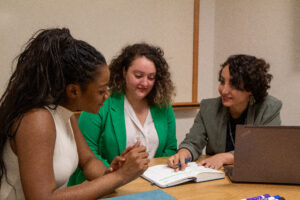
“The projects I worked on include Multilateral Treaties, UNGA, Embassies, and the IGOs. For each of these projects, I coded and vetted data, strengthening my attention to detail and improving my ability to work with complex datasets.”
-Maya Rai, Core Diplo
Some students work directly with the Pardee Institute’s flagship tool, the International Futures (IFs) model, contributing to both internal development and external research collaborations. Pardee Fellows - selected graduate students from the Korbel School - support scenario design, literature reviews, and client projects with global partners. Alongside them, the IFs Data Team maintains the model’s vast database, ensuring its accuracy and usability through technical work that supports long-term forecasting and real-world policy analysis.
Other teams focus on building the Institute’s empirical foundations. The Country and Organization Leader Travel (COLT) team, Pardee’s largest student cohort, maintains a one-of-a-kind dataset tracking the international travel of global leaders. Students gather and code open-source data, transforming it into structured insights that support diplomacy research. The Core Diplometrics team compiles data on international treaties, diplomatic representation, and organizational memberships, while the Perceived Mass Atrocities Dataset (PMAD) team contributed to a multi-year effort documenting mass atrocity events worldwide.
Meanwhile, the Institute’s communications and business operations are also student-powered. From managing Pardee’s web presence and writing research summaries to supporting HR, payroll, and event logistics, students help shape how the Institute functions and how its work is shared with the world. Their contributions ensure that Pardee’s insights reach diverse audiences - from policymakers to the public - with clarity, consistency, and professionalism.
Across all teams, students describe their experience at Pardee as transformative. They gain technical skills in data analysis, coding, and modeling; they refine their writing and communication abilities; and they learn to navigate the demands of collaborative, deadline-driven research. More than that, they find themselves contributing to projects with real-world relevance - projects that influence policy, inform global institutions, and shape public understanding.
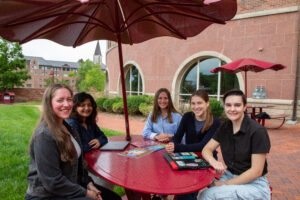
“The Pardee Institute has encouraged me to step out of my comfort zone and nurture my curiosity. My work here has refined my writing and critical thinking skills, equipping me for the professional world.”
-Wara Irfan, Marcom
As Director of Analysis Collin Meisel explains, this impact runs both ways. “Simply put, some of our research, like the COLT project, would not exist without our student research aides. Across this and many other projects, the unique perspectives that students bring, the questions they ask, the big and small suggestions they make, and the hard work they put in improves the work we do together in immeasurable ways. In turn, we aim to improve their professional lives and set our students up for future success, whether that be at a think tank, in government, an NGO, or whichever path they choose to carve in their career after Pardee.”
At the Pardee Institute, students don’t just get to join the conversation - they gain the skills to lead it, equipped with tools that last well beyond graduation. Their contributions are not auxiliary; they are essential. And in the process, these students are not only preparing for their futures - they’re helping to shape the future of global affairs.
For an in-depth look at the work taking place at the Pardee Institute, check out their 2024-2025 Annual Review.
This reflection was written by Ahmad Saleem (MA, International Security, 2025), one of four students selected to represent the Josef Korbel School of Global and Public Affairs at the 2025 Aspen Security Forum.
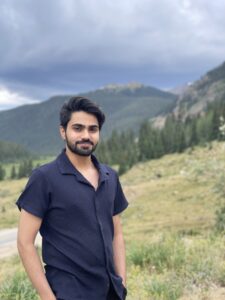
From July 15–18, I had the privilege of representing the Josef Korbel School of Global and Public Affairs as part of a student delegation at the 2025 Aspen Security Forum. As the only university partnered with the Forum, Korbel’s presence stood out—we were proud to be the only students attending among a distinguished gathering of world leaders, policymakers, and experts in global security.
The forum was insightful, exposing me to a wide range of opinions on pressing global issues. A recurring theme throughout the event was the growing role of artificial intelligence and cybersecurity in international security. In the session Cracking the Code: AI and National Security, we heard from Tarun Chhabra, Head of National Security at Anthropic and Distinguished Visiting Fellow at the Hoover Institution, Stanford University, and Katrina Mulligan from OpenAI for Government. These speakers, representing both public and private sectors, discussed how AI is poised to transform the security landscape. As an international security student, I was deeply intrigued by these discussions.
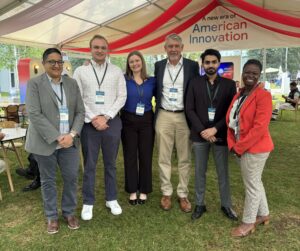
Another recurring theme was the future of European defense. A powerful session on this topic featured Baiba Braže, Minister of Foreign Affairs of Latvia. Following the discussion, our Korbel delegation had the privilege of engaging with the Latvian delegation, who kindly invited us to the upcoming Rīga Conference. Korbel also hosted a session at the Forum titled Russia, Ukraine, and Beyond. This session explored the geopolitical and defense implications of the Russia-Ukraine war and featured a remarkable lineup of speakers: Dr. Condoleezza Rice—Korbel alum and former U.S. Secretary of State—Pasi Rajala, Political State Secretary for Finland’s Foreign Ministry, and Halyna Yanchenko, Member of Ukraine’s Parliament and Head of the Investment Taskforce for the Defense Industry. The discussion emphasized the enduring importance of transatlantic partnerships and the need for sustained global support for Ukraine. It was a proud moment when Dr. Condoleezza Rice recognized Dean Fritz Mayer and the Korbel School for organizing the session.

The forum also came at a pivotal moment for Middle Eastern geopolitics. The session titled Israel at a Crossroads featured Amos Yadlin, former Chief of the IDF Intelligence Directorate, and Michael Herzog, former Israeli Ambassador to the U.S. and Tisch Distinguished Fellow at the Washington Institute for Near East Policy. They discussed Israel’s evolving strategic posture and described its military doctrine as one of “short, decisive, and limited war.” I appreciated that the forum also provided an alternative narrative through Dr. Vali Nasr’s book talk on Iran's Grand Strategy: A Political History. His presentation offered a deep dive into Iran’s domestic politics and its shifting strategic paradigms. Dr. Nasr argued that, in contrast to Israel’s doctrine, Iran’s strategy is oriented toward long-term, less decisive conflicts. These sessions together provided a comprehensive and nuanced understanding of regional dynamics.
One of the most fascinating sessions for me was Great Power Competition – Global POVs. This panel offered compelling perspectives from the Global South and included speakers such as Hina Rabbani Khar, Former Foreign Minister of Pakistan; Claudia Ruiz Massieu, Former Foreign Minister of Mexico; and Balázs Orbán, Political Director to the Hungarian Prime Minister. It was especially insightful to hear how different regions interpret great power dynamics—and why including these voices is crucial for shaping inclusive global policy.
Outside the formal sessions, I, along with other Korbel students, was invited to informal networking opportunities. These provided a chance to connect with professionals working in tech, defense, and government. As someone who aspires to work in think tanks, especially in Washington, D.C., I was excited to meet individuals from the Atlantic Council, Aspen Institute, Center for a New American Security, and Delphi Global. Many of them were already familiar with the Korbel School and expressed willingness to support me and my fellow students in our career journeys. Beyond these professionals, I also met a Stanford graduate who had recently founded an AI company supporting semiconductor development. These connections helped me not only network professionally but also draw inspiration from fellow academics and innovators.
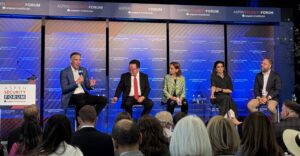
I returned from Aspen with a new perspective on global security issues and a wealth of connections. I truly felt that this opportunity, along with the Korbel School, provided a bridge between theoretical knowledge and real-world practice. I am deeply grateful to Dean Fritz Mayer, Prof. Naazneen Barma, and the Scrivner Institute of Public Policy for providing this opportunity. Experiences like this are a powerful reminder of how the Korbel School continues to empower students like me to connect academic learning with real-world policy and practice.
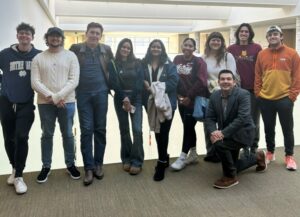
Dr. Chavez-Norgaard hosts a class trip to the History Colorado Center with undergraduates taking "PPOL 3701: Urban Politics."
Teaching Assistant Professor Dr. Stefan Chavez-Norgaard’s lifelong interest in public policy began at just six years old. As he took Philadelphia’s SEPTA train from his grandparents’ house to Center City, he was struck by the disparate quality of livelihoods visible from his window. “Even as a young kid,” he said, “I was shocked by the inequalities that the city line could mean in terms of land use, tree cover, and house size.”
That early awareness of inequity sparked a lifelong passion for public policy and urban planning, one that eventually brought him to the Josef Korbel School of Global and Public Affairs, where he is now completing his first year as a faculty member.
“That’s where it all started,” he reflected. “A six-year-old visiting his grandparents with his mom and dad.”
That moment on the train sparked more than curiosity; it ignited a lifelong commitment to understanding how people with different lived experiences exist alongside one another, and how systems can either support or hinder that possibility. “The throughline across all my research is how can people of different backgrounds — racial, ethnic, gender, and class — live together side by side, as opposed to being separated by walls, segregation, and disparity,” Dr. Chavez-Norgaard explained.
That guiding question led him to Johannesburg, South Africa, where he returned many times to study the Born Free Generation: the first cohort to come of age without direct memory of apartheid. “This generation represented a really amazing historical moment — a society of explicit racial hierarchy and oppression giving way to a multiracial democracy,” he said.
Dr. Chavez-Norgaard’s research centers on local democratic governance — bottom-up forms of engagement — and in Johannesburg, he found a powerful case study of a multiracial society striving to transcend its past. “I’ve stayed in touch with many of the original interviewees from my undergraduate thesis. They became interviewees in my PhD dissertation — and now, I would call them friends.”
The insights gained from this work not only shaped his academic journey but also drew him to Colorado, where he was born and raised, and where the intersection of democratic engagement and urban development offered new opportunities to continue his exploration. So, when the opening for a faculty position at the Korbel School popped up, Dr. Chavez-Norgaard was immediately interested. “There’s a sort of pragmatism about democratic problem solving in Colorado,” he said. “And then there’s the nature and beauty of the region as well as dynamism and growth.”
Throughout his first year, Dr. Chavez-Norgaard visited neighborhood associations and community organizations, which led to involvement in projects like the East Colfax Bus Rapid Transit (BRT) project. The effort to bring public transportation to this part of Denver required collaboration among a diverse range of stakeholders, creating a dynamic participatory process at the intersection of democratic principles and urban planning. “Who’s the envisioned rider of such a system?” he asked himself. “What about the displacement of existing residents of Colfax? Is BRT along Colfax even the right answer?” Projects like this, and the complex questions they raise, have affirmed that coming to Colorado was the right decision — a place where his research can take root and make a tangible impact.
All Dr. Chavez-Norgaard’s efforts networking across the city culminated in making his debut Public Policy Analysis classes possible – one for undergraduates and another for graduate students. “These aren’t your typical lecture-based courses,” he said. “They’re chances for students to dive into real-world policy work, connect with professionals, and explore how cities like Denver interact globally.” Throughout the quarter, students meet with a lineup of inspiring guest speakers, taking an experiential learning approach.
Some of the guest speakers are former ambassadors, representatives from institutions like the Truman Center, the Pacific Disaster Center, World Denver, and multiple members of the Colorado Consular Corps. Students work directly with the U.S. Department of State and Colorado’s Office of Economic Development and International Trade (OEDIT) on client-based projects.
Much of this is powered by the Korbel alumni network, which plays a big role in opening doors. Former students now working in these agencies are eager to give back, mentoring current students, and bringing their professional world into the classroom.
Dr. Chavez-Norgaard’s first year at Korbel has been defined by connection to his colleagues, students, and the broader Denver community. By grounding his teaching in hands-on experiences and his research in questions that matter across borders and backgrounds, he’s created a learning environment that is as intellectually rigorous as it is personally meaningful.
“I’ve felt welcomed and supported by the Korbel faculty from the very beginning, and I’m hoping to grow alongside faculty and staff colleagues at Korbel, whom I hope I can think of as lifelong friends,” he shared. That spirit of collaboration and purpose is shaping not just his own path, but the journeys of the next generation of public policy leaders — students learning to navigate complexity with clarity, empathy, and a drive to make a difference.
Dr. Hilary Matfess, Assistant Professor and Director of Korbel’s International Security Degree, never planned to study gender and war. However, a series of unexpected obstacles early in her career forced her to rethink her approach and ignited a passion for uncovering overlooked narratives—one that continues to fuel her work today.
“I love telling my students how I started this work because my entire career is an exercise in serendipity and mistakes,” she said.
From Serendipity to Passion
Dr. Matfess, who has taught at Korbel since 2021 and is an affiliate of the Sié Chéou-Kang Center for International Security and Diplomacy, examines how women mobilize for war globally with a focus on sub-Saharan Africa. She looks at what they do in non-state armed groups, “which is a clunky academic term,” she explained, “for any group that’s not ‘official’ state military.” Her work explores why women join these groups, their roles, and their personal experiences within them.
“When I was getting my master's degree, I had the opportunity to work as a research assistant tracking political or social violence in Nigeria,” she said. When she arrived to study Boko Haram, Dr. Matfess found that she couldn’t access the armed men at the heart of the conflict. “I was ambitious enough to think I’d get to the bottom of Boko Haram as a 20-something. Turns out, insurgencies are very good at staying hidden. I was really frustrated that I couldn't sit down with the people that I thought were at the heart of the war, which would be armed young men my age or younger.”
Fortunately for Dr. Matfess, what started as a roadblock became an opportunity that would shape the course of her work for years to come.
“Through other activists, practitioners, and academics, I landed interviews in displacement camps and with people who fled the crisis. Mostly women. Really embarrassingly, I treated them like a consolation prize at first, but they revealed conflict dynamics that I didn't see reflected in any of the narratives around Boko Haram. From then on, I became obsessed with shedding light on this under-explored dynamic of how armed groups function.”
Bringing Women’s Experiences from the Margins into the Light
Much of Dr. Matfess's research feels like assembling a puzzle with missing pieces. Alongside Associate Professor Meredith Loken, who teaches at the University of Amsterdam, she built the Women’s Activities in Armed Rebellion (WAAR) Dataset—tracking women’s roles across more than 350 rebel groups worldwide. The challenge? “Women’s experiences are often tucked away in offhand comments or footnotes, if they’re mentioned at all. It can be hard to track them down.”
Women’s experiences reveal how policymakers need to respond to crises and how counterinsurgency responses should adapt. “Bringing women’s experiences from the margins into the light — that’s the work. It’s essential to understanding not only conflict itself but also how we build more effective policies for peace.”
Celebrating Women’s History Month: Honoring Women's Stories in March and Beyond
For Dr. Matfess, Women’s History Month has been less about grand gestures and more about reaffirming why her work matters daily. “It’s a reminder of the power of global women’s networks, activism, and what’s possible when we center gender in building political movements and communities of care,” she said.
Her perspective is a call to action—one that acknowledges both progress and persistent challenges. As she points out, “We’re living through a backlash moment on gender equality, and it’s exhausting. We need to rebrand more inclusive institutions as meritocracies because that’s what they’ve always been. It’s not about political correctness. The best person for the job only emerges when the playing field is actually level.”
Dr. Matfess brings this same urgency and dedication into the classroom. As degree director for International Security, she prepares her students for careers ranging from defense and intelligence to advocacy and policy analysis, emphasizing that security extends beyond military might to include human security, gender justice, and economic stability.
Her students, in turn, fuel her optimism. “They care so much about the world, and they challenge me every day with fresh questions and new perspectives.” Their passion and curiosity reflect the change Women’s History Month and work like hers seek to inspire—not just in March, but every day. To learn more about Dr. Matfess's work, visit her website here.
Women’s History Month is a moment to reflect not only on women’s achievements but also on the untold stories of women whose experiences are often pushed to the margins—including those in conflict zones. To learn more, visit the official Women’s History Month website, or check out Korbel's initiatives through our Inclusive Global Leadership Initiative (IGLI).
Studying abroad at the Korbel School isn’t just about hitting the books in a different country. It’s about creating opportunities for students to immerse themselves in new cultures, network with global leaders, and dare to redefine their futures. The month between the Fall and Winter Quarters — called “Winter Interterm” — is a chance for Korbel students to embrace these experiences.
This year, graduate and undergraduate students took three separate faculty-led academic trips to Kenya, Colombia, and the Balkans.
Researching Green Energy in Kenya
For Grecia Castel, a first-year Global Economic Affairs MA student, the study abroad program in Nairobi, Kenya was a deep dive into her passion for sustainability and green energy. “I got to research what I was passionate about while also talking to locals about real-world issues,” Grecia said.
Assistant Professor Singumbe Muyeba and Postdoctoral Research Assistant Abigail Kabandula led the trip in collaboration with faculty from the University of Nairobi’s Department of Diplomacy and International Studies. Dr. Muyeba and Dr. Kabandula supplemented these lessons with research activities across the city, bringing students to United Nations offices and the Parliament of Kenya to experience Kenya’s green energy transition first-hand. “I learned how representatives write environmental law into the Constitution,” Grecia said.
Alongside their studies, there was time to explore the African countryside, too. “We got to see some lions in the middle of a hunt, and they even used the tourist vehicles to get closer to their prey. Everyone was quiet, and it was really interesting to watch and wait. It felt like National Geographic in real life,” Grecia said.
Connecting with Leaders in the Balkans
Teaching Associate Professor Keith Gehring led a group of undergraduates to the Balkans. “Dr. Gehring’s enthusiasm was contagious,” Micah DenBraber said, a junior majoring in International Affairs. “Whether we were meeting with local politicians or just walking the streets, he made everything feel incredibly relevant and personal.”
The group’s itinerary included lectures at the University of Osijek, oral histories on pivotal events like the siege of Vukovar, visits to Parliamentary Assemblies in Belgrade and Sarajevo, and meetings with Serbian and US ambassadors. The trip was grounded in experiences with locals across the Balkans, ranging from personal accounts of local conflict to lectures about diplomatic relations.
“The opportunity helped me understand how leaders relate to their people and what a dysfunctional nation-state looks like,” Micah said. “We talked to politicians, including Marina Raguš, a Serbian parliamentarian, and even attended a lecture from the chair of the Serbian Parliament’s foreign affairs committee in the actual parliamentary hall. That was really cool.” Alongside his studies, Micah shared how life-changing it was to spend mornings in a city like Sarajevo. “I’d wake up to the call to prayer echoing across the city. From my hotel room, I had an amazing view of all the minarets lit up at twilight. It was something I’ll never forget.”
A Career Epiphany in Colombia
“I always pictured myself as an intelligence analyst,” Helen Lee, a first-year International Security MA student, shares. “But after this trip, I realized I might actually want a career where I can travel, engage with people, and be on the ground. That was a huge shift for me.”
Associate Professor Oliver Kaplan and Associate Dean for Academic Programs and Student Affairs Lewis Griffith accompanied students to Colombia, where they toured Bogotá and engaged in meaningful conversations with government officials at the University of the Andes. They also traveled to Zipacón, a region famous for coffee cultivation, hearing from organizers about sustainability in the area. Students interviewed locals to hear what political advocacy looked like from people on the ground.
And for Helen, a simple late-night conversation in a hammock with a fellow student turned into an unforgettable bonding experience. “We stayed up until 3:30 in the morning, just talking about everything—life, career goals, travel. You build these relationships that you wouldn’t have in a normal classroom setting.”
Take the Leap
One thing all three students agreed on: spending December abroad was worth it. “Since this is only a two-year program,” Helen said, “I didn’t want to miss too much of my time here. So when I saw that there was a Winter Interterm program, I thought, ‘perfect!’”
Micah says that even the Winter Interterm application process at Korbel incentivized travel. “Applying was super easy. I wasn’t nervous because I knew it was a great fit. If you’re applying for a trip and don’t know much about the host location, that is totally fine. You come to Korbel for opportunities like this. Not every school has experts with such incredible networks and first-hand experience. You can’t put a price on that.”
All three students emphasized how invaluable traveling with peers in their cohort was. “It’s a unique experience you’re all sharing at the same time,” Grecia said, “so you get to know each other very well and very quickly.”
To learn more about earning a degree at the Korbel school, contact us here.
Copyright ©2026 University of Denver | All rights reserved | The University of Denver is an equal opportunity institution