
Join us for Open House on November 13, 2026. Register now.

Menu

Menu
Join us for Open House on November 13, 2026. Register now.
Hughes, B. B. (2026). International Futures: Exploring and Shaping. London Academic Press, An Imprint Of Elsevier.
eBook ISBN: 978-3-032-22084-4
ISBN: 978-3-032-22083-7
Pardee Institute founding Director, Barry Hughes, has published the fifth edition of Exploring and Shaping International Futures, an open-access book that makes the foundations of International Futures available as a practical guide for learning, teaching, scenario analysis, and long-term policy thinking.
The book updates earlier editions for the eighth generation of IFs and is organized around three questions: What future would we like? Where do current trends appear to be taking us? And what leverage do people and institutions have to shape what comes next? Across chapters on population, economics, human well-being, food and agriculture, energy, the environment, and domestic and global sociopolitical systems, Hughes connects forecasts, model insights, and points of intervention to help readers examine uncertainty, choices, and possible futures.
Moyer, Jonathan D., & Meisel, Collin J. (2026, March 16). “Climate change modelling and international relations: in pursuit of an integrated, long-term research agenda” in Handbook on the Geopolitics of Sustainability. (pgs. 368-378). Edward Elgar Publishing.
In this book chapter, Pardee Institute Director Jonathan Moyer and Director of Analysis Collin Meisel, identify a crucial disciplinary gap between international relations theory and climate change modelling. To help bridge this divide, Moyer and Meisel call for an integrated research agenda that aligns international relations with the long-term, large-scale quantitative forecasting models utilized by climate researchers. By incorporating a “systems map” approach, researchers can establish a baseline forecast of the international system to test the complex, interacting geopolitical impacts of direct climate effects, mitigation, and adaptation.
Explore the full chapter here.
Sweijs, T., & Michaels, J. (2024, July). "Forecasting the future of war" in Beyond Ukraine: Debating the future of war. (pp. 287–303). Oxford University Press.
Collin Meisel publishes a book chapter in Beyond Ukraine: Debating the Future of War. An edited volume on how Russia's 2022 invasion of Ukraine has affected our understanding of the future of war. Collin's chapter discusses what makes the prediction of its onset over long time horizons particularly unknowable and how to deal with this unknowability. The chapter is titled "Forecasting the future of war," with releases in Europe this month and in the US this August.
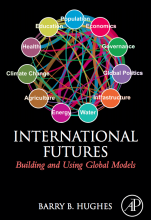
Hughes, B. B. (2019). International Futures: Building and Using Global Models. London Academic Press, An Imprint Of Elsevier.
eBook ISBN: 9780128134221
Hardcover ISBN: 9780128042717
In March 2019, International Futures: Building and Using Global Models by Barry B. Hughes was published by Elsevier Academic Press. The volume has two purposes: (1) to explain (by no means fully document) the International Futures (IFs) model system and (2) to place it in the context of the larger environment of global modeling. It thereby is commentary on the state of the enterprise of building and using global models, its strengths and challenges.
Founding Director of the Pardee Center and developer of IFs, Dr. Hughes is a Distinguished University Professor at the Korbel School and now serves as Senior Scientist and Mentor to the Center. His principal interests are in global change, computer simulation models for economic, energy, food, population, environmental, and sociopolitical forecasting, and policy analysis. The fundamental concerns that synthesize these interests are developing effective response to long-term global change and improving the long-term human condition.
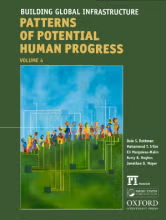
M.T., Hughes, B.B., Dale S. Rothman Margolese-Malin, E., Moyer, J.D. (2014). Building global infrastructure: Forecasting the next 50 years (Patterns of potential human progress volume 4). Routledge.
Volume 4 in the PPHP series tells a story of possible futures for basic infrastructure (access to all-season roads, electricity, improved water and sanitation, and information and communication technologies) across the globe. Questions addressed by Building Global Infrastructure are:
Additional Resources:
Base Case End Tables Using IFs 7.0.2
Base Case End Tables
Alternate Scenario 1 End Tables Using IFs 7.0.2
Infrastructure Good Performance 2050 Targets
Alternate Scenario 2 End Tables Using IFs 7.0.2
Infrastructure Universal 2050 Targets
Summary Scenario Annotations, All PPHP Volumes
PPHP Summary Scenario Annotations
Detailed Scenario Annotations, All PPHP Volumes
PPHP Detailed Scenario Annotations
Pardee Center for International Futures (Barry B. Hughes, ed.). 2013.
“Development-Oriented Policies and Alternative Human Development Paths: Aggressive but Reasonable Interventions.” In Khalid Malik and Maurice Kugler, eds., Human Progress and the Rising South. UNDP
Irfan, Mohammod T., and Eli S. Margolese-Malin. 2012.
“SADC Higher Education Futures 2050.” In Building Higher Education Scenarios 2025: A Strategic Agenda for Development in SADC. SARUA Leadership Dialogue Series Volume 2. South Africa: Southern African Regional Universities Association (SARUA), 6−24.
Authors: Mohammod T. Irfan and Eli S. Margolese-Malin
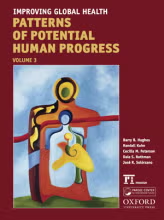
Hughes, B.B., Kuhn, R., Peterson, C.M., Rothman, D.S., Solorzano, J.R. (2011). Improving global health: Forecasting the next 50 years (Patterns of potential human progress volume 3). Routledge.
The questions addressed in Improving Global Health, the third volume in the PPHP series, are:
Additional Resources:
Base Case End Tables Using IFs 7.0.2
Base Case End Tables
Alternate Scenario 1 End Tables Using IFs 7.0.2
Health All Drivers Good Adjusted Base
Alternate Scenario 2 End Tables Using IFs 7.0.2
Health Things Go Wrong
Summary Scenario Annotations, All PPHP Volumes
PPHP Summary Scenario Annotations
Detailed Scenario Annotations, All PPHP Volumes
PPHP Detailed Scenario Annotations
Hughes, Barry B., Jonathan D. Moyer, and Timothy D. Sisk. 2011. “Vulnerability to Intrastate Conflict: Evaluating Quantitative Measures.” Peaceworks No. 72. United States Institute of Peace, Washington, DC.
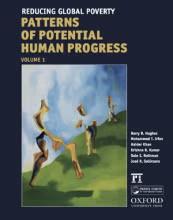
Hughes, B.B, Irfan, M.T., Khan, H., Kumar, K.B., Rothman, D.S. (2015). Reducing global poverty: Forecasting the next 50 years (Patterns of potential human progress volume 1). Routledge.
The ambitious Patterns of Potential Human Progress series was inspired by the United Nations Human Development Reports, the United Nations Millennium Development Goals (MDGs), and other initiatives to improve the global human condition. The foundational element of those initiatives, reducing poverty worldwide, is the focus of this book, the first volume in the PPHP series.
Reducing Global Poverty uses a large-scale computer program called International Futures (IFs), developed over three decades and based and the Frederick S. Pardee Center for International Futures within the Josef Korbel School of Global and Public Affairs at the University of Denver. The book presents the most extensive set of forecasts of global and country-level poverty ever made, providing and exploring a massive multi-issue database and a wide range of scenarios. The forecasts are long term, looking 50 years into the future, thereby anticipating the need of the global community to think well beyond the MDGs.
Additional Resources:
Base Case End Tables Using IFs Version 7.02
Base Case End Tables
Alternate Scenario 1 End Tables Using IFs Version 7.02
Poverty Combined Domestic Interventions
Alternate Scenario 2 End Tables Using IFs Version 7.02
Poverty Combined International Interventions
Alternate Scenario 3 End Tables Using IFs Version 7.02
Poverty Combined Domestic and International Interventions
Summary Scenario Annotations, All PPHP Volumes
PPHP Summary Scenario Annotations
Detailed Scenario Annotations, All PPHP Volumes
PPHP Detailed Scenario Annotations
Copyright ©2026 University of Denver | All rights reserved | The University of Denver is an equal opportunity institution