
Join us for Open House on November 13, 2026. Register now.

Menu

Menu
Join us for Open House on November 13, 2026. Register now.
Citation: Meisel, C. (2026, August 26). Toward a “mini-polar” future: Where do Africa and Europe stand? Federation of German Industries. https://bdi.eu/en/articles/internationales/toward-a-mini-polar-future-where-do-africa-and-europe-stand
Abstract:
We published this article as part of The Future of African-European Relations project, a collaboration among BDI, the Institute for Security Studies, the Hanns Seidel Foundation, and the Megatrends Afrika consortium. In “ Toward a ‘mini-polar’ future: where do Africa and Europe stand?” Collin uses International Futures (IFs) forecasts to examine how global power may shift by 2050, with the United States and China remaining the two largest poles while the EU and India retain enough weight to influence outcomes in key regions and issue areas.
The article argues that Africa’s demographic and economic rise will give many African states greater room to shape partnerships, even if no individual African country or the African Union is likely to become a full “mini-pole” by 2050. For Europe and Africa, the strategic question centers on how today’s policy choices on trade, migration, governance, security, and partnership will define whether a more diffuse global order leads to cooperation or rivalry.
How can long-term analysis help decision-makers prepare for futures that are uncertain, interconnected, and still partly knowable?

That question guided a three-day foresight and forecasting training in Rwanda, from May 4th to the 6th, where the Pardee Institute joined Rwanda’s National Council for Science and Technology, AUDA-NEPAD, and the Institute for Security Studies (ISS) to introduce participants to International Futures (IFs), Pardee’s open-source, integrated forecasting platform.
Led in part by Taylor Hanna, Associate Director of Development Analysis at Pardee, the training brought together 33 participants for hands-on engagement with IFs. Over the three days, participants explored the model, built and tested scenarios, and discussed how integrated forecasts can support long-term planning across complex development systems.
The training connected continental and national planning questions. Participants examined how IFs supported analysis related to the African Union’s Agenda 2063 Second Ten-Year Implementation Plan and considered how scenario-based approaches can inform Rwanda’s Vision 2050. Hanna stated, “This kind of analysis helps bridge the gap between long-term ambitions such as Vision 2050 and Agenda 2063 and the practical steps needed to achieve them.” Rather than treating development goals as isolated targets, IFs enables users to explore how changes in areas such as education, health, infrastructure, governance, economics, and the environment may interact over time. The participants tested a scenario to explore the effects of meeting national R&D investment targets on productivity.
The training also builds on Pardee’s longstanding relationships with ISS and AUDA-NEPAD. Through the African Futures Project, Pardee has collaborated with both institutions to support long-term strategic analysis across the African continent. AUDA-NEPAD’s mandate includes strengthening the capacity of African Union member states and regional bodies, while ISS’s African Futures and Innovation program provides forward-looking policy analysis on Africa’s development prospects using dynamic forecasting tools.
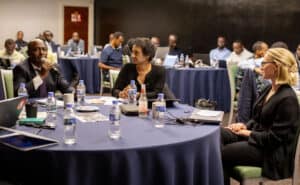
“What stood out most was the enthusiasm participants brought to thinking about Rwanda’s future. Putting integrated forecasting and scenario tools in the hands of policymakers allows them to test ideas, explore alternative futures, and better understand how decisions in one area affect outcomes across the development system,” reflected Hanna. For Pardee, this exchange reflected one of the central purposes of capacity-building: creating space for policymakers, researchers, and practitioners to work with shared tools, transparent assumptions, and a common language for thinking about the future.
Moyer, Jonathan D., Abigail Kabandula, David K. Bohl, Vivian Yang, Kaylin McNeil, Yutang Xiong, Ibrahim Mayaki, Martin Bwalya, George Murumba, and Bernice Mclean. 2021.
"COVID-19: The Future of African Development Systems." Frederick S. Pardee Center for International Futures, Josef Korbel School of Global and Public Affairs, University of Denver. Denver, CO. Report with African Union Development Agency (AUDA-NEPAD).
Moyer, Jonathan D. and Kabandula, Abigail and Bohl, David and Hanna, Taylor, Conditions for Success in the Implementation of the African Continental Free Trade Agreement (2021). Available at SSRN: https://ssrn.com/abstract=3941470 or https://dx.doi.org/10.2139/ssrn.3941470
"Conditions for Success in the Implementation of the African Continental Free Trade Agreement." Frederick S. Pardee Center for International Futures, Josef Korbel School of Global and Public Affairs, University of Denver. Denver, CO. Report for African Union Development Agency, NEPAD.
View the report in English.
View the report in French.
View the reference report in English.
Moyer, J.D., Bohl, D.K., Hanna, T., Mayaki, I. and Bwalya, M. (2018). Africa’s path to 2063: Choice in the face of great transformation.
Denver, CO and Midrand, Johannesburg: Frederick S. Pardee Center for International Futures and NEPAD Planning and Coordinating Agency
Africa’s Path to 2063: Choice in the Face of Great Transformation is a report researched and written by the Pardee Center’s Jonathan D. Moyer, David K. Bohl, and Taylor Hanna, in collaboration with Ibrahim Mayaki and Martin Bwalya from New Partnership for Africa’s Development (NEPAD), the technical arm of the African Union.
Invited by the African Union and launched in February 2019 at the 32nd African Union Summit and the 37th. Session of NEPAD Heads of State and Government Orientation Committee Meeting. the report uses IFs to take a long-term, macro, and integrated approach to thinking about four transformations already taking place in Africa: demography, human development and inequality, technology, and the environment. The analysis seeks to inform policy, investment, and development choices for Africa’s pursuit of Agenda 2063 and the United Nation’s Sustainable Development Goals.
ISBN-13: 978-1-7335865-0-4
Moyer, J.D., Bohl, D.K., Hanna, T., Mayaki, I. and Bwalya, M. (2018). Africa’s path to 2063: Choice in the face of great transformation. Denver, CO and Midrand, Johannesburg: Frederick S. Pardee Center for International Futures and NEPAD Planning and Coordinating Agency
Moyer, Jonathan D., David K. Bohl, Taylor Hanna, Ibrahim Mayaki, and Martin Bwalya. 2018.
Africa’s Path to 2063: Choice in the Face of Great Transformation is a report researched and written by the Pardee Center’s Jonathan D. Moyer, David K. Bohl, and Taylor Hanna, in collaboration with Ibrahim Mayaki and Martin Bwalya from New Partnership for Africa’s Development (NEPAD), the technical arm of the African Union.
Invited by the African Union and launched in February 2019 at the 32nd African Union Summit and the 37th. Session of NEPAD Heads of State and Government Orientation Committee Meeting. the report uses IFs to take a long-term, macro, and integrated approach to thinking about four transformations already taking place in Africa: demography, human development and inequality, technology, and the environment. The analysis seeks to inform policy, investment, and development choices for Africa’s pursuit of Agenda 2063 and the United Nation’s Sustainable Development Goals.
Moyer, J.D., Bohl, D.K., Hanna, T., Mayaki, I. and Bwalya, M. (2018). Africa’s path to 2063: Choice in the face of great transformation. Denver, CO and Midrand, Johannesburg: Frederick S. Pardee Center for International Futures and NEPAD Planning and Coordinating Agency
Hedden, Steve, Barry B. Hughes, Dale S. Rothman, Alanna J. Markle, Joel Maweni, and Ibrahim A. Mayaki. 2016.
"Ending Hunger in Africa: The Elimination of Hunger and Food Insecurity on the African Continent by 2025: Conditions for Success." Invited Research Paper for The New Partnership for African Development Planning and Coordinating Agency. Frederick S. Pardee Center for International Futures, Josef Korbel School of Global and Public Affairs, University of Denver. Denver, CO.
Moyer, Jonathan D., Jessica Rettig, David K. Bohl, and Barry B. Hughes. 2013.
"NEPAD’s Integrated Approach for African Development: The Big Push to 2063." Invited Research Paper for The New Partnership for African Development Planning and Coordinating Agency. Frederick S. Pardee Center for International Futures, Josef Korbel School of Global and Public Affairs, University of Denver. Denver, CO.
Copyright ©2026 University of Denver | All rights reserved | The University of Denver is an equal opportunity institution