Join us for Open House on November 13, 2026. Register now.

Menu

Menu
Join us for Open House on November 13, 2026. Register now.
Shape the future through public policy. This program prepares you for a meaningful career in government, international organizations, NGOs, or the private sector, addressing a wide range of policy issues.
You’ll master quantitative and qualitative methods to define policy problems and analyze potential solutions, gain expertise in the issues that matter to you, and develop practical skills to effect change. And because the program is embedded within a school of international affairs, you have the option of an international track to enrich your global perspective.
Whether you’re driven by a passion for creating economic opportunity or affordable housing at the state and local level, addressing budget or welfare issues at the national level, or confronting global challenges, you’ll find the tools and support needed to make a difference.
Program length
60 credits
Degree awarded
Master of Public Policy
Course delivery
On campus
Term length
10 week quarter
Admission & merit aid priority deadline
Priority: October 15, 2026, followed by rolling admissions

PPOL 4200

4 Credits
PPOL 4400
4 Credits
PPOL 4500
4 Credits
PPOL 4352
2 Credits
PPOL 4353
2 Credits
INTS 4057
4 Credits
Learn More

Learn More
Learn More
Learn More
Learn More
Learn More
Learn More
Strategic Intelligence
TRAN 4100
4 Credits
View Info

TRAN 4110
4 Credits
View Info
TRAN 4120
4 Credits
View Info
TRAN 4130
4 Credits
View Info
TRAN 4140
4 Credits
View Info
TRAN 4150
4 Credits
View Info
TRAN 4160
4 Credits
View Info
TRAN 4170
4 Credits
View Info
TRAN 4180
4 Credits
View Info
TRAN 4190
4 Credits
View Info
TRAN 4901
4 Credits
View Info
TRAN 4902
4 Credits
View Info

Hands-on experience is essential to your success. You’ll find an abundance of opportunities to develop your professional skills and explore career paths.
Build experience across city, state, and national government agencies, international organizations, global NGOs, and the private sector. With guidance from our career coaches, you’ll land positions that align with your skills and interests.
Join one of our simulations for a taste of on-the-ground realities in an interactive environment. From negotiating international conflicts to managing humanitarian crises, these engaging scenarios are a highlight for Korbel students.
Korbel students have the opportunity to study in vibrant cities like Rio de Janeiro, Geneva, Vienna, and Washington, D.C. These experiences offer rich firsthand experience and insights, all at no additional tuition cost.
At Korbel, research directly contributes to real-world impact. Many students engage in applied research at our Pardee Institute for International Futures, serving clients like the US government, the United Nations, and the Africa Union.
Ready to Take The Next Step
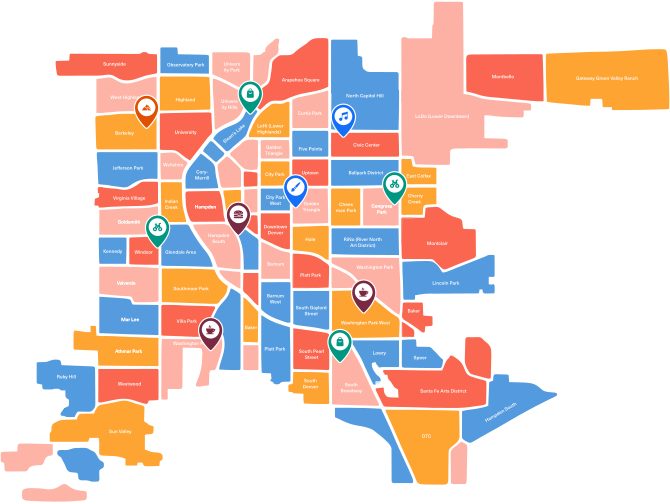
Balance your graduate work with an active outdoor lifestyle in the Mile-High City. Take advantage of a vibrant art, music, and food scene — while enjoying Colorado’s 300 days of sunshine each year.
Explore


The practical, real-world skills I learned in the MPP program helped prepare me for my current role by being able to critically analyze existing policies, understand all possible implications, and come up with creative ideas that then inform conversations with state and school district leaders to drive more meaningful outcomes for all students.

My career goal is to lead in ESG and corporate responsibility strategy, helping businesses align their operations with social and environmental impact. The MPP program is equipping me with the analytical, negotiation, and policy design skills I need to drive that change—bridging the gap between business goals and public good.
MPP applicants come from diverse academic and professional backgrounds. No specific major is required. Quantitative readiness is helpful but not mandatory.
The MPP program equips students to analyze, design, and evaluate public policies at local, national, and international levels. The curriculum combines quantitative policy analysis, economics, research methods, and practical skills related to governance, program evaluation, and policy implementation.
Korbel’s MPP integrates domestic and international policy, allowing students to combine traditional public policy training with global affairs coursework. Students can also take interdisciplinary electives across the University of Denver.
Graduates work in government agencies, consulting firms, nonprofits, research organizations, legislative offices, and international organizations. Common roles include policy analyst, program evaluator, researcher, and government affairs specialist.
The MPP program is built around a core quantitative foundation —statistics, data and evaluation, policy analysis — paired with opportunities to develop qualitative research and strategic communication and policy writing skills. Students can tailor the level of quantitative rigor based on their career goals.
Students complete a rigorous core plus electives that allow for specialization. Popular elective clusters include environmental policy, global governance, national security policy, poverty and inequality, and international development. The program is designed to be completed in two years full-time.
All MPP students complete an applied policy memorandum, which is primarily student driven on a topic of their choice (ideally related to the student’s specialization). Students often work with a real client to produce a professional policy analysis or evaluation. Many projects involve partnerships with Colorado-based agencies, nonprofits, or international organizations.
Many MPP students obtain internships with government agencies, policy research institutes, advocacy organizations, or consulting firms. The Korbel Office of Career and Professional Development helps students secure placements in federal agencies, the Colorado State Capitol, local policy organizations, and international NGOs.
While the MPP is a domestic and international public policy degree, students may take electives across Korbel programs in areas such as international security, human rights, development, and global governance.
Yes, and Korbel provides career support tailored to public policy roles in various international contexts.
Professional experience strengthens an application but is not required. The program welcomes early-career applicants as well as mid-career professionals seeking advancement or career transition.
Applicants submit transcripts, a statement of purpose, résumé/CV, letters of recommendation, and optional GRE scores. International applicants must submit English-language proficiency scores. A writing sample is not required.

Military & Veteran Pathways
Explore
Copyright ©2026 University of Denver | All rights reserved | The University of Denver is an equal opportunity institution