

Menu

Menu
By: Wara Irfan
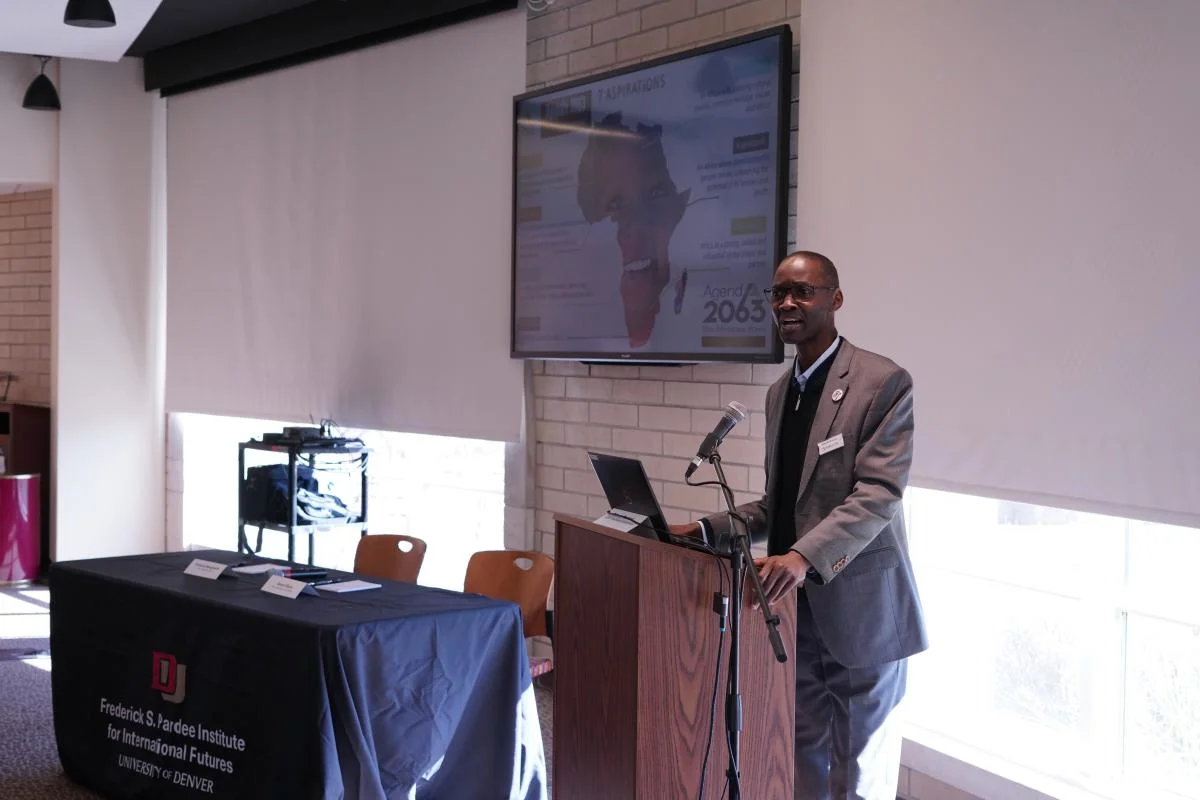
Africa faces its own unique development challenges, aspirations, and constraints, said Senior Researcher Alize le Roux of the Institute of Security Studies’ African Futures & Innovation (AFI) program during a conversation hosted by the Frederick S. Pardee Institute on September 9, 2025. The event, moderated by Awa Sanneh, President of Students for Africa at Joseph Korbel School of Global and Public Affairs, included a lively discussion and audience Q&A.
Joined by fellow ISS AFI Senior Researcher and economist Blessing Chipanda, le Roux emphasized that the African Union’s Agenda 2063 serves as a “blueprint” for the continent, aligning individual national development plans with a broader vision encompassing all 54 African countries. Agenda 2063 is Africa’s 50-year plan to become prosperous, integrated, and peaceful through seven aspirations and successive Ten-Year Plans.
The ISS is a leading Pan-African think tank dedicated to research and policy engagement on issues of human security. For nearly 15 years, ISS has partnered with the Pardee Institute to use the International Futures (IFs) model. Together, they build knowledge about Africa’s development pathways and create alternative scenarios to help policymakers shape strategies for improved outcomes. ISS and Pardee also collaborate with the AU and its Development Agency (AUDA-NEPAD) to inform key aspects of Agenda 2063.
Le Roux and Chipanda began by walking the audience through two of the more than 4,000 interactive graphs available on the African Futures website, which employs IFs, to show how long-term forecasting and scenario planning can inform Africa’s development trajectory and support Agenda 2063.
 Alize le Roux addresses the audience. Photograph taken by Pam Hoberman.
The first graph explored GDP per capita in Africa relative to the rest of the world from 1960 to 2023. While Africa’s GDP per capita has been “growing since 1960 to 2023, [...] it's growing very slowly in relation to that of the rest of the world,” le Roux said, noting that the gap has widened, from roughly $2,700 in 1960 to just under $15,000 in 2023, and is projected to exceed $21,000 by 2043.
The takeaway, she underscored, is that there is wealth generation on the continent, but it is “very unequally distributed” and “not translating into real poverty reduction”.
The second graph focused on poverty trends. While the UN Sustainable Development Goal is to reduce poverty to below 3% by 2030, AFI projections show that Africa’s poverty could remain around 26% in 2030 without significant intervention.
“This is really the foundation of our work,” she said. They AFI considers Africa’s current development trajectory, or the Current Path, and explore how policies and scenarios can accelerate development and reduce poverty more rapidly.
Chipanda then introduced AFI’s scenario analysis approach, which explores how targeted policy interventions might alter these trends. AFI has developed eight sectoral scenarios, covering governance, demographics and health, agriculture, education, manufacturing, the African Continental Free Trade Agreement (AfCFTA), large Infrastructure and leapfrogging, and financial flows, and then combines them into a “Combined Scenario” that estimates the overall impact on development outcomes.
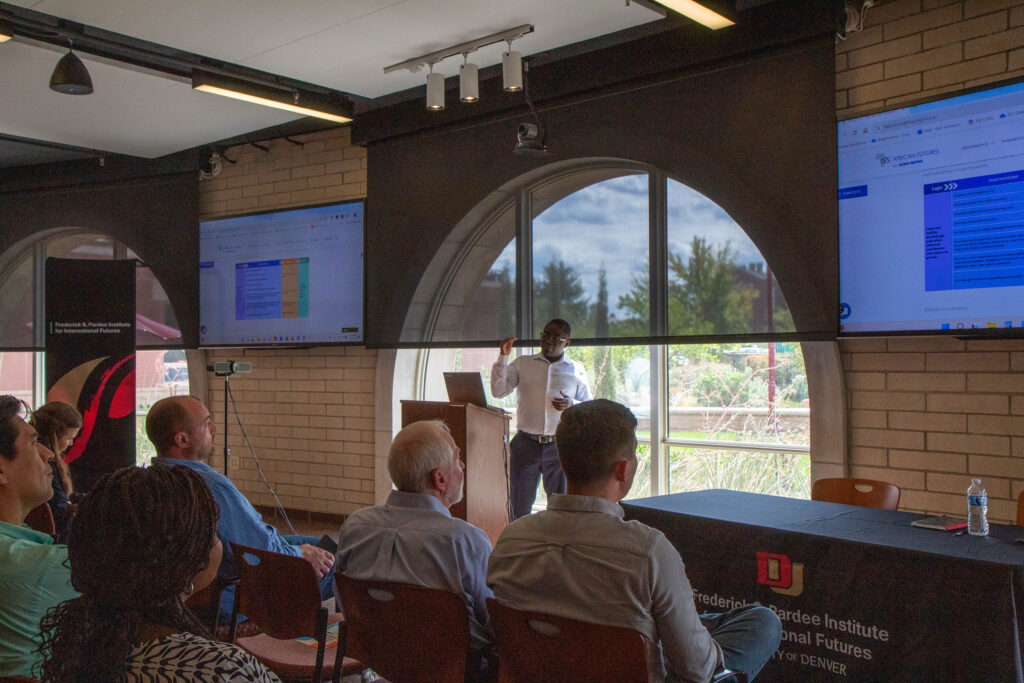 Blessing Chipanda gives an overview of the African Futures website. Photograph taken by Pam Hoberman.
“Our analyses are done at the country level. Then we form what is called a Combined Scenario,” Chipanda explained. He highlighted results showing that agriculture, infrastructure, and manufacturing have the greatest impact on GDP per capita across different country income groups. For extreme poverty, the Combined Scenario showed a decline from 385 million people, forecasted by the Current Path, to 168 million by 2043.
Both speakers emphasized the importance of open access to these data and scenarios. Everything they produce is publicly accessible, Chipanda said, encouraging students and researchers to explore interactive graphs on their website and country reports online.
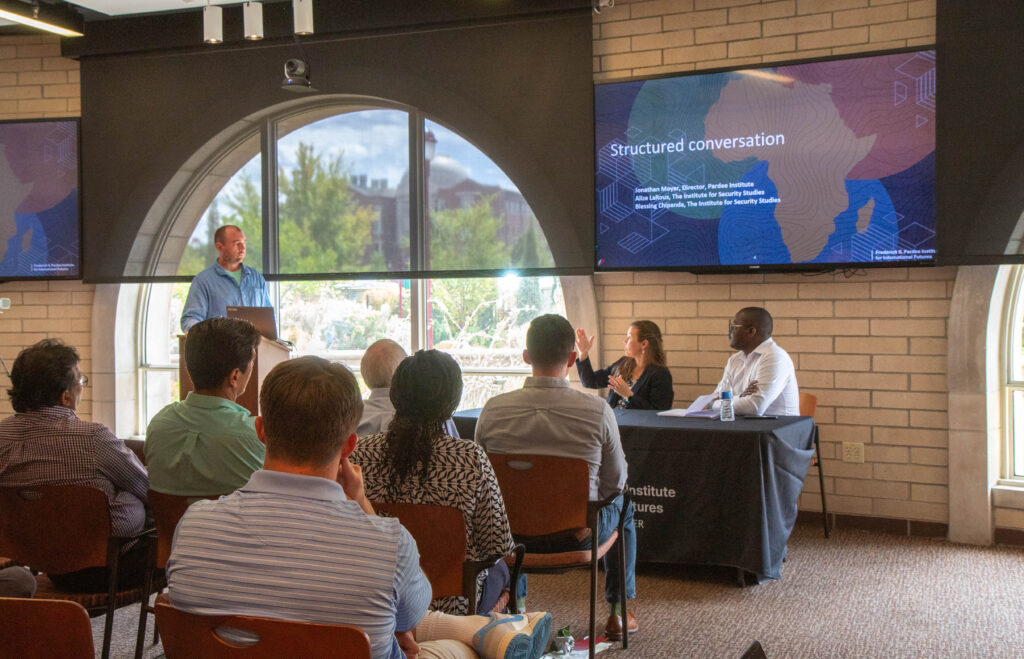 Jonathan D. Moyer leads a structured conversation with le Roux and Chipanda. Photograph taken by Pam Hoberman.
Following the presentation, Pardee Institute Director Jonathan D. Moyer led the conversation with le Roux and Chipanda on career pathways and lessons learned in development work.
Le Roux reflected on her 14 years working in research and development before joining AFI. “Good research does not automatically speak for itself,” she said. One can produce excellent tools and findings, but if they are not effectively communicated to decision-makers, they will not drive change. She also stressed the importance of networks, and as a student, it is important to build relationships as they will matter later in your career.
Chipanda shared how his background in economics led him to scenario building and modeling, highlighting the collaborative nature of AFI’s work with policymakers across Africa.
The event concluded with an open Q&A, moderated by Sanneh, with students asking about the challenges of aligning national development plans with continental goals, the role of governance reforms, and the future updates to AFI’s scenarios.
The session highlighted the power of data-driven foresight in shaping policy and offered students and researchers a practical view of how models like IFs can address some of Africa’s most pressing development challenges.
United Nations Entity for Gender Equality and the Empowerment of Women, & United Nations Department of Economic and Social Affairs. (2025). Progress on the Sustainable Development Goals: The Gender Snapshot 2025. UN Women. https://unstats.un.org/sdgs/gender-snapshot/2025/
The Pardee Institute used its International Futures (IFs) to develop and analyze future scenarios related to gender equality and women's empowerment. The analysis examined several of the six action areas outlined in UN Women's Beijing+30 Action Agenda and informed contributions to UN Women's Progress on the Sustainable Development Goals: The Gender Snapshot 2025 report, providing data-driven insights into pathways for advancing gender equality worldwide.
By: Wara Irfan
Frederick S. Pardee Institute for International Futures, in collaboration with UNICEF Innocenti’s Global Office of Research and Foresight and the African Union Development Agency–NEPAD (AUDA‑NEPAD), has released a new foresight report titled Unlocking the Potential of AfCFTA for Africa’s Young Population, exploring how the African Continental Free Trade Area (AfCFTA) could transform outcomes for children and youth across Africa.
Using the Pardee Institute’s International Futures (IFs) model, the report compares three scenarios: continuing current trade patterns without AfCFTA (referred to as the Current Path scenario), full AfCFTA implementation (AfCFTA scenario), and AfCFTA plus strategic reinvestment of trade revenues into education, welfare transfers, and research & development (R&D) (AfCFTA For Africa’s Young Population scenario). The report finds that a child-centered approach to the trade agreement is crucial for ensuring equitable and sustainable development in the region.
Led by Pardee researchers Deva Sahadevan, Taylor Hanna, and Jonathan Moyer, the collaboration began in late 2023, alongside a 2024 contribution to UNICEF’s Global Prospects for Children report. Although the AfCFTA has been established, it has not yet been fully implemented across all African Union member states, so its full potential remains unrealized. Building on Pardee’s previous work on AfCFTA and intended to model the effects of a complete implementation of AfCFTA, the recent report uniquely leverages IFs’ bilateral trade model, covering all 55 African Union members, to capture both tariff and non‑tariff barriers, such as bureaucratic delays, which the model shows can suppress trade as strongly as tariffs themselves.
The report finds that fully implementing the AfCFTA could boost intra-African trade by 97 percent and increase foreign direct investment (FDI) inflows by 20 percent by 2063, compared to the Current Path scenario. Moreover, the AfCFTA for Africa’s Young Population scenario is projected to generate far greater improvements in GDP growth and poverty reduction across Africa’s regions than the AfCFTA-only scenario.
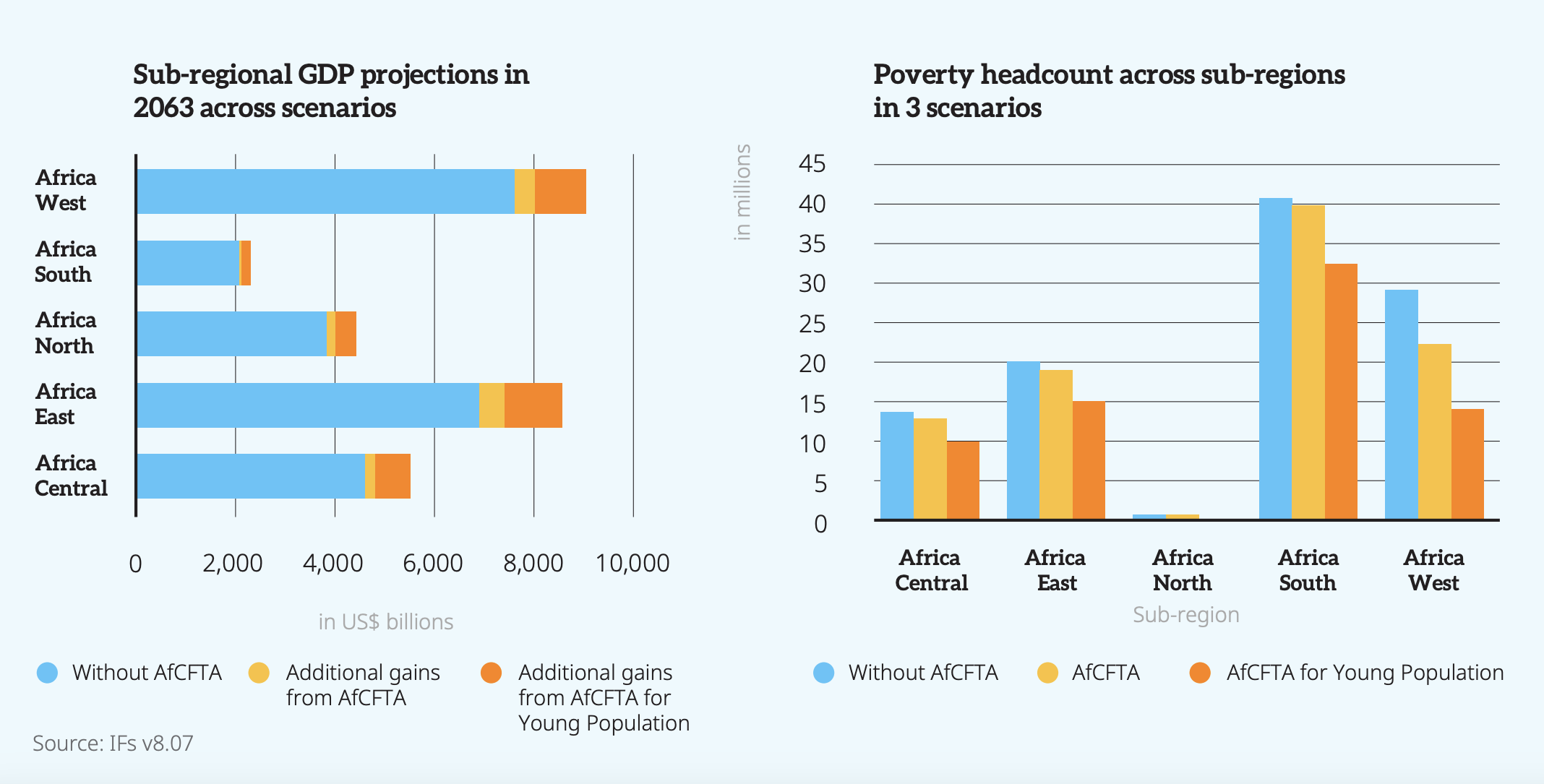 Credit: Pardee Institute via UNICEF Innocenti
However, it is the third scenario that can significantly amplify the benefits. Under the AfCFTA for Africa’s Young Population scenario, reinvesting cumulative AfCFTA revenue of around US$4 trillion, with US$2.4 trillion allocated to education, US$1.8 trillion to welfare transfers, and US$90 billion to R&D, yields multi-fold benefits by 2063. Africa’s GDP could rise to US$29 trillion (nearly US$3.5 trillion more than the no-AfCFTA scenario), 32.5 million people could be lifted out of extreme poverty, child stunting could fall by 3.4 million cases, malnutrition in children by 900,000, and female upper‑secondary graduation could increase by 72 million, narrowing longstanding gender gaps.
By quantifying how trade gains can be ring‑fenced for child‑centered investments, the Pardee Institute provides governments and partners with key strategic policy actions. It recommends encouraging youth participation in AfCFTA implementation, creating transparent monitoring systems, reinvesting in human capital, establishing systems of accountability, and promoting public-private collaboration.
The broader goal is to shift the narrative from merely economic integration to social transformation, with a particular emphasis on advancing the well-being of children and young people. Stakeholders can use Pardee’s insights in this report to design capacity‑building initiatives that foster digital, green, and STEM skills among the youth, consistent with emerging business models in the region. Aligned with the African Union’s Agenda 2063 and positioning the AfCFTA as a strategic development tool rather than merely a market‑access agreement, the findings underscore that investing in human capital today is essential to forge a healthier, better‑educated, and more prosperous Africa by 2063.
Unlocking the Potential of AfCFTA for Africa’s Young Population. (2025, May). Unicef.org. https://www.unicef.org/innocenti/reports/unlocking-potential-afcfta-africas-young-population
UNICEF and the Pardee Institute recently launched a collaborative report on the African Continental Free Trade Area (AfCFTA) and its implications for Africa’s young population, led by Pardee researchers, including Deva Sahadevan, Taylor Hanna, and Jonathan Moyer.
Using our International Futures (IFs) model, the report compares three paths: no AfCFTA, AfCFTA as agreed, and AfCFTA plus strategic investments in education, welfare transfers, and research & development, all the way to 2063. The report recommends that countries put children at the center by investing AfCFTA revenue in education, health, nutrition, and green jobs, while building strong social safety nets. They also need to manage risks like job shifts, environmental impacts, and child protection issues.
Coordination, the right systems, and partnerships are all needed to propel Africa’s development agenda, offered Florence Chidamahiya Nazare, head of knowledge capitalization & management for the African Union Development Agency-NEPAD. Nazare shared these insights during a panel discussion hosted by the Frederick S. Pardee Institute for International Futures at the Josef Korbel School of Global and Public Affairs, University of Denver.
This event was part of a series planned of activities for a delegation of AUDA-NEPAD senior representatives visiting the Pardee Institute that week. The Pardee Institute has maintained a long-standing partnership with AUDA-NEPAD to assist the organization in creating a comprehensive growth and development strategy for countries within the African Union (AU).
During their visit, the delegation participated in training sessions to use the Pardee Institute’s signature tool, the International Futures model (IFs), to inform their work and enhance engagement among AU member states in various development initiatives and their implementation.
The panelists highlighted AU progress and challenges in achieving its long-term vision of inclusive growth, sustainable development, and regional integration. To kick off the panel discussion, Simon Kisira, the head of monitoring and evaluation, presented the transformative goals outlined in Agenda 2063, which includes seven broad aspirations and twenty goals designed to position Africa as a prosperous, integrated, and peaceful continent.
The agenda is operationalized through five Ten-Year Implementation Plans. The first plan covers the years 2014 to 2023 and the second spans 2024 to 2033. This second Ten-Year Plan emphasizes “acceleration of implementation, building on the first that primarily focused on convergence.” According to Kisira, the first plan faced challenges, including insufficient awareness and limited implementation at the national level. The second decade marks a period of speed and scale and is structured by “ambitions beyond the ordinary.”
The AUDA-NEPAD panelists highlighted how the model is the only one with features that are essential to the second Ten-Year Plan’s success, citing IFs ability to both “domesticate” the second Ten-Year Plan down to national and regional levels using a systems-wide approach and to aid evaluators with retrospective monitoring. “The beauty of IFs model looks at targets in an integrated manner. We need a system that looks not just at education but also health and everything it touches,” observed Gideon Nimako, one of the panelists.
However, challenges remain. Nazare underscored the difficulty of harmonizing national plans with regional and continental goals while addressing specific country needs. “We need African solutions for African problems,” she stressed, adding that sustainable livelihoods and more robust domestic private sectors are key to success.
During his closing remarks, Jonathan Moyer, the director of the Pardee Institute, reiterated the importance of knowledge transfer, noting that it is a two-way street. Moyer commended the representatives from AUDA-NEPAD for their continuous collaboration with the Pardee Institute and offered that the Institute continues to apply learnings from its ongoing work with AUDA-NEPAD in ways that strengthen the reach and impact of this tool and the research it informs.
The event underscored the vital role partnerships like AUDA-NEPAD and the Pardee Institute play in advancing Africa’s development agenda, integrating cutting-edge tools like the IFs model with localized knowledge and innovative thinking.
The event also provided a platform for engagement between students and faculty from the Josef Korbel School of Global and Public Affairs, along with staff from the Pardee Institute. Attendees had the opportunity to listen to and interact with representatives from AUDA-NEPAD, enhancing their understanding of key issues regarding the African development agenda and fostering meaningful dialogues on the topic.
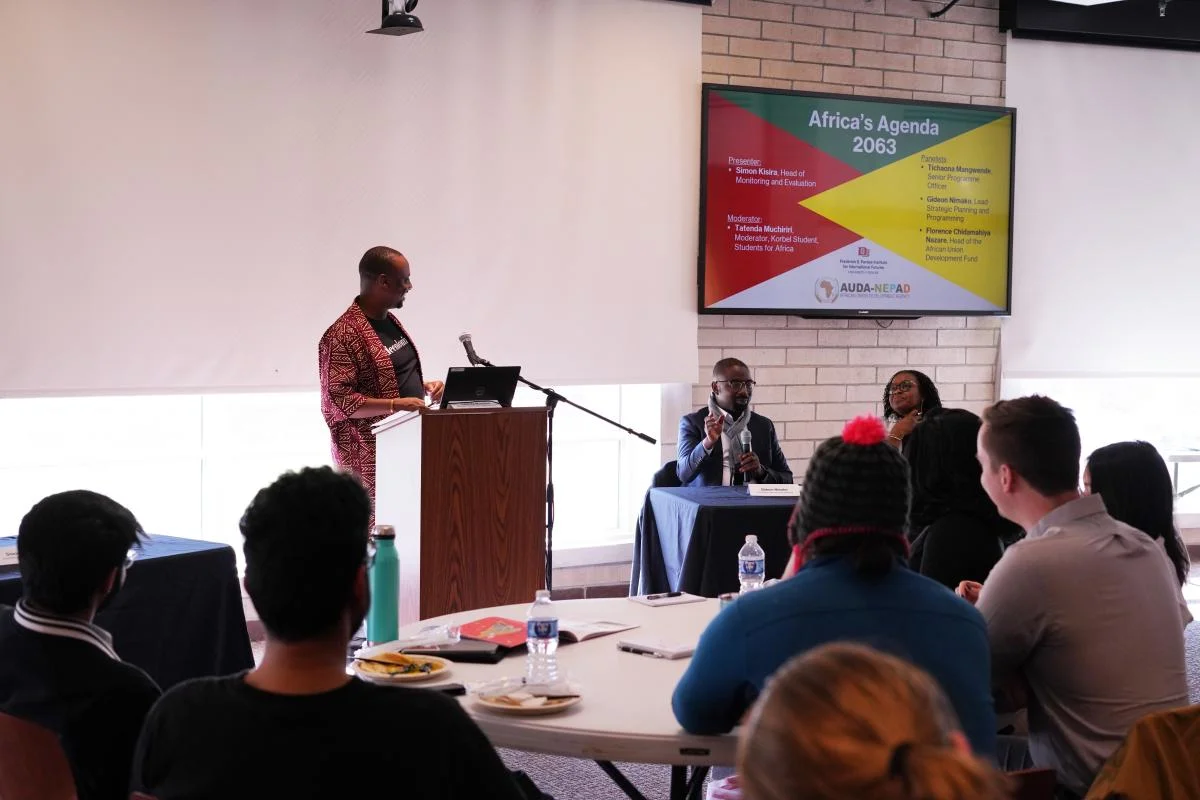
AUDA-NEPAD representatives answer questions and discuss "Agenda 2063."
African Union Commission. (2024). Second ten-year implementation plan of Agenda 2063 (2024–2033). African Union. https://au.int/sites/default/files/Agenda%202063%20STYIP%20Feb%202024%20Launch%20Version.pdf
The Frederick S. Pardee Institute for International Futures contributed the futures modeling that informed the African Union’s Second Ten-Year Implementation Plan of Agenda 2063 (2024–2033). Using the International Futures (IFs) model, Pardee researchers supported analysis of plausible development pathways across Africa’s 55 countries, integrating factors including demographics, education, agriculture, economics, energy, environment, governance, health, infrastructure, and technology. The modeling helped inform development priorities, target-setting, and cost estimates for advancing Agenda 2063’s goals—illustrating how integrated futures analysis can support long-term planning and policy choices. [Source: African Union, Second Ten-Year Implementation Plan of Agenda 2063 (2024–2033)]
While the prevalence of Chronic Obstructive Pulmonary Disease (COPD) has been studied, its future has not been well understood until now, thanks in part to a novel application of the Frederick S. Pardee Institute for International Futures’ International Futures (IFs) forecasting tool. The study sheds light on the future of COPD, which is a disease that makes breathing difficult and has widespread health and economic implications.
As the global community grapples with evolving health challenges, this study takes a forward-looking stance by employing a holistic approach to forecast COPD prevalence. The research, which was authored by Elroy Boers, PhD, Meredith Barrett, PhD, and Jason G. Su, PhD, and published in the JAMA Network Open, found that by 2050, almost 600 million people might develop COPD. The study further predicts this growth will be most concentrated among females and in countries and regions that are low-to-middle income.
The study relied on IFs to model future outcomes among COPD risk factors, including the Human Development Index (HDI). Drawing on historical data, a meta-analysis of global COPD prevalence in 2019, and estimates from 2010 to 2018, the study utilizes IF's projected HDI to provide a nuanced understanding of the factors influencing COPD prevalence.
This study not only brings attention to the alarming trajectory of COPD but also emphasizes the pivotal role of IFs’ comprehensive HDI insights in shaping these projections. IFs include integrated projections of over 500 variables for 188 countries through the year 2050 across the following domains: agriculture, demographics, economics, education, energy, environment, gender, governance, health, infrastructure, international politics, and technology.
This study employs random-effects meta-analytical models, considering not only traditional health parameters but also broader factors like socioeconomic development, smoking prevalence, and air pollution.
The Pardee Institute, which is a research hub at the Josef Korbel School of Global and Public Affairs builds and uses data and tools to analyze our complex world and the long-term dynamics of change in human, social, and natural systems.

Rafa, Mickey and Kabandula, Abigail and Bohl, David and Yang, Vivian and Kwasi, Stellah and Hanna, Taylor and Moyer, Jonathan D., Advancing Development in Uganda: Evaluating Policy Choices and Their Long-Term Impact (March 25, 2022). Available at SSRN: https://ssrn.com/abstract=4066838
The policy, programming, and donor communities in Uganda face a range of competing priorities that will shape future patterns of development. Various factors will determine which policies should be prioritized, including long-term patterns of human, social and environmental development. This report is motivated by the desire to better understand the future of development in Uganda to support these decision-makers as they choose among various policy options in a future characterized by uncertainty.
In November 2021, the Pardee Institute launched a report with USAID titled, "The Future of Food Security in the Wake of the COVID-19 Pandemic." Authors of the report include, Willem Verhagen, David Bohl, Mallory Cannon, Andres Pulido, Audrey Pirzadeh, Iris Nott, and Jonathan D. Moyer.
In barely two years, COVID-19 has set back progress in development efforts across the world and available data indicates there will likely be significant increases in extreme poverty, undernourishment, and child stunting in the coming years. But how will these effects persist, and what consequences will COVID-19 have for the future of food security?
Researchers at the Frederick S. Pardee Institute for International Futures at the Josef Korbel School of Global and Public Affairs at the University of Denver, projected the pandemic’s effects to the year 2040 on economic growth, rising inequality, rising government debt, and education losses from school closures in 2020-2025, to explore their long-term impacts on extreme poverty, undernourishment, and child stunting.
Using the International Futures (IFs) model, which focuses on long-term analysis of economic and human development conditions for 186 countries, the team compared three scenarios:
Learn more about The Future of Food Security in the Wake of COVID-19, watch a special presentation from Lead Researcher, Dr. Willem Verhagen of the Pardee Center, and learn more about his personal experience producing the report in the article Dr. Willem Verhagen and The Future of Food Security in the Wake of COVID-19.
View presentation here.
View interview with Willem Verhagen here.
O'Neill, Brian C., Leiwen Jiang, Samir KC, Regina Fuchs, Shonali Pachauri, Emily K. Laidlaw, Tiantian Zhang, Wei Zhou and Xiaolin Ren. 2020.
“The effect of education on determinants of climate change risks.” Nature Sustainability 3, 520–528 (2020). https://doi.org/10.1038/s41893-020-0512-y
Copyright ©2026 University of Denver | All rights reserved | The University of Denver is an equal opportunity institution