
Join us for Open House on November 13, 2026. Register now.

Menu

Menu
Join us for Open House on November 13, 2026. Register now.
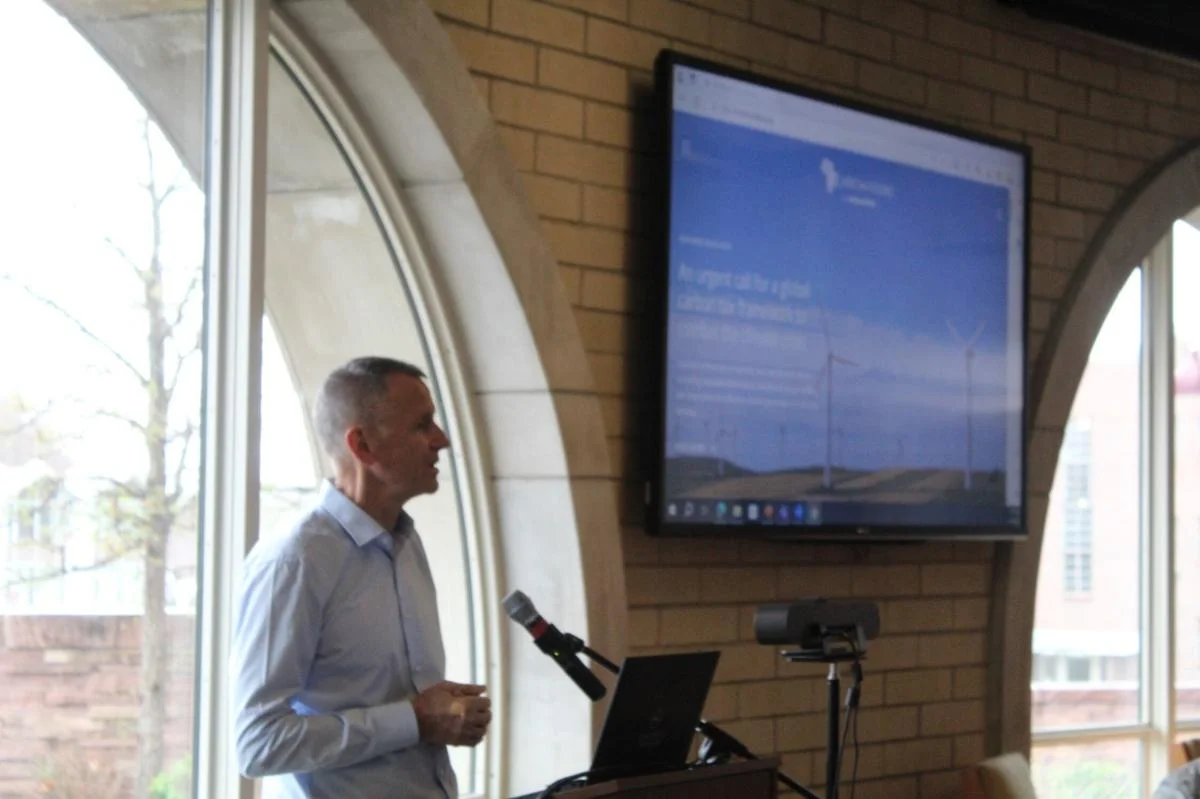
The Frederick S. Pardee Institute for International Futures, formerly known as the Pardee Center, collaborated with the Institute for Security Studies (ISS) to organize an event at the Josef Korbel School of Global and Public Affairs in Denver. The event provided a platform for Dr. Fonteh Akum, the Executive Director of ISS, and Dr. Jakkie Cilliers, founding Director of ISS, to present their research on the Future(s) of Africa with a focus on Africa’s energy demand and production and the potential to achieve its targets by 2063.
Presenting their research findings on Africa’s energy outlook conducted using the Pardee Institute's International Futures (IFs) platform, Dr. Cilliers projected a significant increase in energy demand driven by rapid population growth, noting that the continent is likely to fall short of the minimum energy requirements needed to unlock development opportunities without decisive action.
"To unlock development, you need a minimum of about 8 barrels per person. Even by 2063, Africa does not reach that level," Dr. Cilliers emphasized.
Amidst global calls for shifts towards renewable energy, the research suggests that Africa requires an extended transition period away from fossil fuels, recognizing the current absence of technology capable of fully closing the gap. “Africa will need a longer transition from fossil, and that the rest of the world would need to provide a larger carbon emissions budget for Africa”
Adding that, Africa plays a crucial role in trapping carbon emissions through its vast forests and ecosystems. Leveraging this carbon sink capability presents an opportunity for Africa to generate revenue through mechanisms such as carbon taxes.
Speaking at the event, Dr. Fonteh Akum, the Executive Director of ISS, however, underscored the institution's multilayered approach to addressing Africa's most pressing challenges in governance, peace, and security. He emphasized ISS's commitment to using evidence-informed research to inform policy development, stressing the importance of creating platforms for strategic convening that allow research to influence policy spaces.
Dr. Akum further called for deeper cooperation between ISS and the Pardee Institute, highlighting the need for a shared responsibility in finding sustainable solutions to global challenges in an interconnected world.
The ISS team expressed gratitude to the Pardee Institute for providing access to its IFs tool, which has supported their work in producing evidence-based decision-making.
Jonathan Moyer, the Director of the Pardee Institute for International Futures, commended the ISS team for their remarkable research and affirmed Pardee's commitment to collaborative efforts aimed at producing research with real policy impact.
The event brought together students and some faculty members at the Josef Korbel School of Global and Public Affairs to showcase how our unique approach to integrated assessment modeling has far-reaching, real world applications for informing policymaking at the continental the level.
Sahel Human Development Report 2023. (2024, February 15). United Nations Development Programme. https://www.undp.org/africa/publications/sahel-human-development-report-2023
Sustainable energy could regenerate Africa’s Sahelian zone by using the region’s abundant clean energy potential to transform lives, diversify economies, give hope, and protect the planet. Analyzing viable pathways to move the Sahel away from energy dependency to energy agency that delivers accessible, reliable, and affordable energy for all, is the focus of this Human Development Report, which covers Burkina Faso, Cameroon, Chad, The Gambia, Guinea, Mali, Mauritania, Niger, Nigeria, and Senegal. The HDR uses empirical techniques and political economy analyses to consider optimal energy strategies that would be most appropriate for the sub-region and also for each country's context.
Meisel, C. (2023, October 6). Opinion: Renewables are America’s pathway to energy independence. The Colorado Sun. https://coloradosun.com/2023/10/06/renewable-energy-independence-gasoline-electricity-colorado-opinion/
There’s no better way to reduce pressure on gas prices — or take away Putin’s leverage.
Gas prices in the U.S. are at an 11-month high, reducing the purchasing power of Coloradans and bolstering stubbornly high inflation. Earlier this year, U.S. ally Japan, in a pinch for energy, has already had to negotiate an exception to the U.S.-imposed price cap on Russian oil that is meant to pressure Russian President Vladimir Putin to end his war in Ukraine. Critical U.S. partners elsewhere in the world, such as Singapore, are also feeling pain at the pump.
Moyer, J. D. (2023, September 25). Modeling transformational policy pathways on low growth and negative growth scenarios to assess impacts on socioeconomic development and carbon emissions. Scientific Reports, 13(1), 15996. https://doi.org/10.1038/s41598-023-42782-
Degrowth advocates argue for structural transformations in how economies and societies prioritize material wealth accumulation to reduce the negative effects of future anthropogenic climate change. Degrowth proponents argue that human economic activity could be lessened, and societies transformed to prioritize improved wellbeing, reducing the threat of climate change. This paper explores implications of alternative patterns of economic growth with transformational policy pathways (i.e., redistribution) to assess what effects economic growth and broader policies have on changing patterns of human development across both the Global North and South. Using the International Futures model, this article shows that negative growth and societal transformations in the Global North are possible without dramatically damaging long-term global socioeconomic development, though these interventions do not solve the global climate crisis, reducing future cumulative carbon emissions by 10.5% through 2100. On the other hand, a global negative growth scenario will significantly reduce future cumulative carbon emissions (45%) but also dramatically undermines the pursuit of global development goals, like the elimination of poverty. Even with global policies that significantly increase cash transfers to the poor and retired, dramatically improve income inequality, and eliminate military spending, the Global Negative Growth Big Push scenario leads to an increase of 15 percentage points in global extreme poverty by 2100.
Full Citation: Sahadevan, D., Hanna, T., Moz-Christofoletti, M. A., Orlic, E., Okiya, S., Abidoye, B., & Moyer, J. D. (2023). UNDP. https://data.undp.org/sites/g/files/zskgke476/files/2023-11/20230606_Universal-Electrification-Research-Report.pdf
Pushing for universal electricity access through Sustainable Development Goals (SDG) interventions can have powerful multi-faceted effects across economic and human development. Despite its benefits, expanding electricity access comes with significant costs that may require trade-offs in fiscal choices. By using futures modelling that captures both synergies and trade-offs of pursuing particular SDG targets, UNDP and the Pardee Center for International Futures (University of Denver) assessed the current state of electricity access and modelled different pathways to achieving significant milestones in electricity access, including the UN-Energy Pledge and the UNDP commitments. Read the official report and others here.
Modelling Universal Access
Development Impacts of Electrification
O'Neill, Brian C. and Steve Hedden. 2018. "Xcel Energy carbon emissions targets and limiting warming to less than 2 degrees C." Frederick S. Pardee Center for International Futures, University of Denver, Denver, CO.
Director of Research Brian O'Neill and former Pardee Center Lead System Administrator Steve Hedden published a report evaluating Xcel Energy's recently announced goals for carbon emissions reductions. Their findings, which are incorporated in Xcel Energy's own report outlining their goals, conclude that the company's aims of reducing emissions 80% by 2030 and delivering carbon-free electricity by 2050 are consistent with targets in the Paris Climate Agreement to limit warming to 2 degrees C or less.
Hedden, S. (2015). "Gridlocked: A long-term look at South Africa's electricity sector." Institute for Security Studies and Frederick S. Pardee Center for International Futures, Josef Korbel School of Global and Public Affairs, University of Denver. Denver.
Electricity generation in South Africa is changing, but whether the electricity grid will be able to adapt to these changes is uncertain. This paper presents an alternative frame for the current electricity challenges by focusing on the electricity grid. Using the International Futures forecasting model, the African Futures Project has built three scenarios to 2050 to inform policymakers of the long-term implications of grid decisions. With coordinated planning, improved operational strategies and coherent policies, renewable energy can contribute significantly to the energy mix by 2050, help increase economic growth and benefit all South Africans. These interventions, however, will only be successful if there is a clear plan for the structure of the electricity sector.
Gao, Jing, and Brian C. O'Neill. 2019. “Data-driven spatial modeling of global long-term urban land development: The SELECT model.” Environmental Modelling & Software 119 (458-471) https://doi.org/10.1016/j.envsoft.2019.06.015.
Hedden, S., Moyer, J.D., and Rettig, J. (2013). “Fracking for Shale Gas in South Africa: Blessing or Curse?”
African Futures Paper No. 9. Institute for Security Studies and Frederick S. Pardee Center for International Futures, Josef Korbel School of Global and Public Affairs, University of Denver. Pretoria, South Africa, and Denver, CO, USA.
South Africa is poised to move forward with shale gas development through hydraulic fracturing or "fracking," exploring what experts believe to be the eighth largest shale gas reserve in the world. For a country that currently is almost wholly dependent on coal production, shale gas development could be a game-changer. Yet, the possible environmental impacts could also be devastating. The International Futures model is used to explore both the possibilities and some of the risks of fracking for South Africa.
Camp, H., Hedden, S., Bohl,D., Petersen, A., and Moyer, J.D. (2015). "Green Cape 2040: Towards a Smarter Grid."
Policy Brief 4 of 2015. Western Cape Government Policy and Strategy Chief Directorate and Strategic Initiatives Chief Directorate in collaboration with the African Futures Project. Western Cape Government, Cape Town, South Africa.
Electricity is crucial for the economic and social development of South Africa, but disruptive changes loom on the horizon. It is now clear that Eskom is unlikely to keep its electricity prices lower than those of alternative forms of electricity production, most notably small-scale photovoltaic (PV). This analysis finds that a significant amount of revenue will be lost to PV uptake, but that policies aimed at investing in advanced metering infrastructure (AMI) and other smart technologies, changing the tariff structure and encouraging economic growth from domestic PV manufacturing, can reduce this loss.
Copyright ©2026 University of Denver | All rights reserved | The University of Denver is an equal opportunity institution