

Menu

Menu
By: Sylvia Morna Freitas
Collin J. Meisel, acting director of analysis at the Pardee Institute, and his colleagues have just finished their analysis of the Pardee Institute’s Perceived Mass Atrocities Dataset (PMAD) for 2024—and the news is grim. According to the global dataset, people living in 111 countries around the world experienced some form of mass atrocity in the past year.
Covering 196 countries, the dataset aims to determine the breadth and severity of humanitarian suffering in each country under a single metric. The PMAD highlights several regions where analysis of atrocities using data on lethal atrocities only would be inadequate. In the project, a mass atrocity is an act of violence against 25 or more defenseless members of a social, cultural, ethnic, religious, or political group. The acts are rated on a scale of “lethal to less lethal,” which provides a more nuanced scope of threats of human suffering worldwide. For example, 2024 saw a slight decrease in the number of lethal atrocities from 2023. Still, several types of “less lethal” atrocities—actions involving gross, intentional violations of human rights on a mass scale, short of murder—were more numerous.
But as grim as these reports are, the work Meisel and his team complete is integral to providing an evidence-based foundation for future action. “By systematically tracking these atrocities, we increase the chance that perpetrators will one day be held accountable,” says Acting Director of Analysis Collin Meisel.
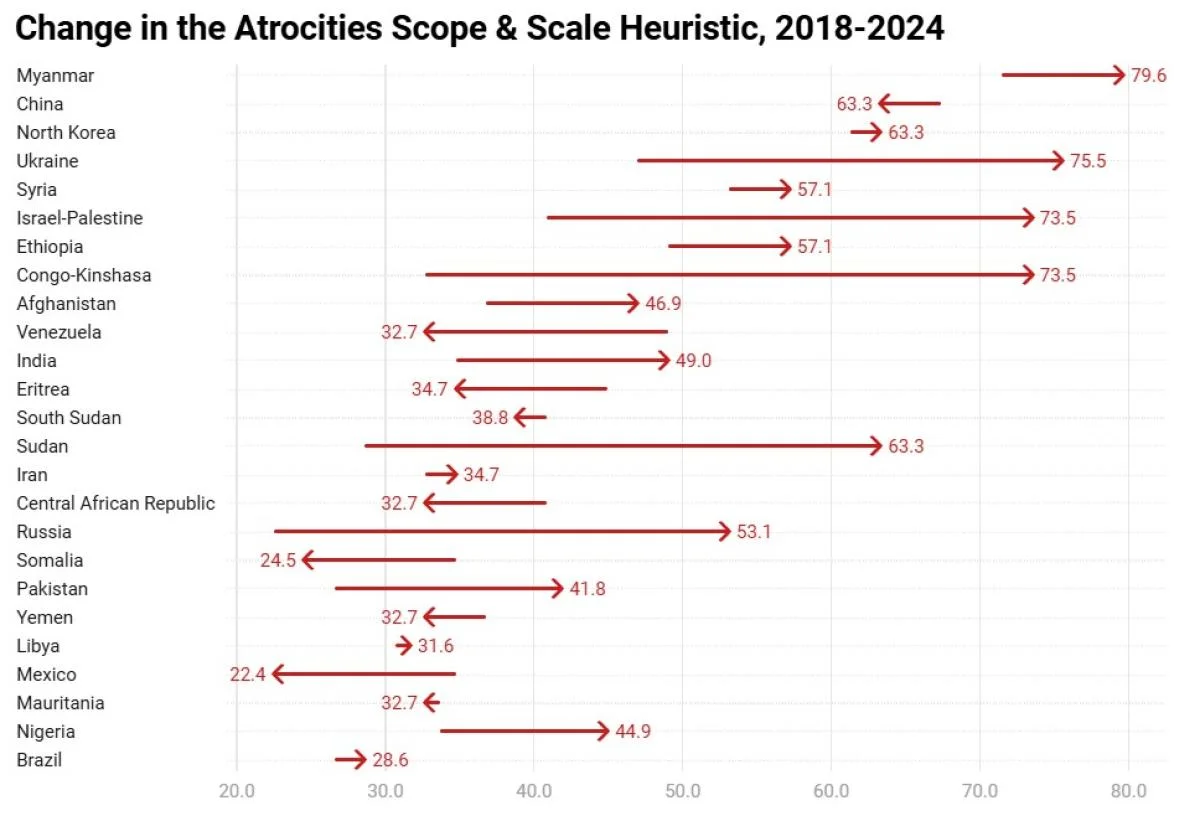
Countries with the top 25 worst average values for all years from 2018-2024, sorted from highest to lowest. *Events for 2024 data still under review; values may be underestimated.
Chart: The Conversation, CC-BY-ND Source: Frederick S. Pardee Institute for International Futures, Perceived Mass Atrocities Dataset Created with Datawrapper
In addition, because the PMAD classes atrocities under a single metric, it provides a measure to facilitate research on the relationship between mass atrocities and a myriad of other interconnected factors, such as state stability and conflict, economic development, colonialism, and gender equality.
Having an empirical framework to tease out these relationships allows us to better understand the risk factors and consequences of mass atrocities within the larger fabric of the world.
PMAD is sponsored by the U.S. Government and built to support the U.S. Congress’s Elie Wiesel Genocide and Atrocities Prevention Act of 2018, which was enacted to prevent acts of genocide and other atrocity crimes through the recognition of patterns of escalation and the methods that prevent them. Elie Wiesel was a Holocaust survivor and Nobel laureate who implored the world not to turn away from atrocities but to bear witness. PMAD is a manifestation of that charge and is one of various datasets used by the US Government for monitoring, evaluation, and learning about mass atrocities worldwide.
More here in The Conversation.
Meisel, C. (2025, January 13). From Myanmar to Gaza, Ukraine to Sudan – 2024 was another grim year, according to our mass atrocity index. The Conversation. https://theconversation.com/from-myanmar-to-gaza-ukraine-to-sudan-2024-was-another-grim-year-accord
Collin Meisel, Associate Director of Geopolitical Analysis at the Frederick S. Pardee Institute for International Futures recently published an article in Journal of Peace Research. The article, titled “Bearing Witness: Introducing the Perceived Mass Atrocities Dataset (PMAD)” is a country-year measure of atrocities with accompanying narratives, commissioned by the US State Department to support the Elie Wiesel Act, which requires relevant organizations within the U.S. government to measure global atrocities.
Built to support the US Congress’s Elie Wiesel Genocide and Atrocities Prevention Act of 2018, PMAD enables the systematic comparison of the occurrence and magnitude of seven atrocity types, in addition to group-perpetrated violence against women and LGBTQIA+ groups, with aggregate atrocities indices for 196 countries from 2018 to 2022.
The article led by Colliin Meisel was co-authored by Jonathan Moyer, Director of Pardee Institutes alongside other authors including Austin S Matthews, Oliver Kaplan, Ruth Byrnes, Kerent Benjumea, and Phoebe Cribb.
When asked for comment, Collin Meisel made it a point to express his appreciation to the team at Pardee Institute and the Josef Korbel School of Global and Public Affairs, who supported over the years and continue to update the data for research.
Commenting on the publication, the Dr. Moyer described the piece as an impressive work, stating that, “Staff researchers can be an essential piece of the puzzle in research centers/institutes and Collin is outstanding and we are lucky to have him at Korbel bridging the gap between academic work and policy communities.”
Meisel, C., Moyer, J. D., Matthews, A. S., Kaplan, O., Byrnes, R., Benjumea, K., Cribb, P., & Van Son, C. (2024, August 20). Bearing witness: Introducing the Perceived Mass Atrocities Dataset (PMAD). Journal of Peace Research. https://doi.org/10.1177/00223433241249333
Led by Pardee's Associate Director of Geopolitical Analysis, Collin Meisel, and commissioned by the US State Department to support the Elie Weisel Act, this coding framework is a prime example of the Institute's goal to bridge the gap between academic work and policy-making communities. Congratulations to all of the hard-working Korbel students who contributed to this impressive research and all the co-authors on this outstanding accomplishment.
Abstract:
The risk factors and consequences of atrocities are deeply interconnected with questions of intra- and interstate stability and conflict, economic development, colonialism, and gender equality, as well as atrocity crime monitoring and prevention. However, there is no globally comparable measure of lethal and less-lethal atrocities. The Perceived Mass Atrocities Dataset (PMAD) is a country-year measure of atrocities with accompanying narratives. Built to support the US Congress’s Elie Wiesel Genocide and Atrocities Prevention Act of 2018, PMAD enables the systematic comparison of the occurrence and magnitude of seven atrocity types, in addition to group-perpetrated violence against women and LGBTQIA+ groups, with aggregate atrocities indices for 196 countries from 2018 to 2022. PMAD offers a foundation for quantitative studies of atrocities as well as more qualitative, process-focused research of lethal and less-lethal violence with its single, divisible framework. The PMAD data highlight several regions where analysis of atrocities using data on only lethal atrocities would be inadequate, especially Central and Eastern Asia. The data can also facilitate research into the relationships between mass atrocities and gender discrimination, neopatrimonialism, and political polarization.
Collin Meisel, the Associate Director of Geopolitical Analysis at the Pardee institute, presented Pardee Institute's Perceived Mass Atrocities Dataset (PMAD) during a round table meeting hosted by Bridging the Gap and the United States Holocaust Memorial Museum in Washington, DC.
The PMAD is a research project that aims to collect and analyze data on perceived mass atrocities worldwide. It provides insights into incidents of violence, human rights abuses, and atrocities that may not be officially documented but are crucial for understanding conflict dynamics.
The meeting, titled “Mass Atrocities Beyond Mass Killing,” provided a platform for participants to learn about research and data needs from the policymaking community, as well as the broad contribution and applicability of Pardee Institute’s research.
It was co-hosted and co-moderated by Scrivner Institute Director and Korbel Professor Naazneen Barma, underscoring the Korbel School's reach in policy-applied international studies research.
PMAD is part of the Pardee Institute's Diplometrics project portfolio, which is supported by the U.S government. The US government commissioned PMAD to support the Elie Wiesel Act, which requires relevant organizations within the U.S. government to measure global atrocities.
Copyright ©2026 University of Denver | All rights reserved | The University of Denver is an equal opportunity institution