


Pardee Institute
Clean Energy and Human Development Go Hand in Hand, Speakers Say at Charged for Change Report Launch
Clean Energy and Human Development Go Hand in Hand, Speakers Say at Charged for Change Report Launch
Clean Energy and Human Development Go Hand in Hand, Speakers Say at Charged for Change Report Launch
By: Wara Irfan
“We are living in a period of two crises,” said Jonathan Moyer, Director of the Frederick S. Pardee Institute for International Futures. While the climate crisis receives widespread attention, he noted, a second crisis often gets “less coverage”. That is the human development crisis. “There are 700 million people in the world living in abject poverty.”
Moyer made these remarks while introducing the new report, Charged for Change: The Case for Renewable Energy in Climate Action, published by the United Nations Development Programme (UNDP) in partnership with the Pardee Institute and Octopus Energy. He was joined by former Colorado Governor Bill Ritter (2007–2011), whose distinctive record of building a “New Energy Economy” framework, which links climate, jobs, utility policy, public health, and economic development, sets him apart from both his predecessors and many of his contemporaries. The report’s lead author, Chibulu Luo, Ph.D., joined Dr. Moyer and the Hon. Bill Ritter for a discussion on how renewable energy can simultaneously advance climate action and human development. “What this report does is help chart a path forward for achieving both,” Moyer emphasized.
Deva Sahadevan, Senior Research Associate at the Pardee Institute, presented the report’s key findings, followed by a panel discussion moderated by Moyer and an audience Q&A. Using the Pardee Institute’s International Futures (IFs) model, researchers examined three scenarios: (1) a Base Case in which the world remains on a warming trajectory under current trends of development, (2) a Renewable Acceleration (RA) scenario where there is accelerated global investment in renewables, and (3) an RA+SDG scenario where these renewable investments are paired with targeted investments in health, education, governance, and infrastructure. 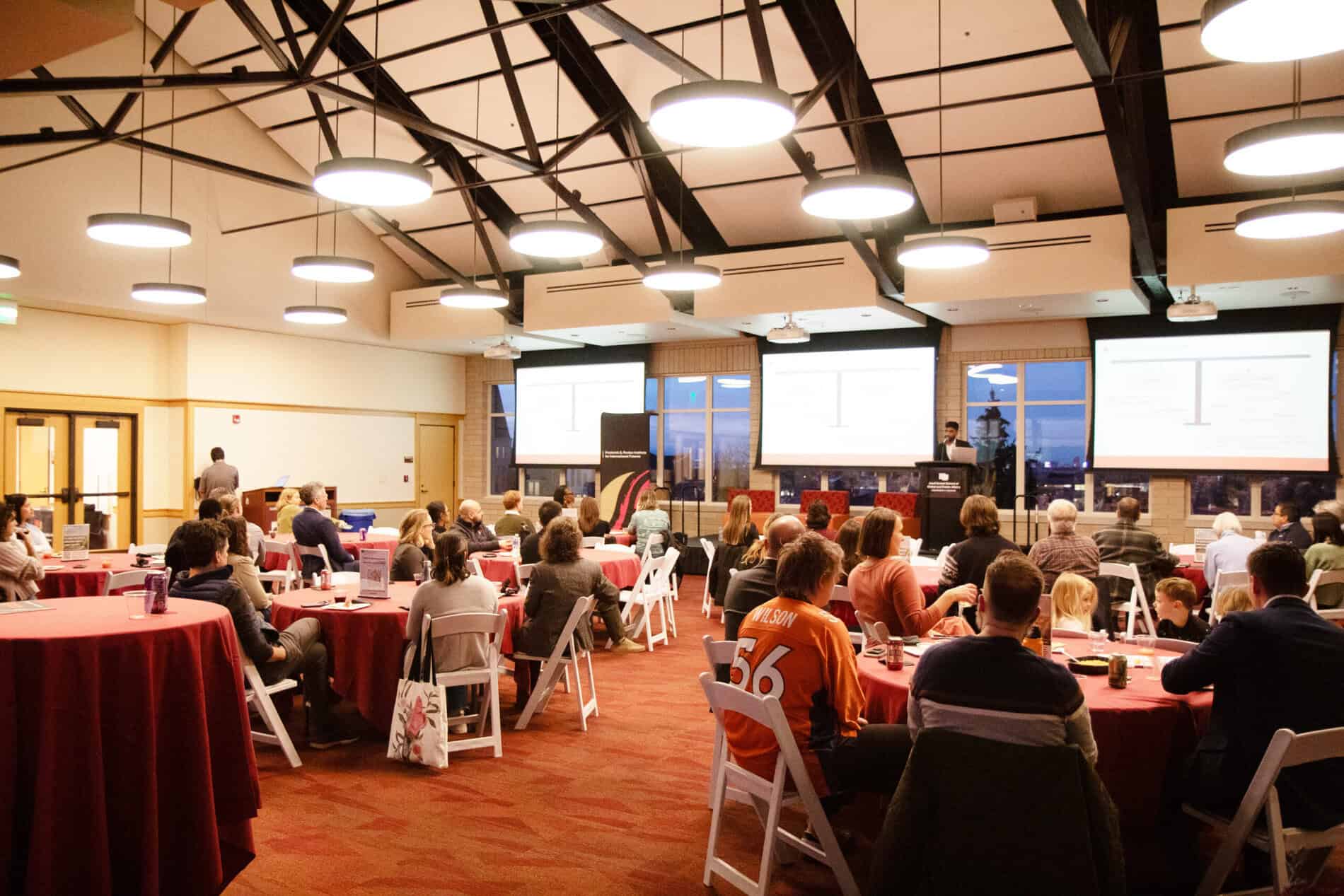
Deva Sahadevan presents an overview of the report. Photograph taken by Megan Livengood.
The study found that RA+ SDG can significantly advance human development while also improving climate outcomes in the long run. Compared to the Base Case, this pathway could lift an additional 193 million people out of extreme poverty, reduce malnutrition for 142 million people, and expand access to clean water and sanitation to 550 million more people by 2060 - all within a 1.5°C-aligned future. In contrast, the RA scenario showed only modest improvements to human development, suggesting that climate action alone is insufficient to balance the dual imperatives of addressing climate change and improving human well-being.
Although the RA + SDG pathway requires substantial upfront investment, the long-term payoff is considerable. By 2060, cumulative savings could reach approximately $20.4 trillion by 2060, driven by energy efficiency gains, declining renewable costs, and a shift in capital from fossil fuels to clean energy, while keeping global warming closer to internationally agreed targets.
Speakers grounded these modeling results in real-world practice. Dr. Luo described how UNDP uses country-level evidence to show how energy policy decisions intersect with priorities in finance, health , and gender, helping government ministries see climate action as integral to development planning. She highlighted examples such as electrified irrigation and solar-powered health facilities in Zambia, alongside a strong policy focus on clean cooking. “It is a smart economic choice for countries to invest in renewables,” she said, noting that the report provides governments with “real numbers” demonstrating the development benefits of a renewable energy transition as they shape climate and development strategies.
 Dr. Chibulu Luo addresses the audience. Photograph taken by Megan Livengood.
Former Governor Ritter shared lessons from Colorado on scaling renewable energy, supporting workforce transitions, and building financing mechanisms that make clean energy both feasible and equitable. Reflecting on his time in office, he remarked, “Colorado is a fascinating little Petri dish” where “development and climate action are not mutually exclusive,” according to him. He stressed that these goals are not opposing values but can be pursued together. The former governor also warned that if the United States retreats from global engagement on climate, human development, and sustainable energy, it risks missing a critical opportunity to lead and make a meaningful impact.
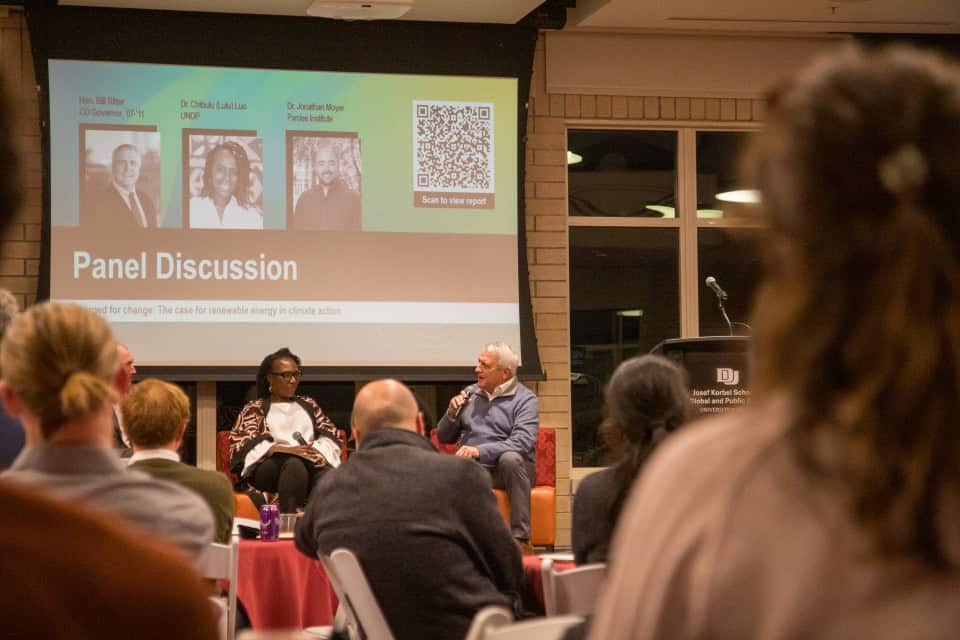 Former Colorado governor Bill Ritter shares his insights. Photograph taken by Megan Livengood.
Dr. Luo added that what gives her hope is the evidence showing that a renewable energy transition can deliver substantial benefits for both people and the planet, benefits that are often even greater in developing countries.
Furthermore, the event drew practitioners, entrepreneurs, researchers, policymakers, and students. The audience's Q&A ranged widely, from clean-cooking and carbon markets to bio and nuclear energy, land use, and the big question of growth versus sustainability. A former off-grid entrepreneur raised the recent KOKO Network cass in which a bioethanol cookstove provider lost access to carbon-credit approval in Kenya, leaving millions of customers at risk; in response, Dr. Luo described how national carbon-market regulations, multilateral guarantees, and blended or concessional finance all matter for managing investor risk and protecting access to clean-cooking solutions, noting Kenya is also exploring electric-cooking options.
Another audience member inquired about bioenergy’s role in future energy mixes and lessons from past biofuel investments. The former Governor answered that bioenergy, carbon capture, and related technologies deserve further development, and that policy tools (tax credits, public investment) and learning about real costs will shape their viability. Sahadevan also addressed broader concerns about growth and equity, noting the report’s framing: modeled pathways highlight a tension between urgently reducing emissions and enabling the growth many low-income countries still need, so solutions will require careful mixes of investment, redistribution, and locally appropriate policies.
The discussion concluded with a reminder that climate action and human development need not compete. “The choices we make today will have long-term implications,” Moyer said. The session underscored the importance of a data-driven foresight in shaping country-level dialogue, financing strategies, social investments, and governance reforms, key elements for achieving a just and sustainable energy transition.
Give to Pardee

Follow Pardee research, publications, events, and tools that help people reason more clearly about possible futures.
Subscribe
Contact us

Copyright ©2026 University of Denver | All rights reserved | The University of Denver is an equal opportunity institution