


Pardee Institute
Pardee Brings Integrated Modeling Perspective to Global Foresight Gathering
Pardee Brings Integrated Modeling Perspective to Global Foresight Gathering
Pardee Brings Integrated Modeling Perspective to Global Foresight Gathering
Pardee Institute Director Jonathan Moyer recently traveled to Geneva to participate in the World Economic Forum’s Global Foresight Network, where he was invited to bring a quantitative perspective to an international gathering of foresight practitioners from governments, international organizations, and the private sector.
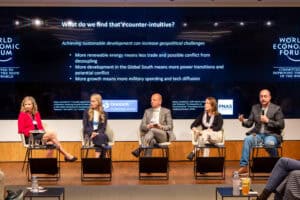
Across sectors, foresight teams help decision-makers consider uncertainty, imagine alternative futures, and develop scenarios that can inform planning. Much of that work relies on qualitative methods, including narratives, participatory exercises, and structured discussions about what could change.
Moyer’s contribution centered on a complementary question: How can foresight remain open to uncertainty while also drawing on empirical evidence about durable trends and systems-level change?
During a panel on quantitative approaches, Moyer introduced International Futures (IFs), the Pardee Institute’s integrated forecasting platform. IFs supports scenario-based analysis across human, social, natural, economic, and geopolitical systems. Rather than predicting a single future, the platform helps users examine plausible pathways under different assumptions and trace how changes in one system may affect others over time.
For foresight practitioners, that kind of integrated modeling can provide an empirical backbone for scenario work. Qualitative approaches help decision-makers imagine possible futures, surface assumptions, and consider emerging risks. Quantitative tools such as IFs can then help test how those assumptions interact with structural trends, including demographic change, economic growth, education, governance, infrastructure, health, energy, and international relations.
The exchange reflected a central feature of Pardee’s approach: future-oriented analysis is strongest when evidence and imagination work together. Forecasting without narrative can miss the human, institutional, and political context that shapes decisions. Foresight without empirical grounding can struggle to distinguish between what is merely possible and what is more plausible given long-running patterns and system relationships.
By bringing IFs into the discussion, Moyer offered a way to connect those approaches. The presentation prompted questions about durable trends, transparent assumptions, and the role of integrated modeling in helping organizations think more clearly about uncertainty.
The Geneva gathering also placed Pardee’s work in conversation with a broader community of people shaping how institutions prepare for the future. For governments, companies, and international organizations, the challenge is not simply to anticipate change. It is to understand which forces are likely to persist, which assumptions need to be tested, and how choices made today could shape outcomes across connected systems.
For Pardee, the trip underscored the continuing relevance of IFs as both a research platform and a public resource. Built over decades, the platform helps users move from broad questions about the future to more structured analysis of plausible pathways, tradeoffs, and long-term implications.
Give to Pardee

Follow Pardee research, publications, events, and tools that help people reason more clearly about possible futures.
Subscribe
Contact us

Copyright ©2026 University of Denver | All rights reserved | The University of Denver is an equal opportunity institution