


Pardee Institute
Pardee Institute Joins Partners in Rwanda to Advance Foresight and Forecasting for Long-Term Development Planning
Pardee Institute Joins Partners in Rwanda to Advance Foresight and Forecasting for Long-Term Development Planning
Pardee Institute Joins Partners in Rwanda to Advance Foresight and Forecasting for Long-Term Development Planning
How can long-term analysis help decision-makers prepare for futures that are uncertain, interconnected, and still partly knowable?
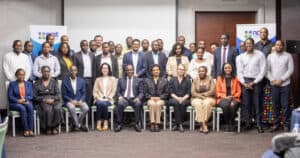
That question guided a three-day foresight and forecasting training in Rwanda, from May 4th to the 6th, where the Pardee Institute joined Rwanda’s National Council for Science and Technology, AUDA-NEPAD, and the Institute for Security Studies (ISS) to introduce participants to International Futures (IFs), Pardee’s open-source, integrated forecasting platform.
Led in part by Taylor Hanna, Associate Director of Development Analysis at Pardee, the training brought together 33 participants for hands-on engagement with IFs. Over the three days, participants explored the model, built and tested scenarios, and discussed how integrated forecasts can support long-term planning across complex development systems.
The training connected continental and national planning questions. Participants examined how IFs supported analysis related to the African Union’s Agenda 2063 Second Ten-Year Implementation Plan and considered how scenario-based approaches can inform Rwanda’s Vision 2050. Hanna stated, “This kind of analysis helps bridge the gap between long-term ambitions such as Vision 2050 and Agenda 2063 and the practical steps needed to achieve them.” Rather than treating development goals as isolated targets, IFs enables users to explore how changes in areas such as education, health, infrastructure, governance, economics, and the environment may interact over time. The participants tested a scenario to explore the effects of meeting national R&D investment targets on productivity.
The training also builds on Pardee’s longstanding relationships with ISS and AUDA-NEPAD. Through the African Futures Project, Pardee has collaborated with both institutions to support long-term strategic analysis across the African continent. AUDA-NEPAD’s mandate includes strengthening the capacity of African Union member states and regional bodies, while ISS’s African Futures and Innovation program provides forward-looking policy analysis on Africa’s development prospects using dynamic forecasting tools.
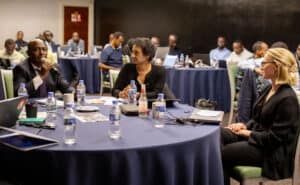
“What stood out most was the enthusiasm participants brought to thinking about Rwanda’s future. Putting integrated forecasting and scenario tools in the hands of policymakers allows them to test ideas, explore alternative futures, and better understand how decisions in one area affect outcomes across the development system,” reflected Hanna. For Pardee, this exchange reflected one of the central purposes of capacity-building: creating space for policymakers, researchers, and practitioners to work with shared tools, transparent assumptions, and a common language for thinking about the future.
Give to Pardee

Follow Pardee research, publications, events, and tools that help people reason more clearly about possible futures.
Subscribe
Contact us

Copyright ©2026 University of Denver | All rights reserved | The University of Denver is an equal opportunity institution