

Menu

Menu
Korbel Career Journey: Clayton King, Master of Public Policy, 2022
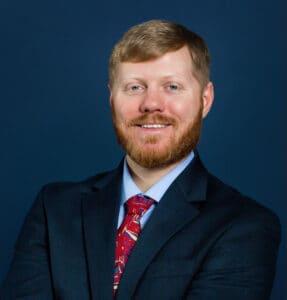
Alumnus Clayton King (Master of Public Policy, 2022) has approached his career in public policy with curiosity and intention. While both embracing new challenges and remaining steadfast in seeking opportunities to make an impact, Clayton has devoted his time to strengthening democratic institutions and closing the gap in civic participation. His commitment to a brighter future brought him to Washington, DC where he went from facing the budget cuts at USAID to becoming the founder of the Alliance for Competitive Elections, a nonprofit focused on building a multiparty democracy in the United States.
We sat down with Clayton to talk more in-depth about his experiences at Korbel, the lessons that have shaped his approach to policy and leadership, and his vision for the future of democracy.
What drew you to public policy and international affairs?
I've always been focused on the idea that politics is a way that you can change the world. I was registering voters in my hometown of Fort Collins, Colorado before ever casting a ballot myself. But after my undergrad at CSU, I realized I hadn't really explored the world yet. "I wanted to see what makes us all human regardless of where we are in the world." So, I joined the Peace Corps and spent two years in the Republic of Moldova.
I worked in a library and in the mayor's office, and it was really my first time abroad for more than a week. I just dove in. I knew it was the only chance for me. If I didn't do it then, it would never happen. It kind of changed my life. I made some friends who are family to me now, and I got a lot of really good experience.
How did you decide to come to Korbel?
COVID hit pretty quickly after I returned from the Peace Corps, so I decided it would be a good time to continue my studies. I was deciding between the University of Denver and Duke. Then I saw that Fritz Mayer was going to become Dean of Korbel after previously leading public policy at Duke. That helped make the decision for me.
Coming to Korbel also meant I could stay near home during the pandemic while working in Colorado politics to start bridging my international experience with my domestic experience. It was a really good combination of things for me. During my time at Korbel, I kept hearing, “Think global and act local.” I think I acted global more before I started bringing that back.
How did your experiences at Korbel shape the work you do today?
A big part of my time at Korbel was spent surrounded by other students who came from experienced backgrounds and were expected to do big things. Despite being in graduate school during COVID, the connections with other students were incredibly valuable. Being in a cohort with other Peace Corps volunteers and people experiencing that same period helped build that out even more.
This was also a community that I could fall back on later. You don't necessarily think about those connections as much when you're a student, but they become really important afterward. I've actually had more interaction with people in the career department, like Jamie Polliard and Rae Ann Bories-Easley, since I graduated than I did when I was a student. Those kinds of resources are really helpful when you're trying to figure out what the next steps are.
How did your Korbel coursework connect to your work in democracy promotion?
During my MPP, I became particularly interested in the relationship between democracy promotion abroad and the tools we could potentially use here in the United States. My capstone focused on U.S. democracy promotion abroad and what kinds of tools we have available to help other countries develop their democracies and improve their institutions. I looked at potential tools that could also be used domestically, tools we have the capacity to use but aren't necessarily using right now.
I also interned with the National Endowment for Democracy during my semester in Washington, D.C. That was a great experience because I got to learn more about what we do abroad and meet with people working across different country teams. It really helped drive my interest in democracy promotion and ultimately influenced my capstone.
There was an intentional gap in that work: organizations focused on democracy promotion abroad aren't designed to directly engage in U.S. politics. I started thinking about what resources and experience could potentially be brought back to domestic organizations. I didn't necessarily think at the time about the human-capital side of it—that people go work for these organizations, develop that experience, and then eventually bring it home. But that's part of the cycle I'm now part of.
What led you from international democracy promotion to founding the Alliance for Competitive Elections?
After Korbel, I worked for the International Republican Institute, doing political party development and election observation work in Eastern Europe, including Moldova, where I had served in the Peace Corps.
That job was the right job at the right time. I always knew that at some point I would leave, but I knew it wouldn't necessarily be my decision. Something would have to trigger it. When USAID cuts disrupted so much of the international development space, that became the moment for me to turn back domestically and apply everything I had learned through my MPP and my international work to building democracy here.
I was sitting in the office during the closeout process, reading The Two-Party Doom Loop by Lee Drutman under my desk and thinking about how we could develop a multiparty democracy in the United States. What tools do we already have? How do we build a system that gives people more choices? That's where ACE came in.
What is the Alliance for Competitive Elections (ACE), and what gap are you trying to address?
ACE is a nonprofit focused on building a multiparty democracy in the United States by strengthening political parties and helping develop the institutional capacity needed for a more competitive system. At the end of the day, we want to give people more choice and agency by creating more opportunities for parties and ideas to compete.
There’s a lot of work happening in electoral reform, but I think there’s a gap in how we approach it. If you implement something like ranked-choice voting or proportional representation, the existing power brokers are going to adapt to that new structure. We flip that question around and ask: Who has the most at risk? Who is most likely to benefit from these changes?
That’s where some of my Korbel learning comes in, particularly the idea of having “skin in the game.” Minor parties and independent movements have the most to gain from electoral reform because, without those reforms, they may not have a meaningful opportunity to participate or compete.
From our perspective, one of the best ways to advance electoral reform is to build the parties that will ultimately participate in those new systems. We're intentionally piloting a lot of our programming in Colorado because it's such a great policy laboratory. The United States is a great experiment, and states like Colorado can be front-runners for policy innovation and institutional change. Colorado also has places like Korbel that are willing to question the status quo and people who are willing to be uncomfortable.
How has your career prepared you to navigate a shifting job market?
When you think about your life and different periods in your life, they can feel fragmented. But if you look back, you often find connections in places and times you didn't expect. Having a graduate degree and those connections and that community to fall back on has been really helpful. I think it's important to take time to reflect on where you've been and where opportunities might exist to reconnect with those experiences. You can't necessarily predict what the next disruption is going to be. We're living through wars, famine, COVID and who knows what else. At this point, unprecedented times are almost expected. You need to be ready to be resilient.
There have been a lot of people from USAID who were cut, and Colorado is one of the largest states for people affected by those cuts. Korbel has been interacting with the Posner Center and the Tuesday Group, which has been a great resource for me. Through Korbel, I've been able to reconnect with people and meet people I had never met before who have similar backgrounds.
What advice would you give to Korbel students entering an uncertain world?
I think sometimes we look at our lives and think that each experience has to directly lead to the next one. But it doesn't always work that way. You don't know which connections are going to become important later. You don't know which experience is going to give you a skill that you eventually need.
My own career is a pretty good example. I couldn't have necessarily predicted that my experience in Moldova would eventually lead me to working on democracy in the United States. You have to be willing to be uncomfortable, too. Things are uncomfortable all the time, and you have to be ready to be uncomfortable if you're going to make change. If you're only willing to work within what's comfortable or what's already been done, it's much harder to create something new. You have to be the change that you see in the world. You have to create that vision now so that in 20 years you can live in the world that you want to see.
Copyright ©2026 University of Denver | All rights reserved | The University of Denver is an equal opportunity institution