
Join us for Open House on November 13, 2026. Register now.

Menu

Menu
Join us for Open House on November 13, 2026. Register now.
Welcoming Assistant Professor Meredith DeBoom to Korbel
The Josef Korbel School of Global and Public Affairs is excited to welcome Dr. Meredith DeBoom as a new assistant professor this year. She brings years of expertise in international environmental politics, global energy access, and the geopolitics of climate change.
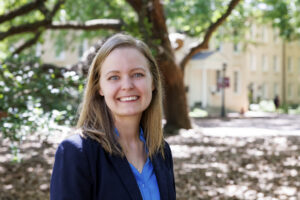
When DeBoom talks about what drives her, she locates the origins in her very first job: pulling weeds on her family's Iowa farm for a penny a piece.
"Commodity price fluctuations defined my childhood. Like many resource-rich places, my hometown bore heavy costs from resource extraction yet was poor in economic opportunities. And that sparked a question: how can the benefits and costs of resource wealth be distributed in a more equitable and just way?" she said.
That question, first sharpened when she wrote a policy proposal for the Truman Scholarship in college, has shaped every stage of her career, and it's part of what she brings to Korbel as a new faculty member this year.
DeBoom's path to international environmental politics wasn't linear. A first-generation college student at the University of Iowa, she arrived thinking she was headed toward law school or a career in government. That changed when she saw a flyer for nonpartisan research work with the Iowa legislature. The job opened her eyes to a different kind of political engagement: interviews, surveys, and comparative policy analysis as tools for understanding how people think about the issues affecting them. Because Iowa's citizen legislature often received information filtered mainly through political parties, DeBoom's research helped fill a real gap, while comparisons with other states offered a window into policy best practices. It was her first taste of combining research, teaching, and direct engagement with policymakers, a perspective she would take with her while studying abroad in Moscow and South Africa.
From there, DeBoom interned at the EPA, where she learned about the intersection of climate change and economic development. After graduating, she moved to Washington, DC to work on environmental policy at the Department of Transportation. She loved the work but missed the chance to shape original research and talk directly with the people affected by policy decisions. That pull back toward fieldwork led her to campaign work, spending more time with the Iowa legislature, and a full summer stationed at the U.S. Embassy in Namibia, experiences that ultimately pushed her toward a master’s and PhD in Geography at the University of Colorado, Boulder.
Her first faculty position took her to the geography department at the University of South Carolina, where she spent seven years. She describes geography as a discipline not unlike history: it’s broad enough to examine almost anything, but with a focus on dynamics across place rather than time.
What eventually brought her to the University of Denver was Korbel's approach to bridging research and policy work in an interdisciplinary environment.
"The spirit here is not just to study problems, but to actually play a part in solutions," she said.
She's also been struck by the students: their curiosity, their range of knowledge, and their willingness to ask hard questions and be challenged in return.
This academic year, DeBoom is teaching two courses. During the Winter Quarter, she’s offering Environmental Geopolitics, a course that examines how environmental issues intersect with conflict, nationalism, sovereignty, and the distribution question at the heart of so much policy debate: who has the right to benefit from a given resource? During the Spring Quarter, she'll teach Environment, Economy, and Development, a course in the broader Global Environmental Sustainability program.
Outside of teaching, DeBoom focuses her research on global energy politics, using Namibia as a case study of the tensions many governments face between economic necessity and sustainable development. Namibia has attracted massive EU-backed investment in green hydrogen, nearly equivalent to the country's GDP, even as offshore oil discoveries complicate the picture. DeBoom sees the country's resulting "hedging strategy" as illustrative of a much larger climate justice issue: historically extractive nations, she argues, bear responsibility for funding diversification and development in places like Namibia that can't simply trust that external green investments will materialize.
For DeBoom, climate change is both a global crisis and an intensely local one, and she doesn't see a shortage of ways in. That range, from grounded fieldwork to global policy debates, is exactly what she hopes to pass on to students at Korbel. We can't wait to see how her work and mentorship shape the next generation of researchers and policymakers.
Please join us in welcoming Assistant Professor Meredith DeBoom to Korbel!
Copyright ©2026 University of Denver | All rights reserved | The University of Denver is an equal opportunity institution