
Join us for Open House on November 13, 2026. Register now.

Menu

Menu
Join us for Open House on November 13, 2026. Register now.
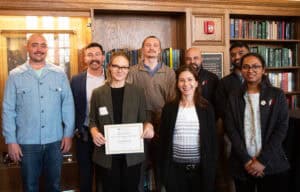
On February 25, 2026, the Frederick S. Pardee Institute for International Futures received the University of Denver's inaugural Research, Scholarship, and Creative Works (RSCW) Impact Award, recognizing research and creative work that makes a demonstrable difference beyond the University.
The award honors the Institute's commitment to producing research that helps governments, international organizations, and development partners make better long-term decisions in the face of complex global challenges.
The recognition highlights the Pardee Institute's work using its International Futures (IFs) integrated assessment model to support the African Union in developing Agenda 2063's Second Ten-Year Implementation Plan. This work helped shape the African Union's Second Ten-Year Implementation Plan for Agenda 2063 by providing data-driven targets and supporting the development of the plan's seven "Moonshot" priorities. The Pardee Institute has also used IFs to study important issues across Africa, including trade, food security, COVID-19 recovery, and long-term development.
The Pardee Institute conducted scenario analysis with the United Nations on sustainable development and global risk. The IFs platform has become a foundational tool for strategic planning, helping the world’s largest development agencies analyze post-pandemic recovery, the climate-poverty nexus, and the invisible economy of unpaid care.
The research quantified the long-term human costs of conflict and climate change in Yemen. The research shifted how people talked about the conflict by providing evidence of the depth of the humanitarian crisis that defined the conflict for the UN Security Council, the United States Congress, and the global press. From the canonical finding of 377,000 deaths to the projection of $93 billion in climate losses, the research demonstrated the far-reaching human and economic consequences of Yemen’s crisis. Together, these efforts demonstrate how integrated, long-term modeling can help clarify policy choices, reveal hidden tradeoffs, and identify levers to support more resilient futures.
The award reflects years of collaboration across the Institute and with partners around the world. Letters of support from partner organizations emphasized the practical value of Pardee's research and its role in informing policy planning and long-term decision-making.
The Research, Scholarship, and Creative Works Impact Award reinforces the tangible value of the Institute's work to translate long-term analysis into practical guidance. Through the International Futures (IFs) system and close collaboration with global partners, the Institute develops evidence-based insights that help decision-makers better understand the future and the choices available today.
Luke Venezia, a core Diplometrics team member at the Frederick S. Pardee Institute of International Futures and an undergraduate student at the University of Denver, has been adjudged the winner of the Stimson Center's 2nd annual Build a Better U.S. Foreign Policy student essay competition.
Venezia’s winning essay, “The US Should Be Taking the Lead on Global Infrastructure Development,” focused on proposing a more efficient approach for the United States to advance sustainable international infrastructure development while avoiding the situation where funds get trapped in corrupt bureaucracies and doomed projects.
Commenting on the award-winning essay in an article published by the Stimson Center, Venezia noted that his experience studying in Italy had inspired his essay. “I was studying abroad in Italy back in the Fall, and at that time, the country had recently withdrawn its membership in the Belt and Road Initiative, in part because of worsening US and China relations,” he said. “The need to curtail Huawei was evident, but the means to do so was limited at best from the European side. A recent class in political risk pointed me in the direction of realizing benefits from risk, not just mitigation. This led to a more business-driven perspective to foreign policy issues, hence, utilizing the private sector.”
Venezia's achievement connects to the Pardee Institute and the work of its Diplometrics team, building their expertise and contribution to international affairs, particularly in sustainable infrastructure development.
The winning essay can be found here on Inkstick Media.

In November 2017, Director Jonathan D. Moyer presented at the Mathematica Policy Research headquarters in Washington, DC to launch a new project for the USAID LAC/RSD Education Team. This work will explore the cross-cutting issues of migration, education quality, labor market dynamics, and violence in Central America. The research will help USAID missions in Guatemala, Honduras, El Salvador and Nicaragua better understand the underlying linkages between investments in education and the possibility for those investments to positively affect not only medium- and long-term educational outcomes for youth in those countries, but unemployment, violence/security, and even migration outcomes of concern to national governments in Central America, and to the U.S. government.
Our Institute is excited to announce that we have been selected to receive a $1.05 million research grant as part of the Department of Defense's Minerva Initiative.
Please read the official press release below.
 DENVER—May 27, 2014—The University of Denver’s Josef Korbel School of Global and Public Affairs announced today that the Frederick S. Pardee Center for International Futures has been selected to receive a $1.05 million research grant as part of the Department of Defense’s Minerva Initiative. The awarded project, “Taking Development (Im)Balance Seriously: Using New Approaches to Measure and Model State Fragility,” will develop a new, more comprehensive index for measuring and monitoring state fragility in the future.
Though widely used and cited, existing state fragility indices, designed specifically to signal instances of abrupt socio-political change such as the Arab Spring or the ongoing uprisings in Ukraine, have missed the mark, limiting the strategic options available to our country’s national security and defense leaders. In this project, a team at the Josef Korbel School intends to improve upon existing quantitative methods by developing and testing new measures of economic, political, or broader social (im)balance and fragility related to abrupt socio-political change and forecasting these metrics to 2035.
Pardee Institute Associate Director Jonathan D. Moyer and Director Barry B. Hughes are the principal investigators on this project. Other co-investigators from the Josef Korbel School include faculty members Erica Chenoweth, Cullen Hendrix, Oliver Kaplan, and Timothy Sisk. This will be the second Minerva grant awarded to both Chenoweth and Hendrix.
“This Minerva grant provides us with an exciting opportunity to extend how we measure and analyze structural factors that contribute to abrupt socio-political change, especially in middle-income countries,” said Hughes.
The grant will be awarded over a three-year period, with a possible two-year extension.
The $1.05 million grant marks a milestone for the Josef Korbel School. Presently, there is more than $4.1 million in external funding for active projects at the School. Over the past five years external funding for research projects has tripled—an increase that reflects the School’s growing strength in quantitative social science research. “Through their innovative research, faculty at the Josef Korbel School are answering some of today’s most pressing questions,” said Christopher Hill, dean of the Josef Korbel School. “We emphasize quantitative skills in both our research and curricula. This award from the Department of Defense and the sharp increase in research grants affirms our continued improvement in this area.”
According to the DoD, the Minerva Initiative was launched by former Defense Secretary Robert Gates in 2008 “to improve DoD's basic understanding of the social, cultural, behavioral, and political forces that shape regions of the world of strategic importance to the US.”
The Frederick S. Pardee Institute for International Futures uses the IFs integrated forecasting system to provide long-term analysis of development, security, and sustainability issues to various governments, private companies, and other non-governmental organizations worldwide. The center has published its own volume series, Patterns of Potential Human Progress, and has contributed to publications including the National Intelligence Council’s Global Trends reports and the United Nation’s Human Development Report.
For more information, please visit the center’s website: pardee.du.edu
You can access the official press release here.
Our staff is extremely grateful for the continued generosity of our founding supporter, Frederick S. Pardee. We are delighted to announce his most recent gift to our Center. Thank you, Fred!
Please read the official press release below.

DENVER—May 1, 2014—The Frederick S. Pardee Center for International Futures at the University of Denver’s Josef Korbel School of Global and Public Affairs announced today the receipt of a $4 million gift from their namesake Frederick S. Pardee. The donation by Pardee is in support of the Center’s general endowment.
Pardee is an economist, businessman, and philanthropist who, in 2007, generously donated $7.45 million to the University of Denver to establish the Frederick S. Pardee Center for International Futures. This gift also supported the Center’s production of Patterns of Potential Human Progress, a series of five volumes on the future of the global human condition published jointly by Paradigm Publishers and Oxford University Press India.
“The entire Josef Korbel School community thanks Frederick S. Pardee for his generous gift and his ongoing support of the Frederick S. Pardee Center for International Futures,” said Christopher R. Hill, dean of the Josef Korbel School of Global and Public Affairs.
The Pardee Center’s mission is to explore, understand, and shape alternative futures of global change and human development. It is home to the International Futures (IFs) model, one of the most sophisticated and comprehensive macro-level, long-term forecasting systems available to the public. IFs is deeply data driven and draws on today’s best understanding of global systems to produce forecasts for 186 countries to the year 2100 and is designed to enhance long-range thinking and policy analysis.
“The Center’s recent and current work with the United Nations, World Bank, and governmental and intergovernmental organizations in Africa and Latin America exemplifies its rapidly growing contributions to global public policy analysis,” said Barry B. Hughes, Ph.D., director of the Pardee Center and John Evans professor at the Josef Korbel School. “The new gift will solidify the Center with ongoing core support from the endowment and will make it possible for the Center in turn to solidify its emergent standing as the world’s leading institution for long-term, multi-issue global forecasting.”
To learn more about the Frederick S. Pardee Center for International Futures and IFs visit their website at https://pardee.du.edu/.
Founded in 1864, the University of Denver is committed to improving the human condition and engaging students and faculty in tackling the major issues of our day. In 2014, the University of Denver will celebrate its sesquicentennial with a full calendar of events and programs that not only honor the institution’s 150-year commitment to serving students, the community and the public good, but that look forward to a future of continued achievement and innovation. The University of Denver ranks among the top 100 national universities in the U.S. For additional information, subscribe to The University of Denver Newsfeed, visit the sesquicentennial website or follow the University on Facebook and Twitter.
The Josef Korbel School of Global and Public Affairs is one of the world's leading schools for the study of international relations. Since its founding in 1964, the Josef Korbel School has produced alumni who work to improve the human condition, advance human prosperity, and enhance human security. Learn more at du.edu/korbel or follow the School on Facebook and Twitter.
To download a PDF version of the original press release, please click here: Frederick S. Pardee Donates $4M to the University of Denver
Other News/Blog Posts from the Pardee Center:
Nigeria's GDP Rebase Illustrates Challenge for Many Developing Countries
5 Features to Explore on Our New Website
Promoting Transparency Through the IFs Help System
Working with the World Bank - The Future of Poverty in Fragile States
Pardee Center,International Futures,Josef Korbel School,Frederick S. Pardee
The University of Denver's Josef Korbel School of Global and Public Affairs announced today that the Frederick S. Pardee Center for International Futures has been selected to receive a $1.05 million research grant as part of the Department of Defense's Minerva Initiative. The awarded project, "Taking Development (Im)Balance Seriously: Using New Approaches to Measure and Model State Fragility," will develop a new, more comprehensive index for measuring and monitoring state fragility in the future.
Though widely used and cited, existing state fragility indices, designed specifically to signal instances of abrupt socio-political change such as the Arab Spring or the ongoing uprisings in Ukraine, have missed the mark, limiting the strategic options available to our country's national security and defense leaders. In this project, a team at the Josef Korbel School intends to improve upon existing quantitative methods by developing and testing new measures of economic, political, or broader social (im)balance and fragility related to abrupt socio-political change and forecasting these metrics to 2035.
Pardee Center Associate Director Jonathan D. Moyer and Director Barry B. Hughes are the principal investigators on this project. Other co-investigators from the Josef Korbel School include faculty members Erica Chenoweth, Cullen Hendrix, Oliver Kaplan, and Timothy Sisk. This will be the second Minerva grant awarded to both Chenoweth and Hendrix.
"This Minerva grant provides us with an exciting opportunity to extend how we measure and analyze structural factors that contribute to abrupt socio-political change, especially in middle-income countries," said Hughes.
The grant will be awarded over a three-year period, with a possible two-year extension.
The $1.05 million grant marks a milestone for the Josef Korbel School. Presently, there is more than $4.1 million in external funding for active projects at the School. Over the past five years external funding for research projects has tripled—an increase that reflects the School's growing strength in quantitative social science research. "Through their innovative research, faculty at the Josef Korbel School are answering some of today's most pressing questions," said Christopher Hill, dean of the Josef Korbel School. "We emphasize quantitative skills in both our research and curricula. This award from the Department of Defense and the sharp increase in research grants affirms our continued improvement in this area."
According to the DoD, the Minerva Initiative was launched by former Defense Secretary Robert Gates in 2008 "to improve DoD's basic understanding of the social, cultural, behavioral, and political forces that shape regions of the world of strategic importance to the US."
The Frederick S. Pardee Center for International Futures uses the IFs integrated forecasting system to provide long-term analysis of development, security, and sustainability issues to various governments, private companies, and other non-governmental organizations worldwide. The center has published its own volume series, Patterns of Potential Human Progress, and has contributed to publications including the National Intelligence Council's Global Trends reports and the United Nation's Human Development Report.
For more information, please visit the center's website: pardee.du.edu
The Frederick S. Pardee Center for International Futures at the University of Denver's Josef Korbel School of Global and Public Affairs announced today the receipt of a $4 million gift from their namesake Frederick S. Pardee. The donation by Pardee is in support of the Center's general endowment.
Pardee is an economist, businessman, and philanthropist who, in 2007, generously donated $7.45 million to the University of Denver to establish the Frederick S. Pardee Center for International Futures. This gift also supported the Center's production of Patterns of Potential Human Progress, a series of five volumes on the future of the global human condition published jointly by Paradigm Publishers and Oxford University Press India.
"The entire Josef Korbel School community thanks Frederick S. Pardee for his generous gift and his ongoing support of the Frederick S. Pardee Center for International Futures," said Christopher R. Hill, dean of the Josef Korbel School of Global and Public Affairs.
The Pardee Center's mission is to explore, understand, and shape alternative futures of global change and human development. It is home to the International Futures (IFs) model, one of the most sophisticated and comprehensive macro-level, long-term forecasting systems available to the public. IFs is deeply data driven and draws on today's best understanding of global systems to produce forecasts for 186 countries to the year 2100 and is designed to enhance long-range thinking and policy analysis.
"The Center's recent and current work with the United Nations, World Bank, and governmental and intergovernmental organizations in Africa and Latin America exemplifies its rapidly growing contributions to global public policy analysis," said Barry B. Hughes, Ph.D., director of the Pardee Center and John Evans professor at the Josef Korbel School. "The new gift will solidify the Center with ongoing core support from the endowment and will make it possible for the Center in turn to solidify its emergent standing as the world's leading institution for long-term, multi-issue global forecasting."
To learn more about the Frederick S. Pardee Center for International Futures and IFs visit their website at https://pardee.du.edu/.
###
Founded in 1864, the University of Denver is committed to improving the human condition and engaging students and faculty in tackling the major issues of our day. In 2014, the University of Denver will celebrate its sesquicentennial with a full calendar of events and programs that not only honor the institution's 150-year commitment to serving students, the community and the public good, but that look forward to a future of continued achievement and innovation. The University of Denver ranks among the top 100 national universities in the U.S. For additional information, subscribe to The University of Denver Newsfeed or follow the University on Facebook and Twitter.
The Josef Korbel School of Global and Public Affairs is one of the world's leading schools for the study of international relations. Since its founding in 1964, the Josef Korbel School has produced alumni who work to improve the human condition, advance human prosperity, and enhance human security. Learn more at du.edu/korbel or follow the School on Facebook and Twitter.
Over the summer, Arrow Electronics Inc., a Fortune 150 company with 16,500 employees worldwide, contributed $100,000 to the Frederick S. Pardee Institute. The gift will help expand and support the important foundational work of the International Futures system.
The Pardee Center’s team of research assistants has made significant progress on its data collection of “diplometrics,” which include a variety of diplomacy measures. The team, so far, has compiled four different databases. One measures the number and location of foreign embassies by country over time. Another shows each country’s involvement in intergovernmental organizations (IGOs). We will also have a database on each country’s voluntary contributions to the UN as well as one on the UN’s professional staff. Our RAs are now carefully vetting the data, and these databases should be ready to integrate into the IFs system soon. Our team hopes to collect additional data on diplomacy throughout the year, including measures of bilateral alliances, staff and budget contributions to all international organizations, and on issues related to measuring sovereignty.
Copyright ©2026 University of Denver | All rights reserved | The University of Denver is an equal opportunity institution