

Menu

Menu
This article was written by MPP student Jenni Gutierrez Marquez
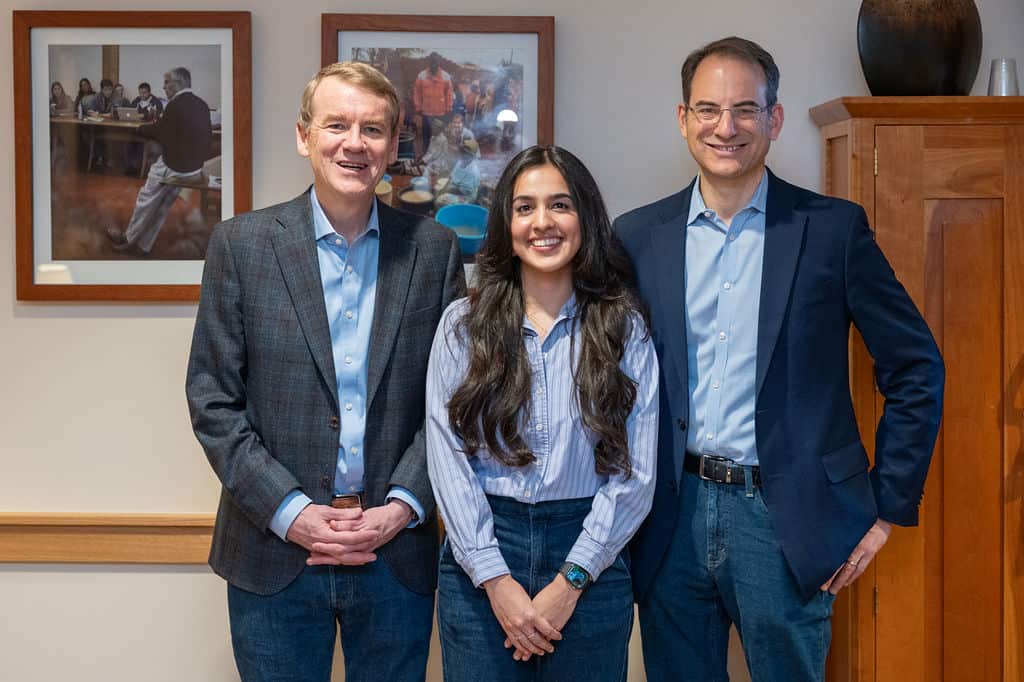
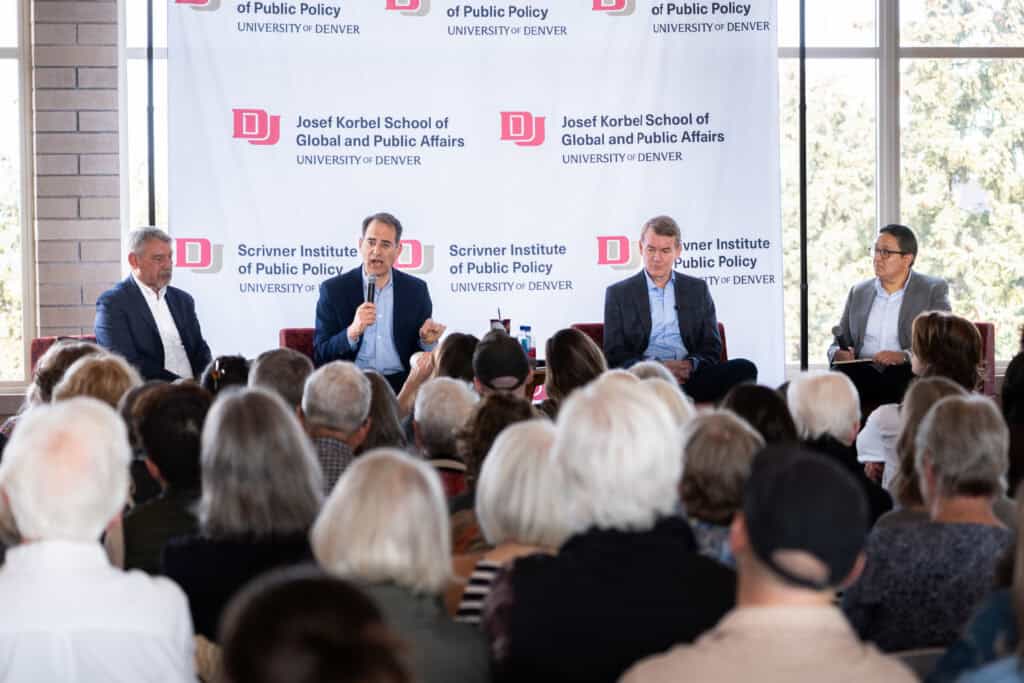
On March 1, 2026, I had the honor of meeting U.S. Senator Michael Bennet and Colorado Attorney General Phil Weiser at the Governing Colorado: Policy Challenges and Priorities event, hosted by the Scrivner Institute of Public Policy. This event provided a unique opportunity for the public to engage directly with two of Colorado’s most prominent leaders, and current gubernatorial candidates, on some of the state’s most pressing policy challenges.
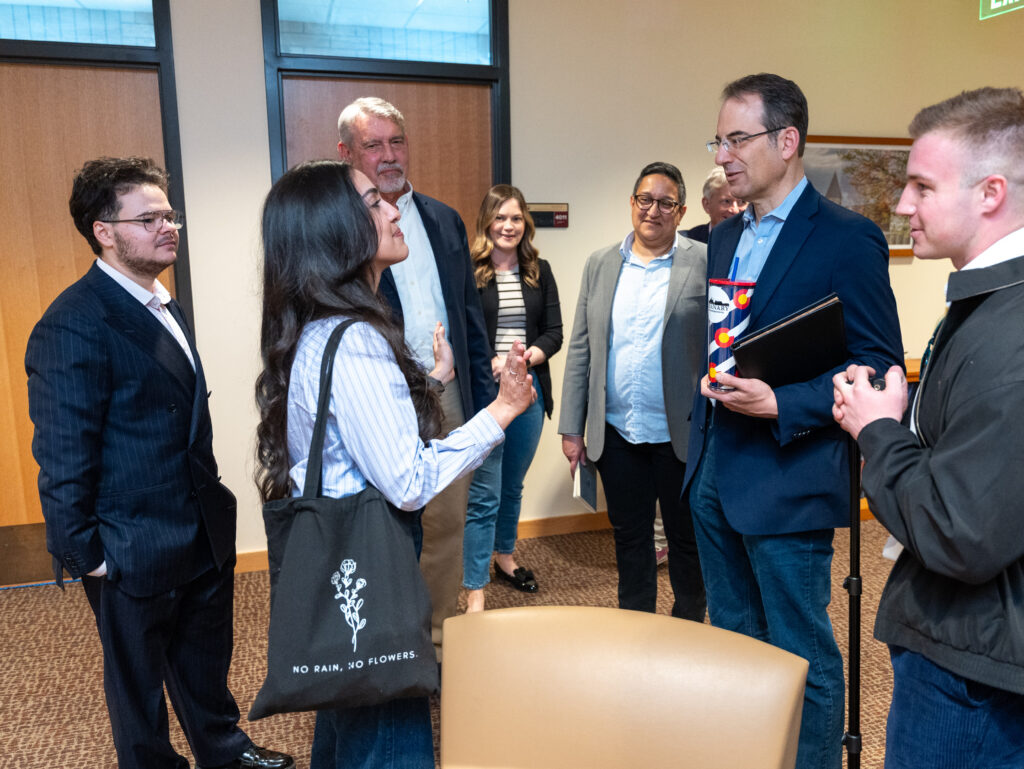
What set this event apart was its educational approach and non-debate format. As Scrivner Institute Director and moderator Naazneen Barma described, it was “a deep dive dialogue on major policy issues that are facing the state in a non-partisan educational space.” The civil discourse felt significant, offering our community both insight into Colorado’s future leadership and a chance to come together around the gravity of issues ranging from affordability and housing to healthcare, natural resources, and more. The dialogue allowed students and community members to learn about potential solutions from state leaders, appreciate new perspectives, and develop a deeper understanding of the challenges Coloradans across the state are facing. The event embodied what it means to be at the heart of meaningful, community-focused education and civic discourse. On a personal note, I truly appreciated the chance to briefly meet both speakers and engage in informal conversations about my own and my classmates’ interests in public policy.
Affordability emerged as a recurring theme, particularly against the backdrop of current economic challenges. The panel discussed the potential effects of the Kroger and Albertsons merger, which could have led to the closure of grocery stores in rural Colorado. This scenario raised important concerns about the possibility of food deserts, making it even harder for vulnerable populations, especially the elderly, to access affordable groceries. Town halls became crucial forums for both workers and consumers to express their concerns and highlight how issues of affordability touch everyone in the community. The discussion on affordability naturally extended to housing, with widespread anxiety over so many Coloradans spending more than 30% of their income on a place to live. The central takeaway was the need to build an economy where everyone can thrive, an idea both candidates addressed by sharing different approaches they would take to achieve this goal.
Healthcare was another significant topic, particularly the question of how and when the state should step in to address gaps left by the federal government. The conversation focused on the risks of rural hospitals closing and the broader issue of retaining essential healthcare professionals across Colorado. There was a strong emphasis on the need to ensure primary care for all at lower costs, with the understanding that fair compensation is crucial not only in healthcare but also in education and other vital professions. The message was clear: Colorado cannot afford to wait for federal action and must pursue innovative state-level solutions.
Both speakers underscored the importance of the entire state coming together, pooling resources, and moving beyond political differences to protect all Coloradans. The conversation also explored the complex relationship between state and federal governments, focusing on the importance of secure democratic practices and the rule of law. For example, the prosecution of Tina Peters was discussed not as a political issue, but as an affirmation of legal integrity. Throughout, the need for Colorado to advocate for its own rights and remain resilient in defending democratic values was a recurring theme.
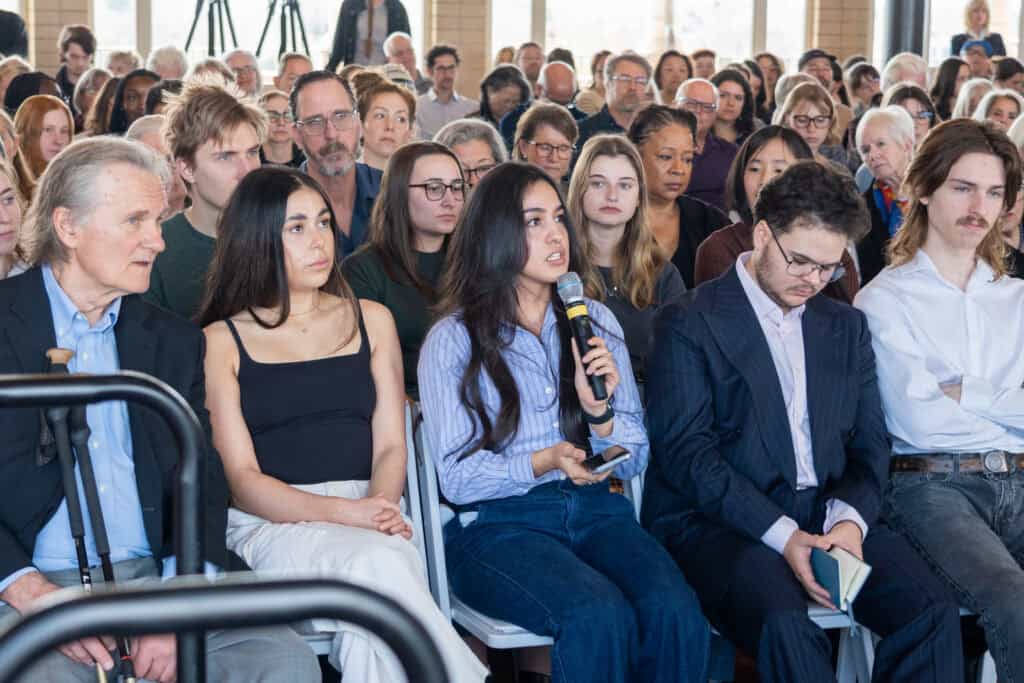
Immigration emerged as a deeply personal theme for both speakers, shaped by their family histories. There was broad agreement on the need for Colorado’s next governor to support mixed-status families and prevent unnecessary separations, as well as a shared recognition of the vital role the immigrant community plays in the state. Both speakers highlighted the continued need for immigration reform and emphasized the importance of creating a culture that values and appreciates immigrant neighbors and first-generation Americans. For me, it was particularly refreshing and meaningful to ask a question about immigration enforcement and receive responses rooted in personal experience. Hearing such thoughtful, nuanced answers, focused on community preservation rather than political posturing, was a reminder of the power of honest, empathetic dialogue in a policy setting.
Natural resources and conservation also featured prominently in the dialogue, with Colorado’s identity deeply tied to its beauty and wildlife. The most pressing issue discussed was the ongoing 25-year drought and the challenges it poses for water resources. Ensuring safe drinking water, particularly in southeastern Colorado, remains an ongoing struggle, despite efforts to address it. The panel underscored the need for state-first approaches to water management, prioritizing the rights of Coloradans in water treaties while also recognizing the needs of those downstream. There was a strong call to build coalitions that address these environmental challenges, including targeted efforts to mitigate wildfire risk in areas like Meeker and the Southern Slope. The conversation highlighted real opportunities for Colorado to lead on climate and resource policy, but progress will require concrete action and collective accountability.
Throughout the dialogue, both speakers exemplified a unique sense of Colorado pride. Even when they disagreed on specific policy solutions, there was an ever-present consensus on the need to protect Coloradans and put the state’s people first. The event went beyond just covering the topics, it dove into the political complexities behind them. As community members, we walked away not only with more knowledge but also with a deeper understanding of the challenges ahead and a sense of responsibility to become more aware and innovative. This especially resonated with me as a student preparing to enter the policy field.
Watch the recording of the discussion here.
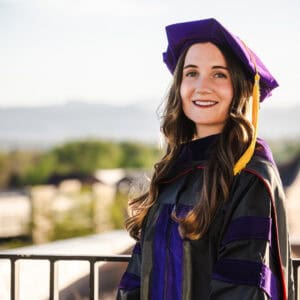
Tell us about your background prior to starting your graduate studies.
I was born and raised in Jefferson City, Missouri, and went to the University of Kansas for undergrad, where I majored in political science and sociology and minored in Spanish. After I graduated in 2019, I joined Teach for America and taught middle school science at a public charter school in Kansas City, Missouri. I taught at my placement school for a third year after my two-year TFA commitment, and I was also a policy fellow with the Urban Leaders Fellowship the summer between my second and third year teaching.
What motivated you to pursue both a JD and an MPP?
I was motivated to go to graduate school because I felt like I was having a difficult time making meaningful change in my role as a teacher, and I wanted to take a different approach to addressing the issues that mattered to me and that I saw affecting my students. I wasn’t sure, though, whether I wanted to focus my career on practicing law, doing policy work, or some combination of both. I knew some people end up doing policy work with only a J.D., but I wanted to make sure my graduate studies included an intentional focus on developing both sets of skills, and I thought a joint JD/MPP program was the best way to do that.
What has been your favorite class, and why?
Two of my favorite classes at Korbel were Professor Tamra d’Estree’s Negotiating Environmental Conflict and Policy class and the Negotiation Workshop. Because of scheduling conflicts and limited availability, I didn’t get the chance to take any negotiation or alternate dispute resolution classes through the law school, so it was great to be able to work on those skills—which are skills that I think are essential for both policy work and for the practice of law—at Korbel. These courses included elements of both theory and real-world application through negotiation simulations, and I thought that made them both especially effective and meaningful.

What makes you feel safe? Is it a familiar voice on the phone, a particular place, friends or family by your side, your spiritual beliefs or even a favorite blanket?
What about a person outside your personal circle, like a paramedic, a lifeguard, a firefighter or a police officer?
20-year-old Joseph said that people should feel safe around police officers, but that isn’t always the case in Durham, North Carolina—where he lives—and elsewhere.
He says, “I think that police officers almost have to have a—not necessarily nurturing aspect, but kind of like a—sense of safety about them. Because you should feel safe around police officers, you know? I don’t necessarily know how to put that in a word, but I think that you should definitely just feel safe around police officers.”
So how can police departments increase safety and earn trust in the communities where they work?
University of Denver Assistant Professor of Public Policy Ajenai Clemmons’ research answers these questions that can extend beyond North Carolina.
On this episode of RadioEd, co-host Jordyn Reiland chats with Clemmons about how the men she interviewed made sense of policing in their neighborhood—and what they needed to both be safe and feel safe.
Clemmons is an assistant professor of public policy at the Scrivner Institute. She researches the policing of marginalized communities in democratic contexts, particularly the United States and Europe. She teaches courses on the politics of the policymaking process, intersectional inequality, as well as state violence and local security.
What the Durham Police Department Can Do to Enhance Safety and Earn Trust
RadioEd S5E3:
Guest: Ajenai Clemmons, Assistant Professor of Public Policy at the Scrivner Institute
Jordyn Reiland (00:04)
You're listening to RadioEd, the University of Denver podcast. I'm your host Jordyn Reiland.
What makes you feel safe? Is it a familiar voice on the phone, a particular place, friends or family by your side, your spiritual beliefs or even a favorite blanket?
What about a person outside your personal circle, like a paramedic, a lifeguard, a firefighter or a police officer?
20-year-old Joseph said that people should feel safe around police officers, but that isn’t always the case in Durham, North Carolina — where he lives — and elsewhere.
He says, “I think that police officers almost have to have a—not necessarily nurturing aspect, but kind of like a—sense of safety about them. Because you should feel safe around police officers, you know? I don’t necessarily know how to put that in a word, but I think that you should definitely just feel safe around police officers.”
So how can police departments increase safety and earn trust in the communities where they work?
University of Denver Assistant Professor of Public Policy Ajenai Clemmons’ research answers these questions that can extend beyond North Carolina.
Clemmons’ work around policing began in 2004 when she worked as a Community Relations Ombudsman in Denver. During that time Clemmons helped create a new government agency called the Office of the Independent Monitor.
Ajenai Clemmons (01:24)
This was in response to some very high-profile incidents, some officer-involved deaths of civilians in Denver and so the city, the citizens rose up. The city came together across all agencies and volunteers from the community as well, to study new systems of civilian oversight that could improve transparency and accountability for public safety in Denver.
Jordyn Reiland (01:49)
The role of the Office of the Independent Monitor allows for an outside party to ensure law enforcement investigations are fair, thorough and timely and that any discipline is reasonable and appropriate.
Civilian oversight of law enforcement is something that's been around for some decades now, but it looks different in every city. Civilian commissions or boards exist in cities throughout the country including Los Angeles, Chicago, Kansas City, Missouri and Detroit.
Clemmons also spent time in Washington, D.C. between 2010 and 2015, where she was the policy director for a national professional association of Black state legislators.
At that time there were a series of high-profile shootings across the country, including Travyon Martin, Michael Brown, Eric Garner, Tamir Rice, Sandra Bland and Freddie Gray.
Clemmons’ interest in policing of marginalized communities only grew from there.
In 2018 until just before the onset of the pandemic, she conducted in-depth interviews with 18- to 29-year-old African American men—like 20-year-old Joseph, who we heard from earlier. These men lived in the most economically distressed, high violent crime areas in Durham.
Clemmons’ work sought to understand how they made sense of policing in their neighborhood — and what they needed to both be safe and feel safe.
She acknowledged the challenges of conducting this type of research in the community and wanted to find ways to ensure people felt the most comfortable sharing their thoughts — positive or negative.
Ajenai Clemmons (03:10)
I went out on foot into these neighborhoods and recruited them. I was in barber shops, I was on basketball courts talking to young men during halftime and trying to pull them aside to see if they were interested in my study. I was hitting the streets. So we did these interviews in a private location. I wanted them to be confidential so that people could be candid. These are very complex feelings that people have, and I wanted them to feel that they could be vulnerable, that they could feel comfortable to be fully honest about whether their experiences were negative, whether they were positive or whether they were neutral, that they would have the full range to discuss whatever they wanted. I was very honored that they were so forthcoming. And they didn't sugar coat anything, and they didn't hold back. And it wasn't just..they were also self-reflective. They talked about what their experiences were like as kids, as youth, as teenagers, you know, being angry, whether they had a chip on their shoulder or not, or whether they were trying to stay out of trouble, and the kinds of ways that they... the kinds of things that they did to keep themselves safe.
Interlude
Jordyn Reiland (04:44)
Why don't people trust the police?
Ajenai Clemmons (04:46)
Yeah, this is a very big question. It's simple, but it's actually complex in a lot of ways. So in a nutshell, people don't trust police when they feel like they're not doing their jobs. They trust police when they feel under policed, when they feel that police are not competent, and I'll talk about that in a second. And they also feel they don't trust police. When they feel that police are being abusive and they're harming them. So they're sort of over policed, right? So these are the neighborhoods that I study. I literally study neighborhoods that are considered by their residents to be over policed and under policed. So in these communities, there's this intense police presence. Residents are stopped on foot or in their vehicles in a way they describe as constant, intrusive and harassing. They describe many officers as quick to accuse them of wrongdoing, right to curse at them and to use unnecessary and excessive force. Yet in these same neighborhoods, in spite of all the police activity going on, they still face high levels of crime, right? And that includes violent crime, and so this causes stress and insecurity on their part. So there's this sense that you know there are all these police around, but they're not there when you need them, right, or they're not in the right spots or focused on the right priorities, or they don't care about us.
When people feel abandoned and neglected, sometimes they distance themselves in return. And so it goes beyond this sense of trust or mistrust, it can breed legal cynicism. And cynicism is this orientation in which the law and agents of its enforcement, like the police and courts, are viewed as illegitimate. They're viewed as unresponsive and ill-equipped to ensure public safety, and that's a definition from Kirk and Papachristos. So it is very much a sense of feeling alienated. And that can go beyond police. It can extend to the judicial system writ large. But when this happens, when people don't trust police anymore and they are cynical toward them, it's rational from the perspective of looking at an individual, but it actually harms the community as a whole, because what happens is that people won't report crime as much, right? They won't cooperate with investigations, they won't serve as witnesses in the court of law as readily, and this can make it very hard to bring people who commit crimes to justice, and I'm not talking about, you know, unserious crimes. I'm talking about serious crimes. And so, you know, these folks are not held accountable, and they are, in fact, making the community less safe. And then this further breeds the cynicism. It's a vicious cycle, because then people see folks running around who are threatening the community, and so then they even feel further alienated, as they feel that the police don't care about them.
Jordyn Reiland (07:55)
Wow, that must be so challenging, and it kind of alludes to what you were talking about with the different meanings and thoughts about safety. And I think you said feeling safe and being safe, if that's correct. Could you talk a little bit about that?
Ajenai Clemmons (08:11)
So in general, a lot of people assume that if crime numbers go down, then they will feel more safe, and that's actually not true. The perception of safety is completely independent of whether or not you are safe or your risk level. So crime went down for years, decades even, and people's assessment of the risk of crime really hasn't changed. And sometimes it went up, even though the crime was going down, depending on where you were. So those are two different things, and it actually makes police, their job tougher, because they do have that accountability of bringing down the crime levels. But then people can feel that way regardless. And so then they have to dedicate some considerable resources to making people feel safer.
In this context, though, there really is unacceptable levels of violent crime and so even though it's a tiny proportion of the population that's carrying it out, it is significant. And in a lot of it, there are innocent bystanders that get caught in the middle. And in fact, out of the men that I interviewed, eight had been shot at least once, and four of those were folks who were caught in the crossfire who didn't have any idea who the shooter was or were mistaken by the shooter for someone else. And then additional men that I interviewed who literally were at a bus stop, waiting for their bus to arrive to go to work, and ended up having to dive for cover as bullets whizzed past them, because somebody saw somebody that they had been looking for, and then, just without regard to the circumstances, just opened fire. So there really is an extraordinary level of risk in these particular neighborhoods, and so it is important for people to both be safer and to feel safer, and so I wanted to make sure that I was being intentional in pulling out those two things in the interviews.
Jordyn Reiland (10:36)
One question that you asked stood out to me, and you said, “If you had a magic wand and could make a perfect interaction happen between an officer and a civilian, what would you do?” And you said you can choose any scenario. Did any of those answers surprise you?
Ajenai Clemmons (10:52)
On the whole, most answers tried to find some sort of win-win. They tried to find some sort of reconciliation between both parties and ensure that that was a positive interaction. And so it wasn't the case that most people's first thought was to just take care of the needs of the civilian. That in that perfect scenario, they really did seek a win-win. And so I was struck by that. A lot of the men did use their wishes to also undo the deaths of the men who had been killed that we talked about earlier, those high-profile deaths that had happened across the country, there was a recognition of that. And it was something that all but one interview we related to on some level, that they could see themselves in those men who had died, or in those people who had died. We certainly want to take into account the women who have been killed as well. So they actually use their magic wand to undo those deaths and to undo the harms that have happened.
Jordyn Reiland (12:10)
You highlight five themes that emerged as the most desired characteristics for officers, including those who are just communicative, invested composed and discerning and adaptive in their decision making. Can you paint a picture for me of the ideal police officer?
Ajenai Clemmons (12:30)
There is not one person that I spoke with who thought that being a police officer was an easy job. Folks were very quick to say it is a hard job. Not everybody should be a police officer, there are a lot of things to manage. It was about being constitutional. People were clear about that. It was making sure that you're observing people's rights, that people are innocent until proven guilty—that officers are truly just in how they enforce the law.
But it goes beyond that. Really, they wanted officers to have integrity. They wanted officers to be good people. And I think this is because this is really the most powerful person in their lives. They're the only person who can literally take life. And so it is important then that people who hold the most amount of power are actually good and righteous, and because you don't have the opportunity to see officers outside of these sort of emergency situations, or time pressure situations, you need other opportunities to observe their behavior, to know if they're trustworthy, right? To know if you can bring confidential information to them, to know whether they will keep confidence and so this is where you know they wanted to see officers' character on display. How do you do that? Well, they got to get in the community. They’ve got to get involved.
Jordyn Reiland (14:14)
Clemmons said that what surprised her about her research in Durham was people’s inherent desire to have a connection and a relationship with law enforcement.
Ajenai Clemmons (14:22)
Now maybe because they can't tell who's a safe officer and who's not a safe officer, and because there's so much unpredictability that is possible in those interactions, having positive encounters and having incredibly scary negative encounters, the safer thing to do could be to avoid police. To try to minimize the possibility of an experience, right? To keep a low profile.
But that ideally in their heart of hearts, many wished that they could just casually walk up to a police officer, say hi, chat, check in, or have that police officer do the same. That in their ideal world, that's what the general relationship would be between the police and the community. That you would see officers jumping in and playing double dutch, or joining in a pickup game of basketball or guiding a young person and talking to them about healthy life choices that those officers would be leading by example, that they would be a fabric of the community, that they would be rolling up their sleeves, and serving food and soup kitchens. And so there were so many ways that they saw police as able to be a force for good that I didn't expect. I didn't expect that level of specificity and of richness and of desire in elevating, actually, the importance and the impact that officers could have.
I also want to add a quote that I think exemplifies this desire for a better relationship and what it would take in order for officers to build trust in the community. So I named this interviewee, Marcus, and he's 25. This is what he says:
“Get police to come out here in these neighborhoods where a lot of these people are getting shot and killed and do something. Make a difference. Go drop off flowers at some of these people's graves. Act like a human being. You want the community to trust you? Do something for the community. Communication. Do a fundraiser. Do a get together, throw a police parade, you know? How many cops are out here, genuinely just to protect and serve? If, instead of judging us, officers would be more prone to trying to get to know the people they see every day, we wouldn't have so many problems with law enforcement and young black men in the communities. Pull up to the basketball court, play some ball with us. Throw a football with us. They're all frisbee for all I care. But do something."
Jordyn Reiland (17:15)
Yeah that really gets to the heart of that aspect of trust building and community involvement and really harkens back to just wanting to have that dual interaction.
Ajenai Clemmons (17:28)
You know, sometimes we can overthink what it would take for officers to create connections. But the desire is already there. It just needs an opportunity to be tapped into. And so it can be so many simple little things that officers can do to connect with folks in a way that's authentic, in a way that's joyful, to have that organic experience. And so those are the things that I'll be researching in the future and working on – like matching officers, even, with opportunities to connect and in activities like anything from this basketball or something sports, to arts and crafts and music, and all sorts of things that young people and officers could take a joint interest in.
Jordyn Reiland (18:24)
Clemmons posed a question that went beyond policing and asked participants if they could have the full attention and concern of anyone in power to fix or improve anything in their life, what would it be?
Here’s one response that really stuck with her.
Ajenai Clemmons (18:37)
This is a quote that really moved me. This is from a young man, Joseph, who's 20 years old, and he said:
“I would tell politicians to more so hear the letter, not the law, of what's being said, and to try to understand people's feelings, not just what they're saying. What comes out of their mouth is ultimately influenced by how they feel. So, if you can understand how someone feels, then you're more so to meet their expectations, not just do what they tell you to do. To say it in other words, when you understand how someone feels, you're more so to not necessarily make the same mistake again, if they understand how we feel when they're reading the analysis and not just see what we're saying, but see in what we are saying, like how we feel, it would help them to make better decisions about how to accommodate what we're saying.”
This is at the heart of what I am trying to do as a researcher, is certainly capture their words, but also pair that with their underlying emotions to capture how they feel, so that when I'm sharing my findings and evidence with policy makers, that they're able to see both. That they're able to see the words, read the words, hear the words, but also understand what's behind that, what's underlying that, that subtext, so that they can properly receive that, understand it and then try to address it in the most appropriate way.
Interlude
Jordyn Reiland (20:29)
Now you write that, in addition to the work that you've done in Durham, at least hundreds, if not thousands of jurisdictions across the country would also be well served by participants' insights and calls for action. How does your work translate beyond North Carolina?
Ajenai Clemmons (20:44)
In terms of the policy recommendations that come out of this report, it is the relationship building. It's also the transparency. It's also the accountability. I mean, if you're not cleaning up things and making it better, if you're not resolving the problems that you know exist in your department, then you're not going to improve that relationship. So, there are many... the hiring, the recruitment, the policies that are in place, the accountability to make sure that those policies are being adhered to, the training and that follow up with the relationship building are all key.
And in Denver, we're fortunate that Police Chief Ron Thomas has taken an interest in this work as well, and so he has already taken many steps in his short—he just recently took over, was appointed relatively recently, and has already started implementing more community outreach programs. And so has asked me to advise on what implementation would look like. And so my colleague Kate Sims and I are working on that with the police department. So, we'll be rolling out a program and evaluating that and measuring and seeing what works, what doesn't work and how to improve upon that. And I think it's commendable, to see a chief that is deeply interested in the evidence base and being a willing partner in the research process to see what can work and how to improve and make things better.
Jordyn Reiland (22:37)
This report is based on interviews that concluded in March 2020 and a lot has happened in the United States as it relates to policing since that time. How do you think about these findings in 2024?
Ajenai Clemmons (22:49)
I believe the findings are still very much relevant in 2024. In the interviews, which ended in March, which ended at the at the onset of the pandemic, the men were very vocal about the deaths that preceded George Floyd, which happened three months after I ended the interviews And so they related very much to the men that they had seen, the people that they had seen in the media. They were concerned about that, they used their magic wand and one of my questions to undo their deaths. So, this was at the forefront. It was something that they thought about when they got pulled over by police. So, George Floyd was not new, in other words, sadly. It was not new to them at all. And so in that sense, I think that the findings still stand.
There have been some researchers that have found in terms of behaviors, like, for example, calling the police to report a crime, that those can be temporarily affected by high profile, very disturbing incidents, but that with time, the behaviors return to normal. And so there's a sort of eventual kind of snap back effect, for lack of a better term, that happens. So whether it's reporting crime, whether it's their likelihood of cooperating with investigations, or avoiding police – whatever police behaviors they had before, whether they were avoiding them, whether they were cooperating with them, all of that, I think, is still relevant. There haven't been a ton of reforms that have happened across the country, not in any kind of systematic way. And so the concerns that they have are still very much present in most jurisdictions, and to the extent that some things were done, not nearly enough, as far as they would be concerned, so the problem is still there. The concerns are still there, and what they were calling for still remains. So yeah, I mean taking all that into account, would say that the findings still stand.
Jordyn Reiland (25:33)
A big thanks to our guest, University of Denver Assistant Professor of Public Policy Ajenai Clemmons. More information on her work can be found in our show notes. If you enjoyed this episode, I encourage you to subscribe to the podcast on Apple Music or Spotify, and if you really liked it, leave us a review and rate our work. It really helps us reach a larger audience and grow the pod.
Joy Hamilton is our Managing Editor, Madeleine Lebovic is our production assistant and musical genius, and James Swearingin arranged our theme. I'm Jordyn Reiland and this is RadioEd.
Article written by Jordyn Reiland.

Leaders of four prominent U.S. think tanks came together last week to take part in a discussion about civil discourse, diverse perspectives and the role of disagreement in a healthy democracy.
The event was the first of the University of Denver’s Denver Dialogues, a series of virtual conversations with experts from the American Enterprise Institute, Aspen Institute, Hoover Institution and New America meant to spark respectful and constructive conversations about world and national events.
University of Denver Chancellor Jeremy Haefner introduced the event by underscoring the importance of engaging authentically and respectfully when challenging evidence-based ideas and presented Denver Dialogues as a way to engage with complex topics as an academic community.
“Since my inauguration as Chancellor, I have committed the University of Denver to be a beacon for intellectual curiosity: for free speech, academic freedom and thought pluralism,” Haefner said. “We do this—and we affirm these values—because they are critical and central to the functioning of democracy.”
The conversation featured former U.S. Secretary of State and current Director of the Hoover Institution Condoleezza Rice, a well-known graduate of the University of Denver. Additional panelists included Robert Doar, president of the American Enterprise Institute; Dan Porterfield, president and CEO of Aspen Institute; and Anne-Marie Slaughter, CEO of New America.
Josef Korbel School of Global and Public Affairs Dean Fritz Mayer and Scrivner Institute of Public Policy Director Naazneen Barma moderated the discussion.
Mayer initiated the discussion by commenting on the importance to democracy of everyone, including those whose political positions do not eventually prevail, accepting the results of referendums on those positions.
“It’s hard to think of a more important issue in this country and, indeed, around the world, than the deterioration of the civic culture on which democracy depends,” Mayer said. “A fundamental requirement of a democracy is that, while we may disagree vehemently about what is to be done, we accept the legitimacy of those with whom we disagree.”
Before opening the floor to the think tank leaders, Barma emphasized the purpose of Denver Dialogues: to model difficult yet respectful conversations about tough subjects for the DU and Denver communities.
“One of the Scrivner Institute’s central mandates is to serve as a hub for conversations on public policy and the collective good,” she said. “The Denver Dialogues will bring substantive policy conversations to our campus and our broader community, while modeling approaches to constructive debate.”
So, what is the nature of the problem when it comes to dwindling civility in public discourse?
Rice said it comes down to information echo chambers.
“We get our information in groups—affinity groups, which we feel very comfortable [in],” she said. “I can, today, go to my website, I can go to my aggregators, can go to my cable news channel. I never have to actually encounter anyone who thinks differently.”
Rice said the opening of hearts and minds to others’ points of view will allow civil discourse to blossom.
Slaughter echoed Rice’s negative view of hive-mind communication.
“Even if we were disposed to listen, we are not in spaces where we are being exposed to people who disagree with us, in a way that allows us to talk, rather than shout, or simply defend,” she said.
Slaughter offered up a valuable lesson: You can’t persuade unless you’re willing to be persuaded.
“And that means coming at any discourse, or dialogue, or conversation with an open enough mind to think, ‘I’m listening and I’m willing to change my mind,’” she said. “Maybe not my core principles, but I’m listening and willing to let you persuade me, and in return, you’re more likely to let me persuade you.”
The think tank leaders urged DU community members to see themselves not just as red or blue—to think about people as more than their policy stances.
Doar placed the blame for increasingly volatile conversations on the growing polarity of political parties.
“We’re retreating to our corners, and the fringes are dominating the dialogue—and the social media world exacerbates that by feeding into and promoting the most angry responses from people that participate in that,” he said.
“I would want to particularly compliment you guys at the University, because I believe part of the problem is on our college campuses … there hasn’t been sufficient viewpoint diversity, and there has been too much shutting down of people who say things that are contrary to the prevailing view,” Doar continued.
Dan Porterfield argued that the problem lies within the human spirit itself.
“We are the problem,” he said. “Because all humans have a tendency to gravitate toward what makes us comfortable or move away from what we fear. This is one of the things we all have to learn, in our schooling, in our family upbringing—how to deal with our vulnerability in such a way it doesn’t prevent us from engaging with others.”
For more information about Denver Dialogues and upcoming events, visit the series website here.
Copyright ©2026 University of Denver | All rights reserved | The University of Denver is an equal opportunity institution