
Join us for Open House on November 13, 2026. Register now.

Menu

Menu
Join us for Open House on November 13, 2026. Register now.
Highlights from the Scrivner Policy Roundtable on 2026 Colorado Ballot Measures
By Morgan Christian, current MPP student
In the November 2026 midterm elections, Coloradans are voting on a record 14 statewide ballot measures — resulting in the longest Blue Book in the 72-year history of the statewide voter guide.
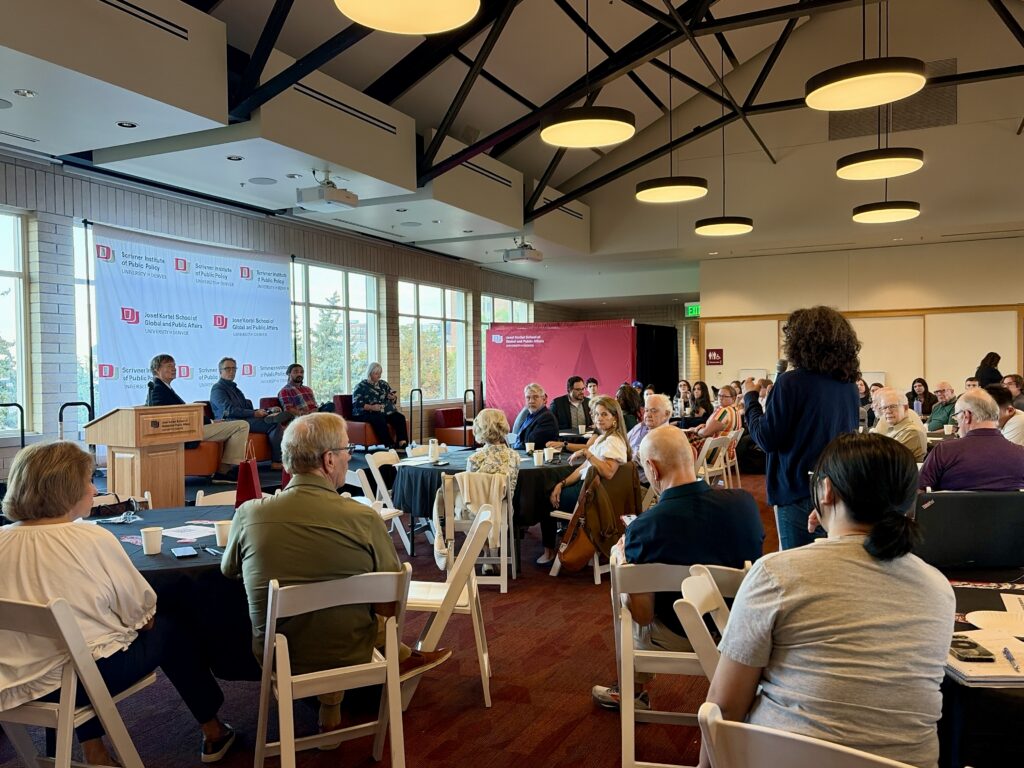
Earlier this quarter, the Scrivner Institute of Public Policy hosted a Scrivner Policy Roundtable in partnership with The Denver Gazette and Colorado Politics to break down two of the statewide measures, plus one that will be decided by Front Range counties:
Need to brush up before casting your ballot? Check out a recording of the event here, plus highlights from each of our three panel discussions below.
Amendment 87: Establish Graduated Income Tax
Our panel on Amendment 87 featured Marianne Goodland, Chief Legislative Reporter for Colorado Politics, and Lorena Garcia, CEO of the Colorado Statewide Parent Coalition and state representative for Colorado House District 35. Stefan Chavez-Norgaard, Assistant Teaching Professor of Public Policy at the Korbel School, moderated the discussion.
Today, Colorado has a flat 4.4% income tax rate. Amendment 87 would establish a graduated income tax whereby taxpayers making less than about $500,000 per year would receive a tax cut, while taxpayers making over that threshold would pay more. Revenue raised — estimated to be between $2 billion to $2.7 billion — would be exempt from the Taxpayer’s Bill of Rights (TABOR) spending cap and would be earmarked for K-12 education, health care, and early childhood care.
Rep. Garcia, a member of the House Finance and House Judiciary committees, spoke in support of the measure, pointing to Colorado’s structural budget shortfall driven by increased state Medicaid spending and an aging population. She also cited childcare subsidy freezes in counties across the state and low teacher pay as pressing issues.
“Because of all of this, we are in this absolute perfect storm that if we don’t in fact generate more revenue for the state to address these three particular circumstances, we are going to be leaving Colorado families in a whole world of hurt,” Garcia said.
Regarding concerns that businesses and wealthy individuals would leave the state should the measure pass, Goodland disagreed, referring to outcomes from other states that have established a graduated income tax system.
Goodland also reminded the audience that revenue from Amendment 87 would be tracked in an annual accountability report.
“One of the knocks against some of the previous ballot measures that have tried to do similar things was that it wasn’t clear where this money was going,” Goodland said. “The proponents of this have done a very good job of adding that accountability language into the ballot measure so we will know how this money is being spent and where it’s going.”
Proposition 132: Penalties for Fentanyl Sale and Possession
Goodland also joined our panel on Proposition 132, which included Kyle Giddings, Deputy Director of the Colorado Criminal Justice Reform Coalition. Ajenai Clemmons, Assistant Professor of Public Policy at the Korbel School, moderated the discussion.
Proposition 132 would increase Colorado’s felony classifications and prison sentencing ranges for possessing and distributing certain synthetic opioids like fentanyl. It would eliminate the possibility of sentencing reductions for distribution charges, including in mitigating circumstances such as getting help for someone who is overdosing (known as the “Good Samaritan Law”).
Estimates from state legislative analysts show that if passed, Proposition 132 would add nearly $70 million to annual state spending by year five due to increased costs across court and prison operations.
Proponents of the measure point to an increase in violent crime across the state, saying current drug laws aren’t strong enough and tougher penalties will help lower overdose deaths.
Giddings disagreed.
“Do we have a crisis? Absolutely. There is no question we have a crisis with fentanyl,” Giddings said. “But what is being proposed in Prop. 132 is the complete opposite of what science and data says works.”
Giddings argued against incarcerating people who may unknowingly share drugs laced with fentanyl with no intent to make money, and cited Colorado’s already low ranking in access to treatment services.
“[Proposition 132] would make us worse than Texas, Louisiana, your traditional tough-on-crime states you think of — this would actually put us in a worse position than those folks,” Giddings said. “Texas is actually taking a very treatment-first approach with a lot of their fentanyl laws...”
Goodland added that if passed, the measure would strain the state’s budget.
“Our Department of Corrections is in critical condition in terms of its finances,” Goodland said. “And anything that adds to the prison population right now, no matter how well intentioned, is a budget buster.”
Ballot Issue 7A, Front Range Passenger Rail District: Levy Sales Tax
Goodland also lent her reporting expertise to our panel on Ballot Issue 7A, which included Sal Pace, General Manager of the Front Range Passenger Rail District, and Branden Shafer, Special Adviser on Passenger Rail for the state of Colorado. Andrew Goetz, Professor in the Department of Geography and the Environment and a Scrivner faculty affiliate, moderated the discussion.
If passed by Front Range voters, Ballot Issue 7A would authorize a sales tax in Front Range communities within the district to build, operate and maintain a passenger rail line, also known as the Colorado Connector. Residents would pay an extra penny for every $3 they spend, generating about $295 million annually.
Phase one of the Colorado Connector plan — three daily round trips between Fort Collins and Denver, beginning in 2029 — has already been funded with money from the Colorado Transportation Investment Office and Regional Transportation District (RTD).
Phase two — four daily round trips between Fort Collins and Denver, plus two daily round trips between Denver and Pueblo — would depend on the sales tax. Ultimately, the service would see 10 daily round trips north and eight daily round trips south, and local station municipalities would have access to $1.3 billion to build station halls and deploy “last mile” transportation services.
Pace and Shafer touted the unique partnership between the state, RTD, and railroad companies — BNSF and Union Pacific — for lowering the overall costs of the plan. The proposed rail line would use the existing right of way of BNSF and Union Pacific for platforms and additional infrastructure, without the need for eminent domain.
“It’s a fraction of the cost working in a partnership with the host railroads as opposed to a contentious relationship,” Pace said. “And we took what was a political liability — unfulfilled FasTracks (funding from RTD) — and turned it into a political opportunity.”
Pace also argued for the environmental benefits of the plan, citing a study from the Southwest Energy Efficiency Project showing that at full buildout, the rail line could take the equivalent of 29,000 gas-powered cars off the road.
When asked about overall ridership and feasibility concerns, Pace mentioned the jump in ridership on the Winter Park Express ski train when ticket prices were cut and the schedule expanded.
“Across the globe, countries are able to figure this out, and even 22 states have intercity passenger rail in the United States,” Pace said. “I think we’re good enough too.”
A Crowded Ballot
In a year with a lengthy ballot, the aim of this event was to help our community better understand several of the measures by learning from balanced, expert perspectives. Happy voting!
Copyright ©2026 University of Denver | All rights reserved | The University of Denver is an equal opportunity institution