


Pardee Institute
Quantifying the Path to 1.5°C: The Pardee Institute’s Role in the ‘Charged for Change’ Report
Quantifying the Path to 1.5°C: The Pardee Institute’s Role in the ‘Charged for Change’ Report
Quantifying the Path to 1.5°C: The Pardee Institute’s Role in the ‘Charged for Change’ Report
By: Sylvia Morna Freitas
The Frederick S. Pardee Institute for International Futures, in partnership with Octopus Energy and the United Nations Development Programme (UNDP), shaped the analytical foundation of the report Charged for Change: The case for renewable energy in climate action, which presents a vision for how renewable energy can simultaneously drive climate action and sustainable development. “Universal electricity and clean cooking access”, a global GDP boost of $48 trillion USD, and the end of extreme poverty for 193 million people are all achievable within a 1.5°C-aligned future, the report finds in its Renewable Acceleration and Sustainable Development Goals (RA+SDG) scenario.
For the report, the Pardee Institute used its International Futures (IFs) model to quantify the impacts of three future scenarios of renewable climate action, or inaction, to provide an evidence-based foundation for revising and implementing Nationally Determined Contributions (NDCs) from the Paris Agreement for over 120 countries. These countries are supported by the UNDP’s Climate Promise: Pledge to Impact Programme, which is a commitment by the UNDP to help countries reach their NDCs by implementing needed programs.
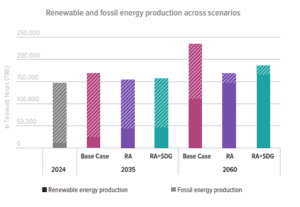
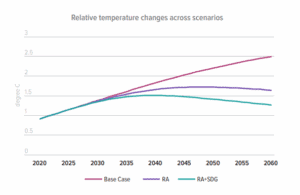
The Institute’s International Futures (IFs) model was used to compare the Base Case, Renewable Acceleration (RA), and Renewable Acceleration + SDGs (RA+SDG) scenarios. In the report, the Base Case forecasts our trajectory under current policies while the Renewable Acceleration pathway simulates a world with ambitious, integrated renewable energy policy. The RA+SDG scenario simulates a world with similar integrated renewable energy policy and the advancement of the UN Sustainable Development Goals (SDGs).
Under current policy trajectories (the Base Case scenario), global temperatures are projected to rise by 2.6°C by 2060, leaving 400 million people without electricity, 700 million without clean cooking access, and 380 million in extreme poverty. The RA scenario, on the other hand, envisions a world where renewable energy transition is accelerated in line with the decision at the first global stocktake which calls on countries to triple renewable energy, double energy efficiency and phase out fossil fuels. This pathway would put the world on track to limiting global average temperature rise to below 2°C.
In stark contrast, the RA+SDG scenario envisions universal access to electricity and clean cooking, lifting 193 million people out of extreme poverty and reducing undernutrition for 142 million. It also brings safe water and sanitation to 550 million more people and boosts agricultural productivity by up to 40% in low- and middle-income economies. Such a transition contributes an additional $48 trillion USD to global GDP by 2060, increases per capita income by $6,000, and saves $20.4 trillion through improved energy efficiency and lower renewable energy costs.
These findings suggest that a just, 1.5°C-aligned energy future with economic gains is possible. They also help bridge the gap between climate ambition and real-world development outcomes, particularly in emerging economies. Countries like Nigeria, Indonesia, Ecuador, and Türkiye could reach 80–94% renewable energy shares by 2060, lifting millions out of poverty and bringing SDG targets within reach.
Importantly, these findings challenge the false dichotomy that pits climate action against sustainable development and provides pathways where both aims are mutually beneficial, and within reach. In a world grappling with climate instability and widening inequality, this kind of evidence-based foresight is essential—and urgently needed.
Give to Pardee

Follow Pardee research, publications, events, and tools that help people reason more clearly about possible futures.
Subscribe
Contact us

Copyright ©2026 University of Denver | All rights reserved | The University of Denver is an equal opportunity institution