

Pardee Institute
The Pardee Institute Kicks-Off Lunch and Learn Series with a Deep Dive into the COLT Project
The Pardee Institute Kicks-Off Lunch and Learn Series with a Deep Dive into the COLT Project
The Pardee Institute Kicks-Off Lunch and Learn Series with a Deep Dive into the COLT Project
How do leaders shape, and how are they shaped, by international relations? What drives a leader to travel from one country to another or to any other place in the world? What can we learn about travel, trade, conflict, diplomacy, democracy, and other interconnected systems by researching the travel patterns of country and organization leaders? These central questions drive the Pardee Institute’s decade-long COLT (Country and Organization Leader Travel) project, which the U.S. Government sponsors.
The Pardee Institute explored these and related research questions for an audience of faculty, students, and staff from the University of Denver’s Josef Korbel School of Global and Public Affairs (the Korbel School) during its first-ever Lunch and Learn seminar.
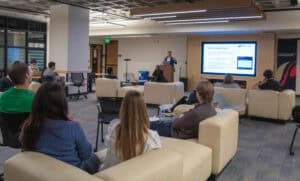
Following an introduction of the COLT dataset and Lunch and Learn series by Pardee Institute Director Jonathan Moyer, Pardee Institute COLT Program Manager Kylie McKee, and Director of Analysis Collin Meisel took turns presenting on different facets of the COLT project.
The COLT project captures data on Heads of Government and State (HOGS) travel from 1990 through the present day for 212 countries and territories. This scale of data collection requires large-scale infrastructure and staff, from coders to vetters to team leads (all positions held by students), until ultimately the data reaches McKee and Meisel.
This dataset tracks over 43 variables and 70 biographical variables for each leader, creating an extensive dataset that requires countless hours to track and ensure accuracy, McKee described. McKee went on to detail her team’s research protocol: monthly updates to the data, as well as annual public reports, made possible by weekly tracking of HOGS travel, reviews of data for errors and/or gaps, and extensive final reviews. This work is divided into four groups of RAs who research HOGS from specific regions of the world.
In Meisel’s words, the COLT dataset is not trying to prove cause and effect; it is trying to see “what moves together.” Meisel, McKee, and their team of student researchers have found the frequency and destination of world leader visits correlate strongly with material interests (such as trade, arms deals, and foreign aid), institutional co-membership (like NATO or the EU), and patterns of conflict. This research matters because diplomatic travel provides a high-frequency, actionable indicator of shifting geopolitical affinities and power dynamics.
Another question that the COLT project is attempting to tackle is the puzzle of leader travel. With all the modern advances in technology —from phone calls to video conferencing —along with the time and potential dangers involved in traveling, what are the benefits of leaders traveling abroad to meet with other leaders in person? The literature suggests that travel plays a significant role in shaping leader opinions, as seen in trade and relationships between HOGS, Meisel explained. However, most of this literature is focused on one country or a region of the world. The COLT project addresses a major missing piece of the puzzle – its scope is global, making it truly unique and a flagship project for this sort of data collection.
Because the data is so exhaustive, it can be challenging to know for sure how much of it is captured by the researchers—is it simply the tip of the iceberg, with much concealed beneath the surface, or is most of it visible to these teams? To address these demands, McKee answered that the teams on Pardee’s COLT project are always innovating their methods and processes so that the data can be better used as a resource and source of lessons for future data gathering. For example, McKee shared that Pardee will soon use AI to streamline its data by gathering qualitative information in a systematic format for analysis.
The event ended with a question-and-answer portion, filled with questions ranging from the use of the data set as a diagnostic tool to which regions have the most tracked travel to if the project had any student position openings. Other questions addressed the uses of AI, how the COLT data is utilized, and where it is sourced.
To learn more about the COLT Project, access the COLT data, or read the COLT analysis published in International Studies Quarterly, click here.
This inaugural Lunch and Learn event is part of a new series of Pardee-hosted lunchtime seminars designed to inform the broader Korbel School community about the research approach and applications of the Pardee Institute's work.
Give to Pardee

Follow Pardee research, publications, events, and tools that help people reason more clearly about possible futures.
Subscribe
Contact us

Copyright ©2026 University of Denver | All rights reserved | The University of Denver is an equal opportunity institution