
Join us for Open House on November 13, 2026. Register now.

Menu

Menu
Join us for Open House on November 13, 2026. Register now.
By: Rachel Ellis, Korbel Communications Staff
I'll never forget my college orientation. I coordinated going the same day as my future roommate, who I met on Facebook, and who ironically knew someone else I had reached out to about housing. I was looking forward to having two people I semi-knew going into orientation. The morning of, my parents and I were leaving the campus hotel when we ran into another family at the elevator, and before we hit the lobby, I realized I was sharing the elevator with one of the girls I'd met online! We embraced like we'd been reunited after years apart, and we've been friends ever since.
Starting college brings a mix of emotions: it’s exciting, scary, unfamiliar, and overwhelming. It's the start of a new era, and the staff and faculty at the Josef Korbel School of Global and Public Affairs are committed to making your new student orientation as seamless as possible, starting the moment you arrive on campus. Below, we've broken down what to bring to orientation, what to expect, and advice from current students to help you feel prepared.
A little prep goes a long way. Here's a simple orientation packing list to keep on hand:
New student orientation typically includes a mix of the following:
We asked current students for their honest orientation tips for incoming students. Here's what they said:
Orientation is about getting acclimated and getting a head start on the journey ahead. No matter how you're feeling about this new chapter, orientation is designed to ease your mind and bring you one step closer to settling into your new life at the Josef Korbel School of Global and Public Affairs. As a college student, I was always told you get out what you put in, so bring your open mind, your packing list, and your positive attitude. We look forward to welcoming all our first-year students to Korbel!
By: Anna Quehl, BA International Studies, ‘27
Hi everyone! My name is Anna Quehl. I’m a rising senior majoring in international studies, geography, and Mandarin. I’m originally from Milwaukee, Wisconsin; however, I have decided to stay in Denver this summer.
When I first made the decision to stay in the city, I was so nervous that the summer would end up in a boring cycle: eat, work, sleep, the works. However, talking with my roommates, many of whom will also be staying over the summer, I realized that this summer will be anything but boring. Here are just a few of the ways I’m enjoying my summer in Denver!
Denver gives you so many options and events to keep you busy and enjoy your days. Every Sunday, there is the Pearl Street Farmer’s market. There are crafts, plants, flowers, and my personal favorite: the food (specifically the Wisconsin cheese curds). There is also live music, so you can snack and enjoy the show. It’s not too far from the DU campus, and on a sunny Sunday morning, it’s the perfect destination to get in a good yap sesh with friends.
While I’m no longer close to Lake Michigan, I still plan on getting some swimming in this summer. One way to do this is by going to Water World. My friends and I went last year during the spring quarter for my friend’s birthday, and we are really excited to go back this year. There are lots of water slides, pools, and a lazy river to have fun and escape the heat. My personal favorites are the wave pool and Voyage to the Center of the Earth (which has dinosaurs🦕).
On the days when we’d rather be inside, my friends and I love to go to the movies. There is a theater within easy reach of campus, about a 20-to-30-minute walk or a five-minute drive, for a quick night out. A Denver staple during the summer is Film on the Rocks, hosted at Red Rocks, where films are paired with live pre-show performances and amazing sunset views. There are five shows to choose from, with Jurassic Park closing things out on August 10.
Additionally, since we have the privilege of being in Colorado, my roommates and I are planning on doing some backpacking and camping. DU is a little under a 2-hour drive from Rocky Mountain National Park, which has plenty of options for trails and campsites. If you’re looking for something a little more niche, there are campsite options in every direction, and many have trails nearby.
In between plans, I’m looking forward to just having free time. With no classes to do homework for, I have space to relax and play video games, do some puzzles, color, and just hang out. If you’re in Denver this summer too, don’t forget that a Denver summer offers a little something for everyone.
By: Assistant Professor Kaitlyn Sims, Degree Director for the Public Policy BA
Some students start their undergraduate career knowing that law school is their next step after college. Others discover a passion for law, justice, and safety along the way. Fortunately for us, DU is home to one of only two American Bar Association-accredited law schools in the state of Colorado—the Sturm College of Law!
No matter your path to law school, a Korbel undergraduate degree can be the springboard leading you a fulfilling legal career.
Public Policy: A Smart Path to Law School
Law is about interpreting rules—and public policy designs those rules. A Public Policy major teaches you how governments make decisions, evaluate evidence, and shape laws that affect society, giving future law students a deeper understanding of how the legal system actually works.
By majoring in public policy, pre-law students build a foundation for understanding how the law fits into and shapes governance at all levels. Students can take classes on crime, social policy, race and inequality, housing, and urban development—all areas where the law determines how social programs and human rights work.
Public policy majors also take applied skills classes where students work directly with real-world, local legal actors, such as the US State Department. Many classes also bring in guest lecturers, such as local attorneys,to give students a hands-on look at how their skills will translate to their future careers.
These skills can also open up career paths for lawyers outside of the classroom. Law is policy and vice versa—and being well-versed in both sets you up for work in the legislature, advocacy, and lobbying.
DU It ALL: AT DU and Double Major
At DU, students can combine Public Policy with other majors to broaden their perspective and strengthen their preparation for law school.
For example, pre-law students could double major in Public Policy alongside:
Or any of DU’s other undergraduate degree programs! All DU students complete a major plus at least one minor or a second major, making it easy to customize an academic path that aligns with their interests and post-grad plans.
Pre-law students at DU can take advantage of our unique location in the Colorado state capitol for everything from internships to dropping in to congressional hearings.

Accelerated options
If you’re confident in your path to law school, consider Sturm’s 6-year Bachelor/JD program. This combined program means finishing undergrad requirements in 3 years before starting your law degree, getting you out a year ahead of the standard timeline. To apply for the dual degree program, apply directly to Sturm after being accepted to DU for undergrad.
The Sturm College of Law is also a top-ranked program for graduates in public interest law. Public interest lawyers represent the interests of individuals and groups on issues such as civil rights, environmental protections, education, and social justice, all in pursuit of the public good. A public policy BA offers a strong foundation for students interested in advancing justice in public interest law.
Fill out this form, and our team will connect with you ASAP.
By: Sama Abdulameer, BA International Studies, ‘28

At seventeen, it can be a little difficult to decide where you will be spending the next four years of your life, let alone your entire career path. I grew up around Aurora, Colorado, and went to a small charter high school. College was advertised as an “I made it” moment, a reflection of your hard work and success. I romanticized the idea of a big state school or a prestigious East Coast university far away from home. For me, I was trying to fit into a pre-determined mold of what the “college experience” should be rather than finding my own path. In reality, I came to learn that the “dream” I was sold didn’t necessarily align with my priorities.
I came into DU with little prior knowledge of Korbel or its programs; all I knew was that I was interested in International Affairs and in pursuing a legal career. After touring, my family and I had dinner at Tatsu Izakaya on University, one of our favorite sushi spots in Denver. After picturing what my daily life would look like at DU and discussing my goals and options, it seemed like DU was the top choice. However, I was still hesitant to commit. In comparison to all my friends, it felt like the safe option to commit to a college only 10 minutes from my high school.
At the time, I was interning at the Capitol and spent a significant amount of my time with the legislative aides. The majority of them were a bit older and had already completed undergrad, so I thought I might benefit from their advice. I remember a distinct conversation with an aide who had graduated from Korbel. She seemed to understand my concerns and shared that she had a similar thought process. She shared that if she were in my position again, she would still choose Korbel. One of my close friends, Aya, who was studying at Korbel, also shared her positive experiences, which was enough of a push for me. So, on May 1st 2024, I submitted my signed commitment to DU.

During the fall quarter of freshman year, I remember receiving an email from Professor George DeMartino inviting me to his office hours. This came as a surprise to me because I remember being told that college professors won’t bother learning your name, let alone actually take the time to reach out to you. This ended up being a pivotal conversation. I shared how I was feeling lost, and how it felt like everyone was able to articulate their understanding of the material much better than I could. He shared such a valuable piece of advice that I’ve held onto: the classroom isn’t about performing; you’re either learning or you’re performing, and you have to let go of the notion that your responses have to be perfect to participate, because you learn by practicing articulating your thoughts and participating in discussions. He shared that everyone was in the same boat, whether I could see it or not, and that he had full faith in my capabilities. That ended up being one of my favorite classes and the reason why I chose to specialize in Global Economic Affairs.
College has been far different than the version I had imagined in my junior year of high school. However, in hindsight, I can’t really imagine it any other way. During difficult times at college, Korbel has always been a safe space. Korbel has pushed me out of my comfort zone and helped me grow into the person I am today. Every time I register for an international studies course, I’m confident that the professor will be the best of the best. Without the care and consideration of the faculty at Korbel, I certainly wouldn’t have had the same opportunities or learning experiences. I guess it turns out that the “safe” option was actually the option that pushed me the most.

By Elias Barbour, BA International Studies '2028
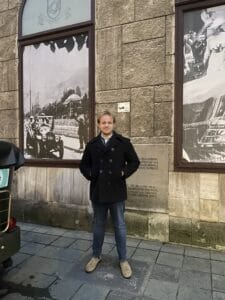
As a history and political science major in the winter quarter of my first year at DU, I decided to take INTS 1700: Intro to International Politics. I felt sheepish walking into my first class at the Josef Korbel School of Global and Public Affairs since I had never taken an official international relations class, nor had I been abroad before. Yet, Korbel gripped me.
As I considered how the class content related directly to the current political state of the world, I realized that the big questions I asked in that class were the very same questions I found myself mulling over while in bed staring at the ceiling at night. I changed my major to International Studies by the end of the quarter. But one thing still bothered me. Despite my newfound affinity for international studies, my lack of actual experience abroad still loomed over me.
Then my Intro to Global Economy professor, Keith Gehring, advertised his interterm class on post-conflict politics, which would take place in Serbia, Bosnia and Herzegovina, and Croatia. Something clicked for me. This was the opportunity I had been looking for.
For some time, my ability to go on the trip was dubious due to financial constraints. Luckily, I was given just enough financial aid to make it work. Though I ended up blowing through nearly all my savings to go on the trip, the experience I got in exchange was worth every penny and proved that this cost would be an investment in my future.
Being able to finally go abroad while developing knowledge and practical skills to tackle some of the world’s most difficult political issues proved not only to be invaluable for my professional development, helping me work towards a potential career in international relations, but this experience also provided me with some much-needed perspective for my own personal development.
Throughout the two weeks of the Post-Conflict Politics in the Balkans course, I met with former US and foreign ambassadors, current diplomats, parliamentarians, ministers, investigative journalists, survivors of genocide, academics, and students involved in some of the largest protests the region has ever seen. Though our schedule was jam-packed, each meeting felt meaningful. Every person we spoke with provided their own insight and nuance into some of the most complicated and difficult issues.
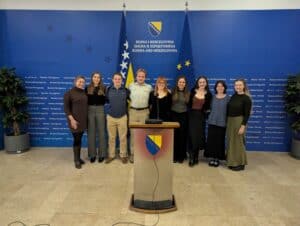
One of the most impactful interactions I had was with a tour guide named Zika in Mostar, a town in the south of Bosnia and Herzegovina that was sieged during the Bosnian War in the early ‘90s. Speaking to our group while we stood in a former sniper’s nest, he spoke of the significance of this place, where Bosnian Serb snipers once targeted civilians basically for fun.
Zika pulled from his pocket a piece of shrapnel and a bullet that was removed from him during the siege. He then brought us to a graveyard and showed us the grave of his childhood best friend – a grave he had dug himself. Zika’s friend had been hit directly by a mortar round right in front of him. They were both 19, younger than I am now.
As bleak as his story was, it was far from uncommon. Everyone I met had been impacted by the war in some way, even beyond the names included in the class itinerary. The stories of strangers I met in random taxis, restaurants, and bars also reflected the weight and pain of the region’s history. Despite this collective pain, I was moved by the level of resilience, kindness, humility, and humor of those I met.
This is what made the trip so transformative. I was able to immerse myself in the discomfort, allowing myself to experience the catharsis that came with seeing the consequences and aftermath of war and genocide, giving deeper personal meaning beyond the trip’s academic and professional aspects.
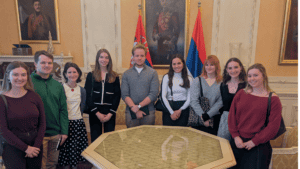
Another impactful part of the trip was the incredible opportunity to speak with both current and former foreign service officers. Since adding International Studies as my major, I’ve gravitated to career interests related to diplomacy or foreign affairs. As I discovered how complicated, difficult, and frustrating the actual process of peace negotiation and conflict resolution can be – directly from people who have spent their lives living that process – I noticed a shift within myself.
What started as changing my major on what seemed like a whim began to morph and solidify into something more real and tangible. My inclination to navigate complexity and operate in areas where it seems like there are no clear “right” answers, alongside my love for language, communication, problem-solving and a desire to do meaningful work, has led me to see diplomacy and conflict resolution as more personally significant and as a career path I legitimately see myself in.
Diplomacy, as it currently stands (I am only a sophomore in undergrad after all), is something that I am passionate about. A career in diplomacy is something that I believe plays into the strengths of both my abilities and my character. It is something that could reasonably be achieved as a result of the environment I am currently learning in. But most importantly, it is something that the world desperately needs.
My time in the Balkans was the perfect way for me to really start to internalize the importance of diplomacy. In the words of Professor Gehring, “If American politics is arithmetic, then the politics of the Balkans is trigonometry or calculus.”
The personal significance of this statement lies less in it not as a warning, but more as an invitation. After all, the most difficult problems are often the ones most worth solving.
This reflection was written by current Korbel graduate student, Erin Mitchell (Master of Public Policy, 2026).
On October 7, 2025, I had the distinct honor of attending the Axios Denver Newsmakers event, hosted by Korbel’s own Scrivner Institute of Public Policy, and sponsored by The Denver Foundation. The event featured an engaging and insightful question-and-answer session with Denver Mayor Mike Johnston, focused on the proposed Vibrant Denver Bond, a five-part, $950 million general bond question that will appear on the November 4, 2025, ballot. Beyond listening to the discussion, I also had the incredible opportunity to speak directly with Mayor Johnston, gaining firsthand insight into how local leaders approach complex policy challenges.

The event began with an overview of the proposed bond, setting the stage for an in-depth conversation about how public financing can shape the city’s future, which provided a rare opportunity to hear directly from the mayor about one of the most significant public financing proposals in Denver’s recent history. The Vibrant Denver Bond is designed to fund critical capital improvement projects across the city, addressing infrastructure, housing, and community development needs. Mayor Johnston emphasized that the bond’s five components, affordable housing, transportation and mobility, parks and recreation, public facilities, and economic development, represent strategic investments in Denver’s long-term vitality and inclusivity.
During the conversation, Johnston highlighted the city’s urgent need to expand affordable housing and improve public spaces to maintain Denver’s quality of life as the population continues to grow. He explained that the bond would not increase property tax rates but would instead reauthorize expiring debt, allowing the city to reinvest in essential infrastructure without overburdening taxpayers. This approach, he argued, reflects responsible fiscal management while ensuring the benefits of growth are broadly shared.
Following the bond discussion, the audience was given the opportunity to ask questions, which touched on issues such as homelessness, climate resilience, and economic equity. Mayor Johnston spoke candidly about balancing Denver’s rapid development with sustainability and social responsibility. He stressed the importance of public engagement and voter participation, noting that every Denver resident has a stake in shaping the city’s future.
This event truly reflected the civic spirit of collaboration between local government, academic institutions, and philanthropic organizations. Axios Denver’s format, focused, conversational, and journalistic, allowed thoughtful dialogue rather than scripted speeches. This approach ultimately led myself and several other graduate students having the unique opportunity to speak one-on-one with Mayor Johnston about the upcoming ballot issues and other pressing policy issues affecting Denver and the state of Colorado.

Mayor Johnston spoke openly and enthusiastically with us about everything from our future career goals to local development projects, including plans for the new Mile High Stadium and its role in Denver’s economic and recreational growth.
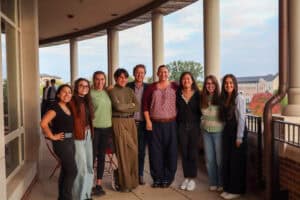
As a Public Policy student, I spend much of my time studying elected officials, their policies, and their impact on society, but I never expected to speak face-to-face with one. Korbel made that possible by facilitating these conversations with the mayor. His friendly, down-to-earth demeanor quickly put our group at ease, and as we stood on the Sie Complex balcony chatting as equals, it struck me that elected officials are, at their core, people like us. That moment brought to life what our work in public policy is all about: creating meaningful connections and striving, regardless of affiliation, to make our communities stronger and more equitable.
For me, attending the Axios Denver News Makers event was both informative and inspiring. It underscored the importance of civic participation and policy literacy, reminding attendees that democracy functions best when communities are informed and engaged. As Denver prepares for the upcoming vote, the discussion served as a timely reminder that the city’s growth and vibrancy depend on the collective choices of its residents. For me, as a student, it was a rare chance to witness these principles in action and to see firsthand how public policy shapes real communities, and it was a reminder that our studies are not just theoretical but are preparing us to actively contribute to the future of the city and the world around us.
Written by: Zoe Lopez, BA in Public Policy, Class of 2028
Growing up, my mom worked for State Representative Mike Villareal. At the time, I did not know what this meant, but as an adult, I realize how much her work then has influenced my life now. I learned how to ride my bike on the Capitol grounds. I remember coloring on official state letterhead while waiting for my mom to wrap up her days in the office during the legislative session. We still hang all 10 of our state capitol ornaments on our Christmas tree every year, one to represent every year she worked for the state. These little moments, as insignificant as they seemed at the time, planted the seeds for my interest in a career in public policy.
Growing up not only understanding our legislative processes, but getting to witness them firsthand at such a young age has been a pivotal privilege in my experiences thus far in the policy world because I was quickly able to shift from utilizing this knowledge as a teenager to participate in advocacy days at the capitol, to getting to plan and host lobby days to help students at the university level do the exact same thing.
I was very lucky that in high school I had a very clear idea of what I wanted to study in college. Unfortunately, it remains a pretty niche area of study for undergraduate students, which narrowed my options for college. My high school counselor introduced me to the University of Denver right before the application deadline, thinking it would be worth my while to just apply and see what happened. I will admit, I did not know anything about the school and had never considered it an option.
After having the opportunity to tour the campus, meet with a few members of the staff and faculty, and talk with a few students, I quickly realized that I would be calling Korbel home for the next four years. Unlike so many other programs I looked into where I felt like I was settling for a major, coming to Korbel made me feel like I had endless opportunities ahead of me.
Each and every course I have taken at Korbel in my nearly two years here has challenged my thinking, sharpened my policy analysis skills, and better prepared me for entering the field post-grad. My classmates are thoughtful and inquisitive, making group discussions inside and outside of class thought-provoking and challenging at times. The Korbel speaker series events allow us as students to engage with experts across a multitude of fields to learn more about real-life applications of the theory and skills we are developing through our coursework. The diverse interests of students also enhances the quality of our experience. In my last class with Dr. Simms, we had students who were active at so many levels of the policymaking and implementation process, from interns at the state capitol to interns with non-profit and mutual aid organizations doing field work to students working as research assistants in housing equity.
I think my affection for my experience thus far in Korbel is evident, but it is all rooted in the overwhelmingly positive experiences I have had. I truly cannot imagine choosing anywhere else to complete my Bachelor's in Public Policy because the diversity of experiences that Korbel has provided me is invaluable and highly unique to our program.
Whether you are a high school senior still exploring your options for college or a current DU student still trying to figure out what you want to do, Korbel could be the place for you too.
Written by: Hugh Mangold, BA International Studies, Graduating 2028
When I was 16, I was fortunate enough to go on a trip to the United Nations in Geneva, Switzerland. Ever since then, I have known that I wanted to pursue a degree in international studies. I became incredibly fascinated with how the world worked and all the various systems that are a part of it. So, while looking at universities that excelled in international studies, I inevitably came across Kobel. Although I did not know it at the time, applying and accepting my offer of admission was one of the best decisions I ever made.
One of the first things that I came to love about the international studies program was the class size and structure. Classes here are well on the smaller side compared to large universities. They are also primarily discussion-based, which I find to be extremely interactive and engaging. This takes the form of debates, policy simulations, and open discussions about either the material or current events. This collaborative learning style has fostered many connections with my peers. Yet at the same time, it has also allowed me to form strong connections with many of our faculty members.
The connections that I have made with the faculty here at DU have been nothing short of amazing. My professors come from different backgrounds. From CIA analysts to lawmakers, renowned economists, and on-the-ground journalists, there is no shortage of professors at the top of their fields. Being able to go to their office hours has also been an amazing opportunity. From help with classwork to career and life advice, building personal connections with faculty has been immensely meaningful.
This standard of open dialogue is upheld by the various events that the school hosts. During my time at Korbel, I have attended countless talks, discussions, and community events. These have been some of the most impactful occasions for me here at DU. They are often led by a combination of faculty and experts in their respective fields. One that always comes to mind is when the founder of The Human Rights Watch came to speak. After the event, I got to talk face to face with him, an instance that happens often in Korbel.
Furthermore, it would be doing DU a disservice if I were not to mention the study abroad opportunities that they provide. The University and Korbel have made it incredibly easy to both find and attend a study abroad program. This summer I will be starting mine in Chile, and I am honestly so glad that the process for making this life-changing opportunity happen was so straightforward.
My time here at Korbel has been nothing short of amazing. Whether it be the classes, the events, the programs, or the people, everything about this school has allowed me to fully explore my interest in international studies. If you have any curiosity about what Korbel has to offer, I cannot recommend it enough, as it has undoubtedly given me the tools and opportunities to succeed in this field in the future.
By Dr. Keith M. Gehring
Teaching Associate Professor
If you're passionate about global issues and want an internationally focused career, you've likely come across two degree options at DU: International Studies at the Josef Korbel School of Global and Public Affairs (Korbel) and International Business at the Daniels College of Business. While both prepare you for success in our interconnected world, they take distinctly different approaches.
What Is International Studies?
International Studies (INTS) is a 44-credit Bachelor of Arts within Korbel that examines the political, economic, and social forces shaping global affairs. Students develop expertise in areas like international security, global health, human rights, environmental policy, or the politics of the global economy. The program emphasizes critical analysis, research skills, and real-world application through a required study abroad experience.
What Is International Business?
International Business (BSBA) is a 40-credit major within the Daniels College of Business that leads to a Bachelor of Science in Business Administration. This program combines International Studies coursework with business courses in multinational finance, international marketing, global management, and international business law. Students complete the full business core curriculum alongside their international focus.
What's the difference between International Studies and International Business?
While on the surface they may seem similar, these are fundamentally different degrees. The BA in International Studies provides a liberal arts foundation with depth in global affairs, while the BSBA is a professional business degree with an international application.
The core distinction comes down to perspective and scope. International Business focuses on applying business principles in international contexts, with coursework in areas like multinational finance, international marketing, and global management. International Studies encompasses economic dimensions through the Politics of the Global Economy specialization, but also extends into domains outside the business curriculum: security and conflict, human rights and governance, global health and development, environmental sustainability, and emerging technology policy.
International Studies students choose from six specializations: Global Health and Development, Global Governance and Human Rights, Global Environmental Sustainability, Global Peace and Security, Politics of the Global Economy, and Technology and Global Affairs. This flexibility allows students to pursue focused expertise while building a foundation in international politics and economics through courses like the Global Issues Research Practicum.
International Business students complete a structured curriculum combining INTS coursework with core business classes in multinational finance, international marketing, global management, and international business law.
International Studies vs. International Business: Career Paths Compared
Career paths diverge accordingly. International Studies graduates pursue careers in diplomacy, international development, policy analysis, intelligence, NGOs, and global governance. As such, they find opportunities with government agencies, not-for-profits, as well as multinational firms. Many continue to graduate programs in international affairs, law, or public policy. Conversely, International Business graduates typically pursue careers that apply business training in international settings, primarily for multinational firms but potentially other entities as well.
Here's something worth noting: The International Business major requires 20 credits of International Studies coursework, including core courses INTS 1500 and INTS 1700. Even business students focused on global commerce need the foundation that Korbel provides in understanding international politics and the global economy. This speaks to how essential the International Studies perspective is for anyone working across borders.
Both programs leverage DU's global resources, but International Studies students benefit from Korbel’s distinctive advantages. Named for the father of former Secretary of State Madeleine Albright, Korbel is consistently ranked in the top 20 schools of international affairs. Undergraduate INTS students study alongside graduate students pursuing careers in diplomacy and international policy, gaining access to world-class faculty and programming. Further, the INTS degree requires a second major or minor, generally within the wider BA degree. Potential options follow:
Complementary Majors and Minors for International Studies
| Major | Minor |
|---|---|
| Economics | Sustainability |
| Political Science | Environmental Science |
| Public Policy | Marketing |
| Geography | Business Analytics |
| Computer Science |
Choose International Studies if you want to:
Choose International Business if you want to:
Why International Studies at Korbel?
International Studies at Korbel offers something unique: the opportunity to study global affairs at an undergraduate level while immersed in a graduate-level environment. Our students don't just learn about international relations in a classroom. They engage with visiting diplomats, attend policy briefings, participate in simulations, and study abroad to experience global challenges firsthand.
The Korbel School's faculty includes former ambassadors, policy practitioners, and leading scholars who bring real-world expertise to every course. Small class sizes ensure meaningful mentorship and professional relationships that extend beyond graduation.
In a world facing complex transnational challenges, from climate change to cybersecurity to migration, leaders need more than business acumen. They need to understand how political systems, international institutions, and global forces shape the context in which all organizations operate. International Studies provides that critical foundation.
If you're ready to prepare for a career shaping our interconnected world, we'd love to talk with you about International Studies at Korbel.
Contact the Korbel Undergraduate Team:
Email: [email protected]
Phone: (303) 871-6451
Written by: Assistant Professor Kaitlyn Sims, Degree Director for the Public Policy BA
Many undergraduate students find themselves deciding between a degree in Public Policy and a degree in Political Science. At first glance, these programs sound similar. Both explore how societies make decisions, how governments function, and how people work to shape the world around them.
But the two majors offer different skill sets, approaches to problem solving, and pathways into future careers. Here’s a breakdown of what each degree focuses on, what kinds of thinkers students become, and what kind of careers they build.
Whether you imagine yourself crafting legislation, improving communities, analyzing data or shaping change at the local, national, or global level, both degree programs can set you up for success in your future career. Understanding the difference between Public Policy and Political Science will help you choose the best academic path to achieve your goals in life and in your college experience.
What Is Public Policy?
The Public Policy BA (PPOL) focuses on how to effect change in the world. Students explore how to create, evaluate, and implement solutions to real-world problems. Even more, students will learn how to identify urgent challenges, analyze data, evaluate policy options, and understand economic and ethical tradeoffs. Core coursework often includes topics such as policymaking, economics, ethics, and data analysis. The DU PPOL degree also builds in hands-on skills courses, where students partner with local leaders to improve Denver.
What Is Political Science?
Political Science centers on how politics and government systems are structured, with a strong emphasis on political theory, political thought, and the philosophical foundations of governance. Students investigate comparative politics, law and society, political ideologies, and how political institutions shape civic life. Political Science majors develop exceptional writing, analytical reasoning, and theoretical thinking skills.
What’s the difference between Public Policy and Political Science?
Both major degree programs give students the skills for successful careers in law, government, research, education, political strategy, and public service. Choosing between Public Policy and Political Science often comes down to how each major shapes your approach to understanding and improving society.
Public Policy develops applied problem solvers who learn to analyze data, evaluate program impact, weigh economic and ethical tradeoffs, and craft actionable solutions.
Political Science, by contrast, builds strong theoretical thinkers who study how governments operate, how political systems compare across countries, and how ideas and institutions influence political behavior.
Public Policy vs. Political Science: Career Paths Compared
Both majors lead to competitive careers in government, nonprofits, advocacy, legislative offices, law, and graduate programs, but the roles students pursue often reflect their training.
Public Policy prepares students to work across a wide spectrum of governance, including state and local government, international organizations, and community-based initiatives, while Political Science focuses more on political systems, civic behavior, and the structure of institutions that shape public life.
Political Science graduates tend to gravitate toward writing-intensive analysis, political advising, and legal pathways. Public Policy graduates frequently move into roles involving quantitative evaluation, economic and cost-benefit analysis, program design, and policy implementation.
At the University of Denver, students can explore these fields through the Public Policy (PPOL) major in the Josef Korbel School of Global and Public Affairs or the Political Science major in the College of Arts, Humanities, and Social Sciences.
DU students can complete a major plus at least one minor or a second major, making it easy to customize an academic path that aligns with their interests.
Strong combinations with Public Policy at DU include:
| Are you interested in? | Complementary majors/minors to PPOL |
|---|---|
| Area or cultural studies | Asian Studies; Black Studies (minor); Critical Race and Ethnic Studies; International Studies; Languages, Literature, and Cultures; Middle East Studies (minor); Spanish |
| Cities and urban studies | Real Estate & the Built Environment; Urban studies (minor) |
| Crime and the law | Criminology; Socio-Legal studies; Sociology |
| Environment | Environmental Studies; Sustainability |
| Health | Culture, Health, and Society (minor); Mental Health and Wellness (minor) |
| Leadership and Governance | Community Engagement for the Public Good; Entrepreneurship (minor); Leadership studies (minor); Political Science |
| Science policy | Biology; Biochemistry; Chemistry; Computer Science; Engineering; Environmental Chemistry; Integrated Sciences; Physics |
| Social issues | Anthropology; Economics; Gender and Women’s Studies; History; Sociology |
At DU, students can tailor their degrees to match their interests and build a powerful, interdisciplinary foundation for their future.
Why Public Policy at Korbel?
Studying Public Policy at Korbel gives students a nationally recognized, hands-on education that prepares them to create real change. DU combines academic rigor with the personal attention of a small school.
Faculty invests deeply in each student, ensuring students gain applied experience, internships, and opportunities that larger institutions often can’t match.
With a curriculum grounded in economics, ethics, data analysis, and real-world policymaking, plus strong connections across Denver’s policy landscape, Korbel equips students with the practical skills and experiences needed to launch a meaningful career in public service, advocacy, or community leadership.
Key Takeaways
Interested in learning more?
Fill out this form, and we will reach out ASAP.
Copyright ©2026 University of Denver | All rights reserved | The University of Denver is an equal opportunity institution