

Menu

Menu
A Hub for Ideas That Shape the World: Inside the Sié Chéou-Kang Center for International Security and Diplomacy
At the Josef Korbel School of Global and Public Affairs, global challenges are not abstract. They are lived, debated, researched, and translated into action. A shining example of this real-world approach is Korbel’s Sié Chéou-Kang Center for International Security and Diplomacy, a research hub born from a vision that ideas, when supported and connected, can move the world toward greater peace, security, prosperity, and justice.
Thanks to a transformative endowment from the Anna & John J. Sié Foundation, the Sié Center was dedicated in 2009 and named in honor of John Sié's father, Ambassador Sié Chéou-Kang, an extraordinary diplomat, educator, author and playwright, who spent much of his adult life in Europe forging relationships on behalf of China. Inspired by Ambassador Sié Chéou-Kang’s legacy of bridge-building, the Center was designed to bring scholars together across disciplines and perspectives.
This generous gift created more than a physical space; It established a durable intellectual infrastructure designed to support interdisciplinary research and elevate scholarship that bridges security and diplomacy across sectors and borders.
Korbel Distinguished University Professor Deborah Avant became the center’s inaugural director, and under her leadership, the center launched important, policy-relevant initiatives and brought in its first faculty and students. Over time, the Center has evolved through different leadership eras, partnerships, and major grants, including multiple iterations of Carnegie Corporation funding.
“As it exists today, the Sié Center serves as a dynamic hub to support faculty whose research interests span the spectrum of security and diplomacy – from nuclear strategy and military security to cultural diplomacy, gender and security, conflict studies, and climate governance,” said Ashten Scheller, program manager of the Sié Center. “We want to be responsive to global events as they happen.”
Today, the Sié Center is led by Korbel Professor Rachel Epstein, who continues Sié’s ambition to keep communities informed through pathbreaking faculty research and programming on ongoing global issues, from the recent elections in Bangladesh to nuclear non-proliferation efforts to understanding limits on immigrants' and asylum seekers' legal access in the United States.
“In our programming, we connect faculty research to events unfolding in real time,” Dr. Epstein said. Faculty expertise puts world developments in historical perspective and illuminates the deeper sources of conflict and cooperation across many regional settings.”
The Sié Center brings research to light to ensure scholarship serving the public good reaches the public itself. Through its primary engagement initiatives, the center explores how academics and policymakers can engage ethically and effectively:
Beyond these initiatives, Sié hosts more than two dozen events and programs each year, including new “Policy Pop-Ups” that bring faculty together for informal conversations about pressing global events, giving students direct access to expertise beyond the classroom.
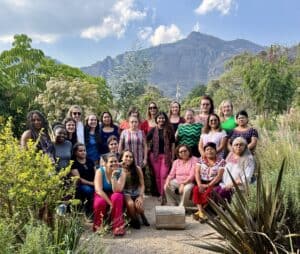
IGLI travels to New Mexico
“We want to be a hub for research and also a gathering hub for community,” Scheller shared, an ethos that is visible in how the center supports both faculty and students.
Faculty Support
From its earliest days, the center’s intention was clear: build an interdisciplinary body of research that cuts across silos, enabling faculty within Korbel and across DU departments such as the College of Arts, Humanities & Social Sciences, along with visiting scholars and practitioners, to collaborate in an ongoing exchange of ideas.
Supporting such research and collaboration means more than administrative coordination. It means working directly with faculty who secure external grants, offering frequent feedback, connecting research opportunities with available funding, and brainstorming programming ideas.
For example, Sié staff coordinate with affiliated faculty like Dr. Hilary Matfess, who leads a team of 14 research assistants as part of a grant on Women’s Mobilization Within Armed Groups During and After War, and support other leading projects on nuclear security, democratic erosion, climate transitions, and global economic restructuring. The center provides the backbone that allows these projects to scale.
Sié’s small staff team has always had an outsized impact. The centralized structure — typically a director and program manager partnership — creates a focused research support unit within the larger school.
“It allows us to specialize more in our program and, in some ways, be more creative with our programming,” Scheller explained. This tight coordination enables faster idea generation, more constructive brainstorming, and targeted administrative support for research projects, she said.
In addition, while high-level research often happens behind the scenes, the Sié Center ensures it does not stay there.
“Because we understand the wide-ranging research outputs of all faculty, we also try to support them in communicating to the public via social media and newsletter announcements to increase their exposure,” Scheller added.
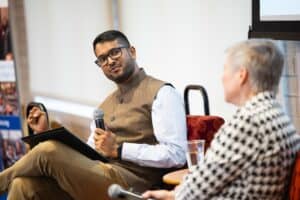
Faculty affiliate Debak Das hosts an event on nuclear arms and armament.
“The Sié Center is also about providing research resources to outstanding students,” said Scheller.
Between 30 and 40 students support affiliated faculty each academic year and do much more than research alone. Assistants develop skills in data collection, literature review curation, analytical writing, and subject-matter mastery, often working one-on-one with faculty in intensive mentorship relationships. Among these research assistants are the highly competitive Sié Fellows, who receive full scholarships that help remove financial barriers and embed students directly in active research.
These unique research experiences and direct line to Sié faculty affiliates have shaped many careers during students’ time at Korbel and after graduation. Here are just a few of many Sié student stories:
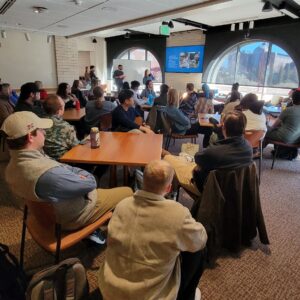
Korbel students attend one of the Center's many events
Universities produce important research, but that research does not always travel on its own. Centers and institutes create a structure that allows scholarships to thrive, even beyond academia.
“Centers provide increased research support and reduce systemic barriers for our faculty,” Scheller said. “As we are able to focus on our specific faculty’s research and needs, Sié allows resources to be allocated more specifically and efficiently to research clusters.”
Without that structure, research can happen more slowly, more sporadically. A center provides organizational scaffolding around research, bringing visibility to work already underway while helping faculty balance scholarship with public engagement, student mentorship, and grant development.
Beyond faculty initiatives, centers and institutes allow opportunities for greater student engagement “because they centralize research projects into both clear and tangible opportunities within the school,” Scheller added.
At the Sié Center, that structure translates into measurable impact that reframes traditional divides in global affairs and contributes to real-world understanding and experience.
The world of security and diplomacy is not static. Neither is the Sié Center.
“Times have always been tumultuous. But today’s foreign policy landscape moves quickly — and the public wants clarity,” Scheller said. “The Sié Center exists to ensure that when global events unfold, the experts are ready, the research is visible, and the next generation of scholars and practitioners is already engaged in the work.”
In the 2025–2026 academic year, programming highlights the human costs and policy dilemmas of Russia’s war in Ukraine; the restructuring of the global economic order under renewed U.S. tariffs; the power of cultural diplomacy through sports and the arts; and the domestic and international implications of a second Trump presidency, among many other pressing topics.
Student simulations, data workshops, and spring programming on nuclear proliferation, democratic erosion, genocide, and the global energy transition are already underway.
The center’s priority remains constant even as topics shift, as staff at Sié continue working directly with faculty to support their most impactful research and ensure that expertise informs public conversation.
“By linking faculty research to analysis of developments in world politics, the Sié Center highlights the importance of deep and free inquiry, independent of any given political wind,” said Dr. Epstein. “Our faculty and students remain committed to seeking the truth, no matter how unpopular or controversial it may be.”
Copyright ©2026 University of Denver | All rights reserved | The University of Denver is an equal opportunity institution