

Menu

Menu
From Denver to the Amazon: A Korbel Student’s Internship in the Rainforest
For Braxton Fuller (MA, International Studies, 2026), one of the defining moments of his graduate school journey took place far beyond Denver. In his first year, he traveled into the heart of Peru’s Amazon rainforest, working alongside Indigenous communities and international researchers in one of the most biodiverse places on Earth.
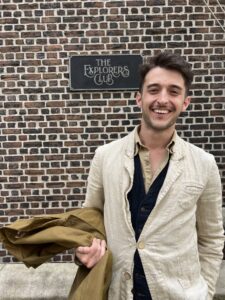
The experience was part of an internship with the Tree Foundation, a research nonprofit operating in Maijuna territory. Braxton found the lead through the Explorer’s Club, a national organization of scientists and adventurers with whom he’d worked as a speleologist and editor of a cave science publication. After finding the lead, he turned to Korbel’s Office of Career and Professional Development (OCPD) to help prepare his application materials. “OCPD is extremely helpful in everything they do,” Braxton said. “Jamie and Rae Ann are so encouraging and make things possible.”
Braxton ended up talking to Meg Lowman, the CEO and Founder of the Tree Foundation. She was going to the Amazon for work, and she offered Braxton the internship. Amongst his list of options, his reaction was immediate: “That one.”
Life and Work in the Amazon
Within weeks, Braxton found himself traveling upriver by boat from the city of Iquitos. “We sailed for four days,” he said. “I couldn’t believe it. We were in a boat in the middle of the Amazon.”
The Tree Foundation operates in Maijuna territory, a region slightly larger than New Jersey and home to about 500 people across four settlements. The organization conducts canopy research while coordinating closely with local communities, medical teams, and eco-tourism organizations.
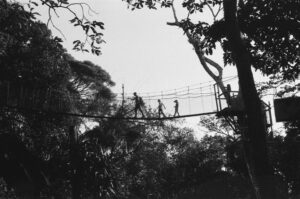
A major initiative of the Tree Foundation is to aid Indigenous people as they navigate increased traffic on the Amazon, a side effect of the Iquitos-El Estrecho Highway’s construction and it ecological impacts. Braxton’s efforts to aid that mission were different every day: helping transport supplies, setting up blood drives, and mapping canopy walkways the Maijuna tribe uses in the forest are just a few examples. From fishing with local families and navigating language barriers, each day required adaptability.
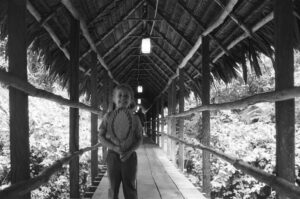
“One of the most gratifying things happened with one family whose home I was staying at,” Braxton said. “They lived in an outdoor hut, and when it rained in the middle of the night, I woke up with the family. I helped them harvest a root for cooking, and once I was done, I noticed one of their boats was filled with rainwater. I discreetly bailed out the water so they could go into town later that day before they could stop me. It was a really gratifying moment. They paid me the kindness of letting a random guy stay in their house, and I paid them the small favor of getting them food and taking care of their boat.”
Experiences like these reinforced a key lesson Braxton will carry into his career: the importance of building genuine relationships.
Lessons in Leadership and Connection
Through his day-to-day, Braxton met humanitarian leaders from around the world. “There’s a Peruvian version of the Red Cross that we worked with to help set up the blood drives,” he said. “There are the other medical teams and the eco-tourism groups, too. There was one intern, like me, who was traveling from Duke, and we worked together a lot.”
These connections required Braxton to develop a new set of communication skills. “Caving prepared me for uncomfortable scenarios already,” Braxton said. “When you’re underground, it can get really cold and wet, and maybe you’re light on sleep. In that sort of state, a joke can really bring people together. But that’s not always appropriate when you’re working across cultures and language barriers.”
Meg taught him a different approach, but one that still built on his strengths. “I’m naturally good at being cheery and cooperative when things are hard. If you can make somebody laugh, you can make somebody feel that you’re having a genuine conversation with them, then you’ve done most of the work. Meg helped me tailor that for the international, humanitarian work we were doing together.”
Carrying the Amazon’s Lessons into a Global Career
Now nearing graduation, Braxton is exploring the next steps that build on his interests in communication, fieldwork, and global service. While his path may not be linear, his time in the Amazon has already shaped how he approaches both challenges and opportunities.
And, of course, it delivered on a lifelong expectation.
“I guess my whole life I have thought one day I’d see the Amazon,” he said. “But actually sticking my hand in the Amazon River was pretty crazy.”
To learn more about the Maijuna People and humanitarian interventions, read Braxton’s article with the Tree Foundation here.
Copyright ©2026 University of Denver | All rights reserved | The University of Denver is an equal opportunity institution